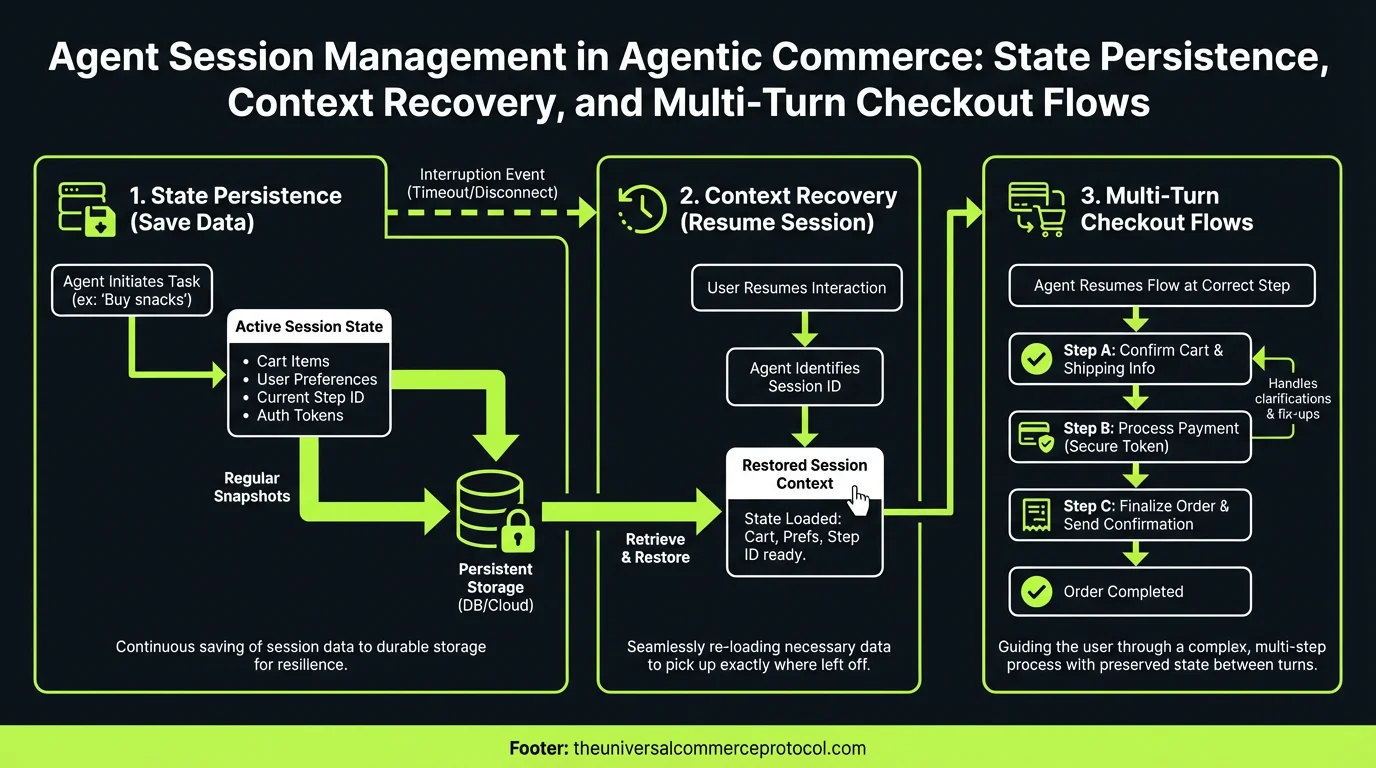
The Session Problem in Agentic Commerce
When a human visits an e-commerce site, session management is invisible—their cart persists, their preferences load, their payment method remembers them. When an AI agent conducts commerce on behalf of a consumer, session management becomes an operational necessity, not a convenience feature.
Unlike human shoppers who abandon and resume purchases hours or days later, agents execute commerce in seconds. But agents also face a unique problem: they operate across multiple API calls, fallback cycles, and potential interruptions. A network failure mid-checkout, a policy rejection requiring human approval, or a multi-day procurement process all demand robust session state.
Today, most agentic commerce implementations lack formal session architecture. Agents rebuild context on each retry. Merchants lose visibility into agent state when handoffs occur. Cross-device agent coordination (mobile agent, desktop agent, voice agent) creates duplicate purchase attempts.
What Session State Means for Agents
An agent session must capture:
- Shopping context: product selections, quantity, delivery address, special instructions
- Decision history: which payment methods were rejected, why approval workflows paused, what policy constraints apply
- Agent identity: which consumer the agent represents, which merchant credentials apply, authorization scope
- Temporal markers: when the session started, when each step completed, how long approval is valid
- Fallback state: which API endpoints have failed, which human interventions are pending, what retry logic is active
Without explicit session capture, agents re-query inventory for products already selected. They re-attempt payment methods that already failed. They lose track of partial approvals and require full re-authorization.
Session Persistence Architectures
Stateless Agent Design (Current Default)
Most deployed agents today run stateless: each call is independent, context is embedded in prompts, and state lives only in the consumer’s message history. This works for simple queries but breaks down in commerce:
- A payment failure forces the agent to re-explain the cart to a new human reviewer
- A multi-step approval workflow loses intermediate decisions
- Agents cannot be paused and resumed without losing optimization state
- No audit trail of agent reasoning across sessions
Session-Per-Transaction (Emerging Standard)
Forward-thinking platforms (Shopify agentic storefronts, JPMorgan/Mirakl implementations) assign each checkout a session ID. The session captures:
- Initial product manifest and pricing
- All policy checks applied (fraud, compliance, inventory hold)
- Each payment attempt and its result code
- Approval workflow state (pending, rejected, escalated)
- Timestamp and duration of each phase
On retry or resumption, the agent loads this session, updates only changed fields, and preserves all prior decision context. Merchants gain visibility into why a checkout paused.
Consumer-Persistent Sessions (Long-Term State)
Some merchants (particularly B2B platforms) maintain persistent agent sessions tied to a consumer profile. An agent can resume a purchase started three days earlier, re-validate the quote, and complete checkout without re-running the full recommendation engine.
This requires session storage with TTL policies: how long is a cart quote valid? How long should approval hold? When does session cleanup trigger?
Technical Implementation Patterns
Session Tokenization
A session token encodes: consumer ID, merchant ID, session start time, session version, and a cryptographic signature. Agents include this token in all API calls. Merchants validate the signature and reject stale sessions.
POST /checkout/session
X-Session-Token: eyJjb25zdW1lcl9pZCI6IjEyMzQ1IiwibWVyY2hhbnRfaWQiOiI2Nzg5MCIsInN0YXJ0X3RpbWUiOjE3NzM2NDAwMDAsInZlcnNpb24iOjF9.signature
Session State Versioning
As an agent updates cart contents or applies a discount, the session version increments. The merchant stores prior versions. On conflict (e.g., inventory changed mid-checkout), the agent can inspect version history and decide: re-validate the cart or escalate to the consumer.
Fallback-Aware Session Recovery
When an agent hits a fallback condition (payment declined, inventory unavailable, policy block), it writes a checkpoint to session state. On recovery, the agent can skip redundant steps:
Session State (Checkpoint):
- Cart validated ✓
- Inventory held ✓
- Shipping quoted ✓
- Payment attempt 1 failed (code: card_decline) ✗
- Next step: retry with alt payment method
The agent resumes at the next step, not the beginning of checkout.
Cross-Device Agent Coordination
If a consumer has multiple agents (voice on Alexa, mobile app, web chat), how do they coordinate a single purchase?
Naive approach: Each agent runs independently, creating duplicate orders.
Session-aware approach: The consumer’s session ID is visible to all agents. A voice agent can check: “Is a checkout in progress on mobile?” and either resume or decline to start a new one. Payment only processes once the consumer confirms across all active devices.
Session Lifecycle and Compliance
Sessions create audit records. Regulators (EU, UK FCA) expect merchants to prove how an AI agent made a decision. Session state provides that proof:
- What policies applied when the agent made this choice?
- Which inventory constraints were active?
- Did the agent receive approval before processing payment?
- How long did the consumer have to review before checkout completed?
Sessions also address PII retention requirements. A session can be flagged for deletion; merchants purge all session state after regulatory holds expire.
Session Timeout and Renewal
How long is a session valid? Too short, and agents fail on large orders. Too long, and inventory quotes become stale.
Industry practice (informed by payment industry PSD2 standards):
- Quote-level sessions: 5–15 minutes (product prices, availability)
- Approval-level sessions: 30 minutes (pending human review)
- Payment sessions: 3 hours (full checkout window)
- Consumer sessions: 24 hours (return and login context)
Agents should proactively refresh sessions nearing expiry, re-validating cart state before timeout triggers.
FAQ
Do I need session management if my agents only run one-shot checkouts?
Not immediately, but you lose observability. If a checkout fails and you want to offer consumers a resume option, session state is required. Shopify and JPMorgan both added this retroactively; building it in saves refactoring.
How does session management interact with PCI compliance?
Sessions should never store raw payment data. Instead, store a payment token reference and the token provider (Stripe, PayPal). The session records only that payment method X was attempted and failed with code Y.
Can an agent modify another agent’s session?
No. Sessions should include a session owner field. Only the agent that created the session can update it. A second agent attempting to resume must request a new session or get explicit consumer re-authorization.
What happens if inventory changes mid-session?
The merchant should write an inventory delta to the session: “2 units held at 2:14 PM UTC, 1 unit still available as of 2:19 PM.” The agent can inspect this and decide to confirm the order or re-quote the consumer.
How do session timeouts interact with agent approval workflows?
If a session expires while awaiting human approval, the agent should not proceed with payment. Instead, it should escalate: “Approval window expired. Consumer must re-authorize.” This forces fresh consent, not stale approval.
Should sessions be portable across merchants?
No. A session is merchant-specific. If an agent shops from multiple merchants in one purchase (e.g., a fulfillment agent buying from suppliers A and B), create separate sessions. Track them with a parent request ID so auditors can see the relationship.
How do I debug a failed agent checkout if I didn’t use sessions?
You have the consumer’s message history and your payment logs, but not the agent’s internal state. With sessions, you can replay: what did the agent see at each step? Why did it choose that payment method? Sessions cut debugging time from hours to minutes.
Frequently Asked Questions
What is session management in agentic commerce?
Session management in agentic commerce refers to the system that maintains and persists an AI agent’s state throughout the shopping and checkout process. Unlike human shoppers, AI agents execute commerce across multiple API calls and potential interruptions, making robust session architecture essential for tracking shopping context, cart items, delivery addresses, payment methods, and transaction status across the entire purchase flow.
Why is session state different for AI agents compared to human shoppers?
AI agents operate differently than human shoppers because they execute commerce in seconds across multiple API calls and potential failure points. While humans may abandon and resume purchases hours or days later, agents face challenges like network failures mid-checkout, policy rejections requiring human approval, and multi-day procurement processes. This requires formal session architecture to maintain context through retries and fallbacks that human sessions don’t typically encounter.
What key information must an agent session capture?
An agent session must capture critical shopping context including product selections and quantities, delivery address and special instructions, payment method information, transaction status, and any policy constraints or approval requirements. This comprehensive state persistence ensures agents can recover from interruptions and maintain continuity through multi-turn checkout flows without losing essential context.
What problems occur when agentic commerce lacks formal session architecture?
Without formal session architecture, several operational problems emerge: agents must rebuild context on each retry, merchants lose visibility into agent state during handoffs, and cross-device agent coordination (mobile, desktop, voice) creates duplicate purchase attempts. These gaps result in inefficient commerce execution and potential transaction inconsistencies.
How does context recovery work in multi-turn checkout flows?
Context recovery in multi-turn checkout flows relies on persisted session state that captures all shopping context and transaction progress. When interruptions occur—whether from network failures, policy rejections, or approval requirements—agents can resume from their last known state rather than starting over, enabling seamless completion of complex, multi-step purchase processes.
Leave a Reply