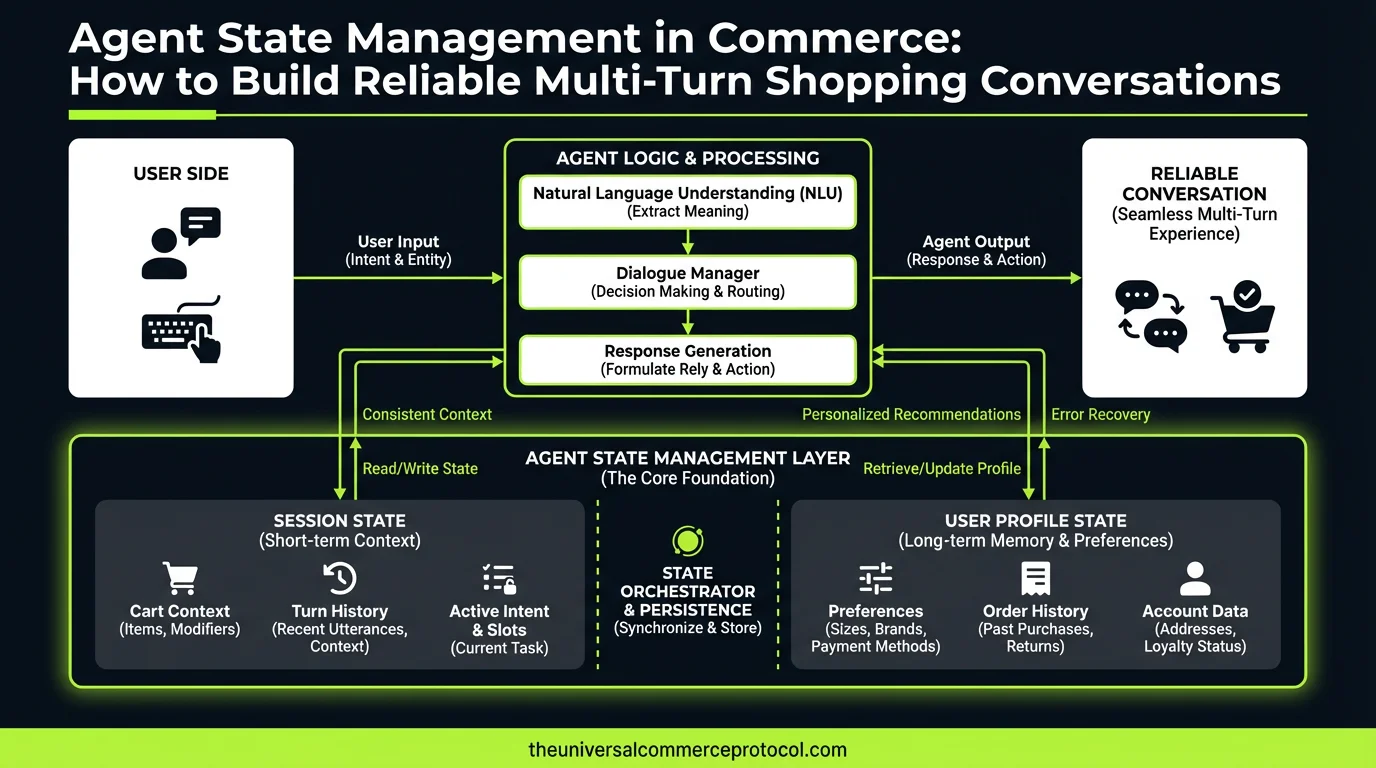
Why State Management Matters in Agentic Commerce
A customer walks into a live chat with an agent. They ask about a product. The agent retrieves it. Then they ask a follow-up question—”do you have it in blue?” A stateless system treats this as a new request, losing context. A properly architected agent remembers the previous product, the customer’s preferences, and their cart state across the entire conversation.
State management is not a new problem in software engineering, but agentic commerce introduces unique constraints: agents must maintain state across multiple LLM calls, preserve it through payment processing, handle concurrent user sessions, and remain auditable for compliance. Yet most agentic commerce architectures gloss over this critical layer.
The State Management Challenge in Agentic Commerce
Unlike traditional stateless APIs, commerce agents operate in a fundamentally stateful domain. Every product query, cart addition, shipping address change, and payment attempt modifies the customer’s transaction state. An agent must track:
- Conversation context: What products have been discussed? What questions remain unanswered?
- Customer context: Preferences, purchase history, loyalty status, shipping address.
- Transaction state: Cart contents, selected variants, applied discounts, shipping method.
- Agent decision history: Which fallbacks were attempted? Why was a particular recommendation made?
The challenge deepens when agents operate asynchronously. A customer might pause mid-conversation, return hours later, and expect the agent to resume seamlessly. Or multiple agents might handle the same customer in parallel (one for chat, one for email), requiring state synchronization across instances.
Three Architectural Patterns for Agent State
Pattern 1: In-Memory State with Persistent Checkpoints
The simplest approach stores conversation state in memory during a session, checkpointing to a database at key moments: after each LLM turn, before payment initiation, after checkout completion.
Pros: Fast state access, minimal latency for multi-turn conversations, straightforward debugging.
Cons: Agent failure loses in-flight state; scaling requires careful session affinity; difficult to migrate sessions across servers.
Best for: Single-session checkout flows where conversation duration is under 15 minutes.
Pattern 2: Event-Sourced State
Instead of storing state snapshots, log every state-mutating event (product viewed, cart item added, discount applied, payment authorized). The current state is derived by replaying events.
Pros: Complete audit trail; state is always recoverable; agents can be restarted without context loss; natural fit for distributed systems.
Cons: Higher latency to reconstruct current state; requires careful event schema management; debugging is harder (replaying 50 events vs. inspecting one snapshot).
Best for: High-compliance environments (regulated payments, B2B), multi-agent systems, long-running conversations.
Example: A customer’s journey logged as: [SessionStarted] → [ProductViewed(SKU-123)] → [CartItemAdded(SKU-123, qty=2)] → [DiscountApplied(CODE-MARCH10)] → [ShippingAddressSet] → [PaymentInitiated]. On reconnection, replay all events to rebuild state.
Pattern 3: Hybrid State with Read Cache
Combine event sourcing for writes with a cached materialized state for reads. Events are immutable; a separate state cache is updated on each event and invalidated intelligently.
Pros: Audit trail plus fast reads; resilience to cache failures; good for high-concurrency systems.
Cons: Cache invalidation complexity; potential state divergence if cache update fails.
Best for: High-traffic retail platforms where state access frequency justifies caching overhead.
Handling Concurrent State Mutations
Two agents (or the same agent handling retries) may attempt to modify state simultaneously. Consider a customer adding an item to their cart while an inventory sync agent is checking stock.
Optimistic locking: Assume no conflict; tag each state mutation with a version number. If version mismatch occurs on write, reject and retry. Fast but requires retry logic.
Pessimistic locking: Lock state before mutation. Safe but can create bottlenecks if agents hold locks during slow operations (API calls, LLM inference).
Event-based resolution: Accept concurrent mutations, order them by timestamp, and apply a deterministic conflict resolution rule. Simpler for distributed systems but requires careful design (e.g., “most recent product view wins,” “sum quantities on duplicate cart items”).
State Preservation Across Agent Transitions
A customer might interact with a browser-based agent, then continue via email. Or a primary agent might hand off to a specialist agent for a specific question. State must transfer cleanly.
Create a state serialization contract: a JSON or Protocol Buffer schema that captures the minimal state needed to resume. Include:
- Current cart state (items, quantities, variants)
- Conversation transcript (or a summary for large conversations)
- Customer context (shipping address, preferences)
- Agent metadata (which fallbacks were tried, confidence scores)
- Timestamp and originating agent ID
Validate on transfer: the receiving agent parses the state and verifies it’s consistent with current inventory, customer record, and business rules. Reject invalid states with a graceful error message to the customer.
Debugging Agent State Issues
State bugs are particularly insidious in agentic commerce: they appear as mysterious customer confusion, incorrect prices, or cart discrepancies.
Implement state observability:
- Log every state transition with a unique ID.
- Store state snapshots at conversation checkpoints (queryable by session ID).
- Emit metrics: state size, mutation frequency, event replay latency.
- Track state divergence: if materialized state doesn’t match replayed state, alert.
Create a state viewer tool: Allow support teams to inspect any session’s state history—what was in the cart 5 minutes ago, which discount was active, what the agent’s last decision was.
Common Pitfalls
Pitfall 1: Forgetting to invalidate state on external changes. Inventory drops, a discount expires, a customer’s address is updated in a CRM. If the agent’s state cache isn’t invalidated, it makes decisions on stale data. Solution: subscribe to change events from upstream systems; invalidate relevant state slices.
Pitfall 2: Storing too much state. Caching the entire product catalog or customer history inflates memory and slows retrieval. Store only what the agent needs for the current conversation. Reference the rest by ID.
Pitfall 3: No state versioning. Your business logic evolves; old conversations have state in a deprecated format. Solution: version your state schema; include a version field; handle migration or explicit rejection.
Pitfall 4: Treating state recovery as optional. If an agent crashes mid-conversation, can you resume? If not, the customer’s work is lost and trust erodes. Solution: checkpoint state synchronously before slow operations (LLM calls, payments).
FAQ
Should we use a general-purpose database or a specialized state store?
For simple sessions, a SQL database with a JSON column works fine. For complex, event-heavy workloads, consider a specialized event store (EventStoreDB, Kafka) or a document store (MongoDB) with strong transaction support. Key question: does your state fit in a single atomic write, or do you need multi-step consistency?
How long should we retain conversation state?
Retain full state for at least 30 days (covers return windows and customer service callbacks). Archive events indefinitely for compliance. Prune in-memory caches aggressively (inactive sessions older than 1 hour).
Can we use a state management library designed for web apps (Redux, Zustand)?
These are designed for browser-side state, not server-side agentic state. They lack durability, audit trails, and multi-agent coordination. Build your own or use a backend state library (e.g., Temporal for workflow state, NServiceBus for distributed state).
What if the agent needs state the customer explicitly didn’t provide?
Example: agent needs to know if customer is prime member, but customer didn’t say. Fetch it lazily from the customer service, cache it in state with a TTL, and log the fetch for auditing. Never assume or guess.
How do we handle state rollback if a transaction fails?
If payment fails mid-checkout, should the cart revert? Design this explicitly: define which state mutations are “tentative” (cart add) vs. “committed” (payment completed). On failure, rollback to the last committed state or prompt the customer.
Should agents be stateless and delegate all state to a microservice?
It’s cleaner architecturally but introduces latency (every state read is an RPC). Consider hybrid: agents cache state locally for reads, but publish mutations to a central state service. The service becomes the source of truth.
How do we test state management logic?
Write tests that replay event sequences and verify the final state. Test concurrent mutations with multiple simultaneous requests. Test state recovery by intentionally killing the agent and verifying resumption. Test state serialization round-trips.
Next Steps
Audit your current agentic commerce system: where is state stored? What happens if an agent dies? Can you replay a conversation? If you can’t answer these clearly, your state management needs work. Start with a simple event log, move to checkpoints, and graduate to event sourcing only if concurrency demands it. The right pattern depends on your traffic, compliance requirements, and conversation complexity—not on what’s trendy.
What is state management in agentic commerce?
State management in agentic commerce refers to the system’s ability to maintain and track customer context across multiple conversational turns. This includes remembering discussed products, customer preferences, cart contents, and transaction history. Proper state management ensures that multi-turn shopping conversations remain coherent—for example, when a customer asks a follow-up question about a previously discussed product, the agent remembers the original context rather than treating it as a new, disconnected request.
Why is state management critical for multi-turn shopping conversations?
State management is essential because commerce involves inherently stateful operations. Without proper state tracking, an agent might lose critical information like what products have been discussed, customer preferences, shipping addresses, or payment details across conversation turns. This creates a poor user experience and can lead to errors in order processing. A stateless system cannot maintain the context needed for natural, flowing customer interactions in commerce scenarios.
What specific information must an agent track in its state?
An agent must track multiple layers of state including: conversation context (products discussed, questions answered), customer context (preferences and history), cart state (items added, quantities, pricing), and transaction state (shipping addresses, payment attempts, order status). This comprehensive state management enables the agent to provide contextual responses and handle complex multi-step transactions reliably.
How does state management differ from traditional stateless API architecture?
Traditional APIs are often designed to be stateless for scalability, treating each request independently. However, commerce agents cannot operate this way because they must maintain context across multiple LLM calls, preserve state through payment processing, handle concurrent user sessions, and remain auditable for compliance. This requires a more sophisticated, stateful architecture than typical stateless web services.
What challenges does state management introduce in agentic commerce systems?
State management in agentic commerce introduces unique constraints including: maintaining state across multiple LLM calls, preserving state through payment processing workflows, handling concurrent user sessions without conflicts, ensuring data consistency, and maintaining audit trails for compliance. These requirements make state management a critical but often overlooked layer in agentic commerce architecture.
Leave a Reply