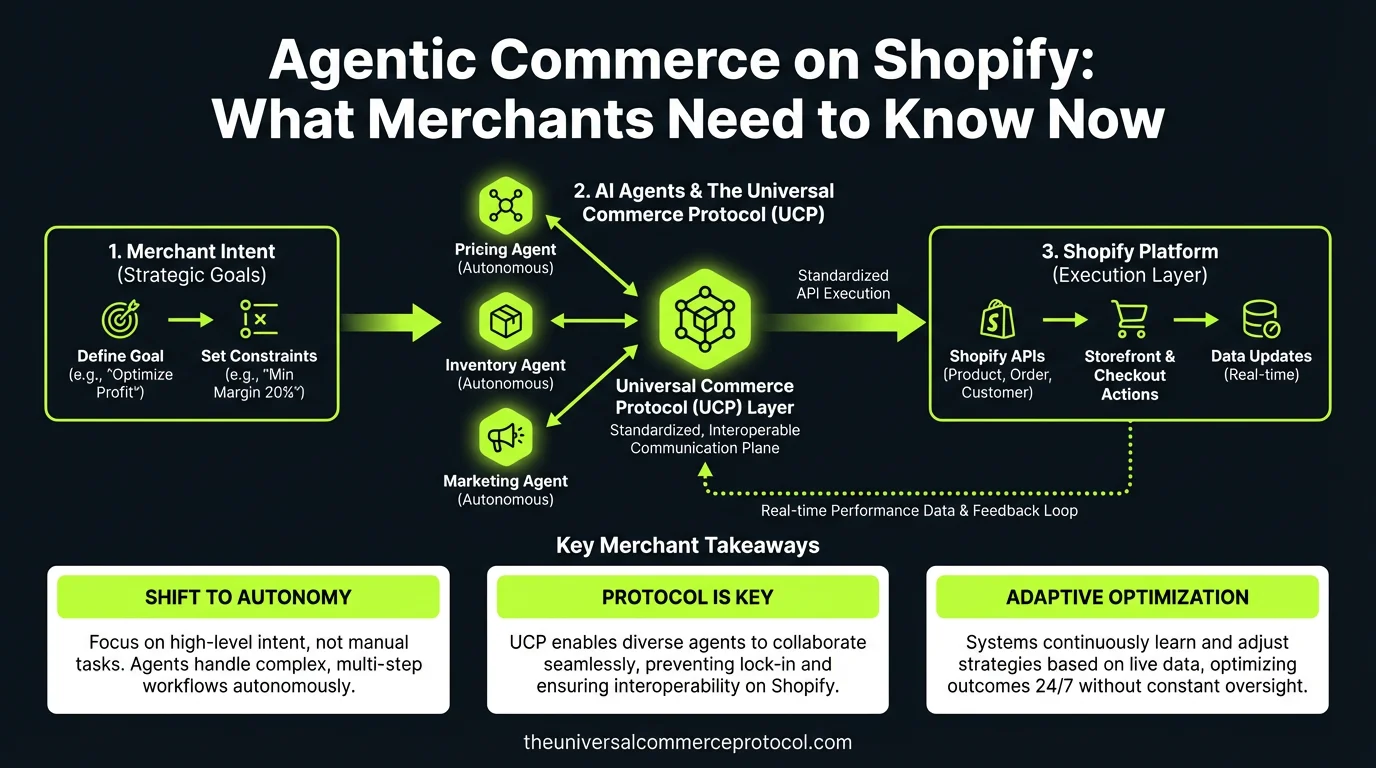
Agentic Commerce on Shopify: What Merchants Need to Know Now
Shopify has entered a critical inflection point. The platform that democratized e-commerce for millions of merchants is now architecting itself for an agent-driven future. As artificial intelligence agents become the primary interface between merchants and customers—handling discovery, transactions, support, and fulfillment—Shopify’s strategic investments in agentic capabilities and alignment with the Universal Commerce Protocol (UCP) represent the most significant platform shift since mobile commerce.
For Shopify merchants, the question is no longer whether agentic commerce matters. The question is: what do I need to do today to remain competitive tomorrow?
Understanding Agentic Commerce in the Shopify Ecosystem
Agentic commerce refers to autonomous AI agents that execute commerce transactions on behalf of customers—across channels, devices, and touchpoints—without requiring manual intervention at each step. Unlike traditional chatbots or recommendation engines, commerce agents can:
- Access real-time inventory, pricing, and product data
- Negotiate terms, apply discounts, and manage cart logic
- Process payments through integrated payment gateways
- Coordinate fulfillment and logistics
- Resolve disputes and handle returns autonomously
Shopify’s advantage lies in its existing merchant ecosystem, payment infrastructure (Shopify Payments), and fulfillment network (Shopify Fulfillment Network). These assets become exponentially more valuable when wrapped in agentic workflows.
The Universal Commerce Protocol (UCP) is the emerging standard that enables this interoperability. Developed collaboratively by commerce platforms, payment networks, and AI infrastructure providers, UCP creates a common language for agents to read product catalogs, execute transactions, and settle payments across disparate systems. For Shopify, UCP integration means merchants gain access to agent channels beyond their own store—including third-party agent marketplaces, voice commerce platforms, and B2B procurement agents.
Shopify’s Agentic Roadmap: What’s Here and What’s Coming
Current Capabilities (2024-2025)
Shopify has already begun laying groundwork for agentic commerce:
- Shopify Functions – Custom APIs that allow developers to extend Shopify’s core commerce logic (discounts, fulfillment, payment validation) for agent workflows
- Hydrogen and Oxygen – Headless commerce framework enabling merchants to build custom agent interfaces and integrations
- GraphQL Admin API – Programmatic access to inventory, orders, and customer data required for agent decision-making
- Shopify Flow – Automation builder that can trigger actions based on order events, inventory changes, and customer behavior
- Native AI Assistant (Shopify Magic) – Early-stage AI tools for product descriptions and content generation, foundational to agent training
These are not agentic commerce features in isolation—they are the architectural building blocks that agents will depend on.
Announced Future Directions
Shopify leadership has publicly committed to:
- Universal Commerce Protocol Compliance – Making Shopify stores natively discoverable and transactable by third-party agents through standardized data feeds and APIs
- Agent Marketplace – A curated listing of vetted commerce agents that can access Shopify merchant data (with explicit permissions)
- Agentic Fulfillment Orchestration – Enabling agents to coordinate multi-warehouse, multi-carrier fulfillment decisions in real-time
- Autonomous Customer Service Agents – AI agents trained on merchant-specific policies to handle returns, refunds, and disputes without human escalation
While timelines remain fluid, Shopify’s engineering organization is actively hiring for “agentic commerce infrastructure,” and the company has begun pilot programs with select enterprise merchants.
How UCP Integration Changes the Game for Shopify Merchants
The Universal Commerce Protocol is not a Shopify initiative—it is an industry standard being shaped by companies including OpenAI, Anthropic, payment networks like Visa and Mastercard, and commerce platforms including Shopify, WooCommerce, and BigCommerce.
UCP standardizes:
- Product Catalog Schema – Structured format for agents to ingest SKU data, pricing, inventory, and attributes
- Transaction Protocol – How agents submit orders, validate payment methods, and confirm fulfillment
- Merchant Authentication – OAuth and API key patterns for agents to securely access store data
- Dispute Resolution – Standards for handling chargebacks, returns, and refunds initiated by agents
For Shopify merchants, UCP compliance means:
- Your store becomes discoverable by agents you didn’t build yourself
- A customer’s AI assistant can browse your inventory and complete transactions without visiting your website
- You can participate in agent-driven channels (voice commerce, B2B procurement networks) without custom integrations
- Payment settlement and dispute handling follow standardized rules, reducing operational friction
Shopify’s role is to abstract away UCP complexity for merchants. Rather than requiring each store owner to implement UCP directly, Shopify will likely offer it as a native toggle—”Enable agentic commerce” in the admin dashboard.
Immediate Action Steps for Shopify Merchants
1. Audit Your Product Data Quality
Agents make decisions based on data. If your Shopify store has incomplete product titles, missing descriptions, vague variant options, or outdated inventory counts, agents will make poor decisions—or skip your products entirely.
Action items:
- Ensure all products have descriptive titles (minimum 50 characters, including key attributes)
- Write detailed, SEO-friendly descriptions that highlight use cases and differentiators
- Tag products with structured attributes (color, size, material, price range) that agents can filter on
- Enable real-time inventory sync across all sales channels
- Add high-quality product images (minimum 3 per SKU, including lifestyle shots)
Tools: Shopify’s built-in product editor, apps like Inventory Planner and DataBox, or custom scripts using the GraphQL Admin API.
2. Implement Structured Pricing and Discount Logic
Agents need to understand your pricing rules. If you rely on manual discounts or context-dependent pricing, agents cannot replicate your logic reliably.
Action items:
- Migrate to Shopify Functions for discount logic (volume discounts, customer segment pricing, time-based promotions)
- Document all pricing rules in a centralized system
- Test discount rules with Shopify’s Function testing tools
- Create clear, machine-readable discount codes that agents can apply
Why this matters: When an agent processes an order, it must calculate the correct final price in real-time. If your pricing logic is opaque, agents will either overpay or underpay, eroding margins or causing customer dissatisfaction.
3. Prepare Your API Infrastructure
Agents will interact with your store programmatically. Ensure your APIs (especially the Shopify GraphQL Admin API) are optimized for agent access patterns.
Action items:
- Review your API rate limits and request patterns—agents may make thousands of queries per minute during peak times
- Implement caching strategies for frequently accessed data (product catalogs, inventory snapshots)
- Use Shopify’s Bulk Operations API for large-scale data exports
- Set up API monitoring and alerting to detect unusual access patterns
- Consider a headless commerce setup (Hydrogen + Oxygen) if you need custom agent integrations
4. Establish Agent Access Policies
Not all agents should have access to all your data. You need clear policies about which agents can transact on your behalf, what data they can access, and what transaction limits apply.
Action items:
- Define which agents (by name, organization, or capability) you authorize to sell your products
- Set transaction limits per agent (daily volume, average order value, etc.)
- Require explicit customer consent before agents access personal data
- Implement audit logging to track all agent-initiated transactions
- Create a dashboard to monitor agent performance (conversion rate, return rate, customer satisfaction)
Shopify will likely provide templates and admin UI for this, but merchants should start thinking about these policies now.
5. Build Agent-Friendly Customer Service Workflows
As agents handle more transactions, your customer service team will shift from handling routine inquiries to managing exceptions. Prepare for this transition.
Action items:
- Audit your current support tickets to identify common issues agents could handle autonomously
- Create clear, unambiguous return and refund policies that agents can execute
- Build escalation workflows for complex issues (e.g., if a return involves damaged goods, escalate to human review)
- Train your support team to handle agent-related disputes and edge cases
The Competitive Imperative
Early adopters of agentic commerce will gain significant advantages:
- Reach – Your products become accessible through agent channels you don’t own
- Conversion – Agents reduce friction in the purchase journey, increasing conversion rates
- Customer Lifetime Value – Agents enable repeat purchases and cross-selling at scale
- Operational Efficiency – Autonomous agents reduce manual order processing and customer service costs
Merchants who delay preparing for agentic commerce risk being invisible to an increasingly agent-driven customer base. The transition is not hypothetical—it is underway.
FAQ
1. Will Shopify charge extra for agentic commerce capabilities?
Shopify has not announced pricing for agentic features. It’s likely that basic UCP compliance and agent discovery will be included in standard plans, while advanced features (custom agent integrations, dedicated agent support) may be premium add-ons. Monitor Shopify’s roadmap and pricing updates.
2. How does UCP differ from existing Shopify integrations and APIs?
UCP is a standardized protocol designed to be platform-agnostic, enabling agents trained on UCP to work across Shopify, WooCommerce, BigCommerce, and other platforms without custom integration work. Existing Shopify APIs are Shopify-specific. UCP is the “common language” agents speak.
3. What happens if an agent makes a mistake or commits fraud on my behalf?
UCP includes dispute resolution standards, and Shopify will likely provide merchant protections similar to those in place for payment processors. However, merchants should implement authorization limits and monitoring to prevent unauthorized agent activity. This is an evolving area—expect regulatory clarity over the next 12-24 months.
4. Do I need to use Shopify Plus to access agentic commerce features?
Shopify has not confirmed this, but historically, advanced features have been available across all plan tiers. Expect agentic commerce to be available to all Shopify merchants, with enterprise-level customization reserved for Shopify Plus customers.
Leave a Reply