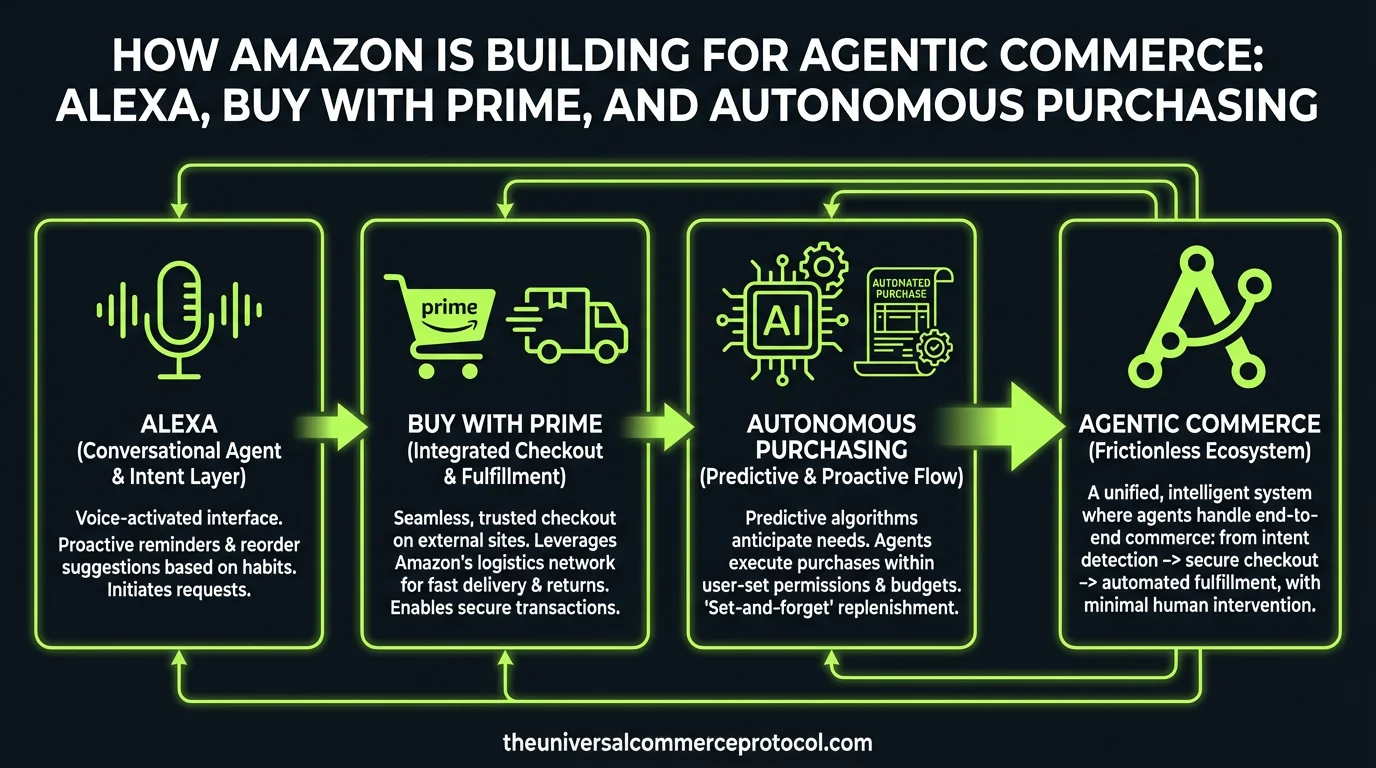
Amazon’s Strategic Pivot to Agentic Commerce
Amazon is making a calculated bet on agentic commerce—a paradigm where autonomous agents execute transactions on behalf of consumers without explicit approval for each purchase. Unlike traditional e-commerce, which requires human decision-making at every step, agentic commerce delegates purchasing authority to intelligent agents trained on user preferences, purchase history, and contextual data.
The company’s infrastructure for this shift rests on three foundational pillars: Alexa’s voice-activated purchasing, Buy with Prime’s frictionless checkout, and Amazon’s proprietary machine learning systems that predict consumer needs before they arise. Together, these components create an ecosystem where commerce becomes ambient—integrated into daily life rather than requiring deliberate shopping sessions.
This approach aligns with the principles of the Universal Commerce Protocol (UCP), which standardizes how agents interact with commerce systems across multiple vendors and channels. By building native agentic capabilities, Amazon is simultaneously preparing for a future where UCP-compliant agents may represent consumers across its platform.
Alexa: From Voice Assistant to Purchasing Agent
Alexa, Amazon’s voice-activated AI assistant, represents the company’s most visible entry point into agentic commerce. Launched in 2014 with the Echo smart speaker, Alexa has evolved from a novelty device into a commerce enabler, with over 100 million Alexa-enabled devices in use globally as of 2024.
The purchasing journey through Alexa demonstrates autonomous transaction mechanics:
- Voice-Triggered Reordering: Consumers can say “Alexa, reorder my paper towels” and the system automatically processes a purchase without confirmation, leveraging prior purchase data and delivery preferences.
- Predictive Ordering: Alexa’s machine learning models analyze consumption patterns. For subscription items like coffee pods or household supplies, the system can initiate orders before users explicitly request them, pending voice or app confirmation.
- Third-Party Integration: Through Alexa Skills, developers have created shopping agents for retailers like Whole Foods (Amazon-owned), Walmart, and Instacart, enabling cross-platform autonomous purchasing.
Amazon’s Alexa Shopping Baskets feature, introduced in 2023, allows users to build purchase queues through voice commands across multiple sessions. Alexa aggregates these items and can execute bulk orders with a single confirmation, reducing friction in the purchasing process. This represents a proto-agentic model where the agent (Alexa) manages cart state and timing autonomously.
The company has also invested in Alexa Fund investments targeting commerce automation. In 2021, Amazon invested in Solugen, a chemical manufacturing company using AI optimization—signaling interest in supply-chain agents that could automate B2B purchasing decisions.
Buy with Prime: Frictionless Checkout as Agent Infrastructure
Buy with Prime, launched in 2022, represents Amazon’s aggressive push to become the payment and fulfillment layer for third-party merchants. By 2024, Buy with Prime was available on thousands of merchant websites, from Grubhub to Spanx.
For agentic commerce, Buy with Prime serves a critical function: it abstracts the checkout process into a standardized, programmable interface. An autonomous agent doesn’t need to navigate unique payment forms, shipping options, or fraud verification for each retailer—Buy with Prime provides a unified transaction layer.
Key advantages for agentic systems:
- Standardized Checkout: Agents can execute transactions across thousands of merchants using identical API calls and data structures, reducing complexity exponentially.
- Stored Payment Methods: Buy with Prime stores payment instruments centrally, allowing agents to complete purchases without requesting credential re-entry—a critical requirement for autonomous transactions.
- Fulfillment Guarantees: Amazon’s logistics network backs Buy with Prime purchases, meaning agents can make purchasing decisions with confidence in delivery timelines and return policies.
- Data Portability: Buy with Prime collects transaction data across merchant ecosystems, feeding Amazon’s machine learning models with richer datasets about consumer behavior.
By 2024, Buy with Prime was processing billions in GMV (gross merchandise value) annually. For agentic commerce, this represents a massive infrastructure play—Amazon is positioning itself as the transaction backbone that agents will rely on, regardless of whether those agents are Amazon-built or third-party systems compliant with UCP standards.
Machine Learning and Predictive Purchasing
Amazon’s core competitive advantage in agentic commerce lies in its machine learning capabilities. The company operates one of the world’s largest e-commerce datasets, with billions of historical transactions, product reviews, and customer signals.
Amazon’s recommendation engine, which drives roughly 35% of the platform’s revenue according to internal estimates, is being repurposed for agentic applications:
- Demand Forecasting: Amazon’s SageMaker ML platform enables models that predict which products consumers will need in upcoming weeks. For consumables, this accuracy rate exceeds 85% for repeat purchases.
- Contextual Triggers: Alexa integrates with Amazon’s smart home ecosystem (Ring, Kindle, Fire TV) to gather contextual signals. If a Ring doorbell detects package theft, Alexa might autonomously recommend security cameras. If a Kindle device shows reading patterns, Alexa might order related books.
- Cross-Device Learning: Amazon’s ecosystem spans smartphones (Amazon Shopping app), tablets (Fire), wearables (Halo), and smart home devices. This creates a unified user model that informs purchasing decisions across touchpoints.
Amazon’s acquisition of Kiva Systems (now Amazon Robotics) in 2012 for $775 million also plays a role. By automating warehouse fulfillment, Amazon reduced order processing times, making just-in-time purchasing by agents more viable. Agents can now make purchasing decisions with confidence that delivery will occur within 24-48 hours in most urban areas.
Competing Pressures and UCP Implications
While Amazon dominates in agentic commerce infrastructure, it faces competitive and regulatory pressures that may force alignment with open standards like UCP.
Competitors are building parallel systems:
- Google Shopping Actions: Google’s integration of Google Assistant with merchant checkout aims to provide agent-compatible purchasing, though adoption remains fragmented.
- Shopify’s Checkout Extensions: Shopify is enabling third-party developers to build custom checkout experiences, including agentic flows.
- Apple’s Siri and Tap to Pay: Apple is quietly building agentic infrastructure through Siri automation and its Tap to Pay payment system, though less aggressively than Amazon.
The Universal Commerce Protocol, developed by organizations like the Open Commerce Initiative, proposes standardized APIs for agent-merchant communication. If UCP gains regulatory or market traction—particularly in EU markets where interoperability is increasingly mandated—Amazon will face pressure to expose its agentic commerce infrastructure to third-party agents.
Amazon’s current strategy appears to be: build proprietary agentic capabilities at scale while maintaining optionality to support UCP-compliant agents if market conditions demand it. Buy with Prime’s API-first design suggests Amazon is already preparing for this scenario.
Real-World Agentic Commerce Use Cases at Amazon
Several Amazon initiatives demonstrate agentic commerce in practice:
Amazon Business: B2B buyers can set up automated reordering for office supplies, industrial equipment, and MRO (maintenance, repair, operations) items. Alexa for Business enables voice-activated procurement for enterprise customers.
Subscribe & Save: Amazon’s recurring delivery program, which manages $20+ billion in annual GMV, is fundamentally agentic—the system autonomously processes orders on user-defined schedules, adjusting quantities based on historical consumption.
Amazon Fresh and Whole Foods: Amazon’s grocery operations are testing autonomous ordering based on household inventory detection (via smart home integration) and consumption patterns. Pilot programs in Seattle and San Francisco have experimented with Alexa-driven grocery replenishment.
The Path Forward: Amazon and the Agentic Commerce Ecosystem
Amazon’s strategy reveals how platform leaders are preparing for agentic commerce dominance. By controlling the agent (Alexa), the payment layer (Buy with Prime), the fulfillment network (Amazon Logistics), and the data (transaction history), Amazon creates a vertically integrated system that competitors struggle to replicate.
However, regulatory scrutiny—particularly from the FTC and EU competition authorities—may force Amazon to open its agentic infrastructure. If UCP becomes an industry standard, Amazon will likely support it, but on terms that preserve its competitive advantages.
For merchants and developers, the implication is clear: Amazon is building the infrastructure for agentic commerce today, and integration with Alexa, Buy with Prime, and Amazon’s ML systems is increasingly essential for reaching autonomous purchasing flows.
FAQ: Amazon and Agentic Commerce
What is agentic commerce, and how does Amazon differ from traditional e-commerce?
Agentic commerce empowers autonomous agents to execute transactions on behalf of consumers based on learned preferences and contextual data, without requiring explicit approval for each purchase. Traditional e-commerce requires human decision-making at every step. Amazon’s approach—through Alexa, Buy with Prime, and machine learning—enables ambient commerce where purchasing becomes integrated into daily life rather than a deliberate shopping session.
How does Buy with Prime enable agentic purchasing?
Buy with Prime standardizes the checkout process across thousands of merchant websites, allowing autonomous agents to execute transactions using identical API calls and data structures. It also stores payment methods centrally, enabling agents to complete purchases without credential re-entry—critical for autonomous transactions. By 2024, Buy with Prime was processing billions in GMV across merchant ecosystems.
Can third-party agents interact with Amazon’s agentic commerce infrastructure?
Currently, Amazon prioritizes proprietary agents (Alexa) and its own payment layer (Buy with Prime). However, if the Universal Commerce Protocol (UCP) becomes an industry standard, Amazon will likely support third-party agents, though on terms that preserve its competitive advantages. Regulatory pressure, particularly from the FTC and EU, may accelerate this shift toward open standards.
What role does machine learning play in Amazon’s agentic commerce strategy?
Amazon’s recommendation engine and SageMaker ML platform analyze billions of historical transactions to predict consumer needs with 85%+ accuracy for repeat purchases. Contextual signals from smart home devices (Ring, Kindle, Fire TV) inform purchasing decisions. This integrated data model enables Alexa to autonomously trigger purchases based on consumption patterns and contextual triggers, creating a competitive moat that competitors struggle to replicate.
Leave a Reply