Category: Strategy & Business Impact
-

GDPR Article 22: Automated Decision-Making in Agentic Commerce
AI agents executing B2B purchases must comply with GDPR Article 22’s automated decision-making safeguards. Learn the three lawful bases and audit your UCP imple
-

UCP Middleware for Legacy ERP: Build Your Bridge
Your AI agent just sent an [inventory query. Your SAP ECC instance returned a timeout](theuniversalcommerceprotocol.com/?s=UCP%20AI%20Kill%20Switches%3A%20Emergency%20Stops%20for%20Autonomous%20Agents). The agent retried. Twice. Your ERP created [three duplicate purchase orders before anyone noticed
-

Is Agentic Commerce the Same as Agentic AI? Here’s the Difference
Agentic AI is the general capability for autonomous reasoning and action. Agentic commerce is its specific application to buying and selling. Here is why the distinction matters and what additional requirements commerce demands.
-

The Business ROI of Agentic Commerce: Moving Beyond ‘Add to Cart’
Discover how the Universal Commerce Protocol (UCP) reduces cart abandonment and scales global reach through agent-led transactions.
-

Mastercard and Visa Lead Agentic Commerce Security Standards
Mastercard and Visa, the two largest payment networks globally, are simultaneously competing and collaborating with technology companies including Google, Stripe, and Amazon Web Services to develop technical standards, security protocols, and interoperability frameworks for agentic commerce—autonomous AI-driven transactions conducted without direct human authorization.
-

AI Protocol Decision: $2.3M Revenue Impact Guide
The Commerce AI Protocol Decision framework quantifies a $2.3 million annual revenue impact differential between Protocol-A (enterprise transaction layer) and Protocol-B (real-time settlement infrastructure) for organizations processing $50M+ in annual transaction volume. Protocol-B delivers measurable performance advantages: transaction fee variance reduction of 0.8–2.1%, processing time acceleration of 15–28%, and working capital redeployment of $400K–$900K annually.…
-

Webhook Architecture Resilience: Reliable Event Processing
Webhook architecture resilience for Unified Commerce Platform (UCP) event processing implements idempotent retry mechanisms with exponential backoff, distributed transaction coordination via Apache Kafka or AWS EventBridge, and event sourcing patterns compliant with exactly-once processing semantics. Dead-letter queue (DLQ) management, HMAC-SHA256 webhook signature verification, and circuit breaker patterns prevent cascading failures across payment processing, inventory synchronization,…
-

UCP vs MCP: Choose the Right Commerce AI Protocol
Google’s Unified Commerce Protocol (UCP) implements centralized feature normalization across omnichannel retail infrastructure—including e-commerce platforms, point-of-sale terminals, and inventory management systems—while Anthropic’s Model Context Protocol (MCP) enables distributed context windows optimized for multi-agent AI reasoning in supply chain orchestration and demand forecasting workflows. Protocol selection directly determines feature engineering dimensionality, training data stratification across transaction…
-

Modeling Cart Abandonment: Training AI Agents for Real-Time Commerce Recovery
Explore the data architecture, model design, and evaluation frameworks needed to train commerce AI agents for real-time cart abandonment recovery.
-
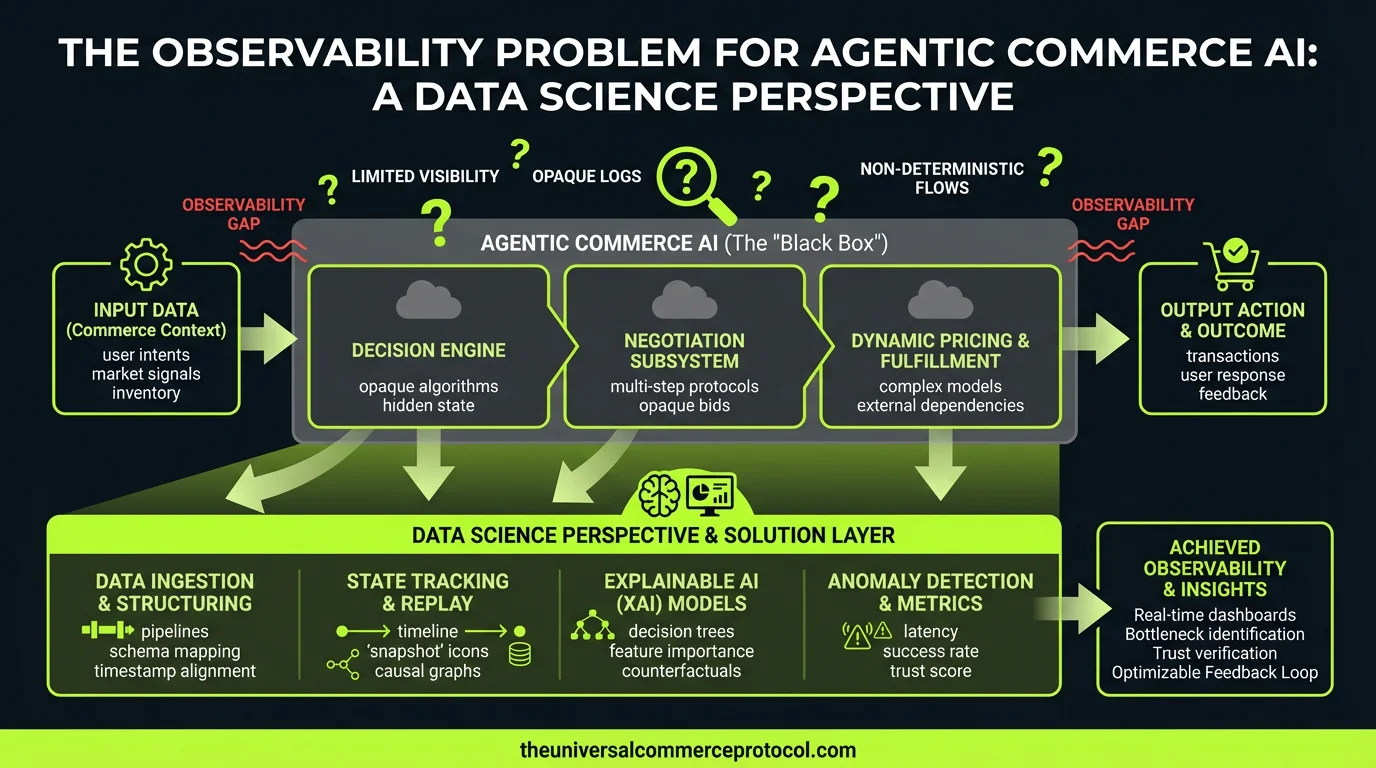
Observability Problem for Agentic Commerce AI
Agentic commerce AI systems processing high-volume transaction workflows require observability frameworks that move beyond traditional ML metrics like precision and recall to capture business-critical signals: transaction success rates, conversion funnel completion, fraud detection accuracy, and latency-induced revenue loss. Data science teams must implement causal inference methodologies and counterfactual analysis to validate decision-making quality across autonomous…