The $2 Million Problem Hiding in Your Commerce Stack
Your CFO dashboard shows all the right numbers: successful UCP implementation, security compliance achieved, inventory systems synchronized. Yet your agentic commerce conversion rates are delivering half the ROI your business case projected.
The culprit isn’t technical complexity—it’s a basic performance issue that’s costing you millions. Agent latency, the delay between customer queries and AI responses, is creating a direct revenue leak that most finance leaders don’t see coming.
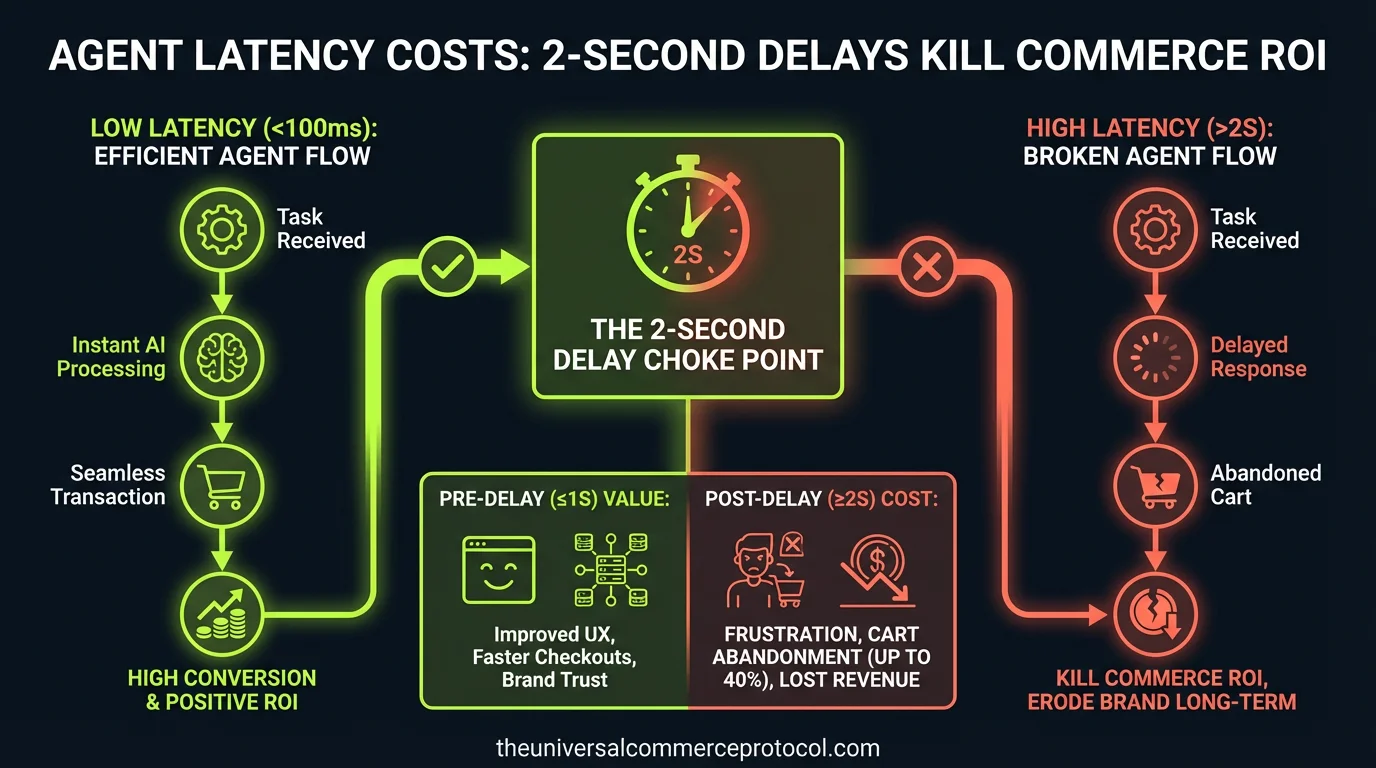
When an AI commerce agent takes more than 2 seconds to respond to customer queries—or 5-10 seconds to complete transaction steps—buyers abandon at rates that would alarm any board. Unlike traditional e-commerce where 100ms delays reduce conversions by 1%, agentic commerce operates under tighter constraints because it competes directly with human interaction speed.
For a mid-market retailer processing $50M annually through digital channels, a 50% conversion rate reduction from latency issues translates to $25M in at-risk revenue—with $2-4M in actual losses depending on your abandoned cart recovery rates.
The Financial Impact: Real Numbers Behind Response Times
The business case for optimizing agent latency is straightforward when you run the numbers:
Revenue Impact Analysis:
- 2-second delays: 15-25% conversion drop ($1.5-2.5M loss on $50M revenue base)
- 5-second delays: 40-60% conversion drop ($4-6M revenue impact)
- 10+ second delays: 70-85% abandonment rate ($7-8.5M revenue at risk)
Customer Acquisition Cost (CAC) Multiplier: When prospects abandon due to latency, your marketing spend delivers zero ROI. If you’re investing $200 per acquired customer, every 1,000 latency-driven abandonments costs $200,000 in wasted acquisition spend.
Competitive Risk Premium: Competitors with sub-2-second agent responses capture 30-40% more market share in head-to-head scenarios, according to recent commerce analytics studies.
Where Your Revenue Leaks Live: The Five Latency Sources
Large Language Model Processing Costs
LLM inference—the time it takes AI models to generate responses—represents your largest single latency source. Models like GPT-4 or Claude require 500ms to 3+ seconds per interaction. LLM inference is the computational process where AI models analyze input and generate responses.
Financial Impact: A three-turn conversation can consume 9+ seconds before any actual commerce activity begins, driving 60-70% abandonment before purchase intent is captured.
Optimization ROI: Deploying smaller, task-specific models for routine queries while reserving premium models for high-value interactions can reduce processing time by 40-60% while cutting AI processing costs by $15,000-25,000 monthly for mid-market volumes.
Inventory Database Query Delays
Real-time stock verification adds 100-500ms per customer query. Across multi-step transactions, this compounds to 1-2 additional seconds of total latency.
Business Case for Optimization: Implementing inventory caching strategies requires $50,000-75,000 in infrastructure investment but delivers 200-400ms latency reduction, improving conversion rates by 8-15% and generating $500,000-1.2M in additional annual revenue.
Payment Authorization Latency
Third-party payment processors introduce 500ms to 2+ second delays during transaction authorization. This often-hidden cost appears at the worst possible moment—when customers are ready to buy.
Mitigation Strategy: Optimistic order confirmation systems confirm purchases immediately while processing payment in the background. Implementation costs $25,000-40,000 but reduces cart abandonment by 12-20% at the crucial payment step.
System Integration Overhead
Each API call between systems—inventory, payment, fulfillment, notifications—adds 50-100ms in network time. A typical transaction touches 5-8 systems, creating 250-500ms in pure network delays.
Optimization Investment: API batching and system colocation requires $30,000-50,000 in infrastructure changes but delivers consistent 200-300ms improvement across all transactions.
Implementation Risk Assessment
Latency optimization projects carry manageable technical risk when properly scoped:
Low Risk (30-60 days): Model optimization and caching strategies can be implemented with existing team resources for $25,000-50,000 investment.
Medium Risk (60-120 days): Payment flow optimization and API batching require vendor coordination but offer predictable outcomes with $75,000-100,000 budget allocation.
Higher Risk (3-6 months): Complete system architecture redesign for latency optimization requires $200,000-300,000 investment but delivers 500-700ms improvement across all customer interactions.
ROI Decision Framework
Use this framework to evaluate latency optimization investments:
Step 1: Baseline Measurement
Current average response time × monthly transaction volume × abandonment rate = revenue at risk
Step 2: Improvement Potential
Target response time improvement × conversion rate lift × annual transaction value = revenue opportunity
Step 3: Investment Analysis
Implementation cost ÷ annual revenue opportunity = payback period (target: 6-12 months)
Step 4: Competitive Context
Market share risk from slower performance × customer lifetime value = strategic cost of inaction
30/60/90-Day Action Plan
Next 30 Days:
• Implement latency monitoring across your agent commerce stack ($5,000-10,000 investment)
• Quantify current revenue impact from response time delays
• Identify quick-win optimization opportunities with existing resources
60-Day Milestone:
• Deploy model optimization and caching improvements
• Begin vendor discussions for payment latency reduction
• Establish baseline metrics for ongoing optimization ROI measurement
90-Day Target:
• Complete Phase 1 optimizations with 200-400ms improvement
• Measure conversion rate improvement and revenue impact
• Develop business case for Phase 2 infrastructure investments
Frequently Asked Questions
What’s the typical ROI timeline for agent latency optimization projects?
Most latency optimization investments deliver positive ROI within 6-12 months. Quick wins like model optimization and caching show revenue impact within 30-60 days, while infrastructure changes require 3-6 months to demonstrate full financial benefit.
How do I justify the business case to the board when the technology is still emerging?
Focus on customer acquisition cost efficiency and competitive positioning. Frame latency optimization as protecting existing marketing investments—every prospect who abandons due to slow response times represents wasted acquisition spending and competitor advantage.
What budget should I allocate for a comprehensive latency optimization program?
Plan for $100,000-200,000 for Phase 1 improvements targeting 300-500ms reduction. Enterprise-scale optimization requiring infrastructure redesign typically requires $300,000-500,000 but delivers 50-70% conversion rate improvements.
How does agent latency optimization compare to other conversion rate optimization investments?
Latency optimization typically delivers 2-3x better ROI than traditional CRO tactics because it addresses a fundamental performance barrier rather than incremental experience improvements. It’s infrastructure investment that compounds across all customer interactions.
What metrics should I track to monitor the financial impact of latency improvements?
Monitor average response time, conversion rate by response time bucket, revenue per session, and customer acquisition cost effectiveness. Establish monthly reporting on latency-attributable revenue impact to demonstrate ongoing program value.
This article is a perspective piece adapted for CFO audiences. Read the original coverage here.
Frequently Asked Questions
What is agent latency and why does it matter for commerce?
Agent latency is the delay between when a customer submits a query to an AI commerce agent and when they receive a response. In agentic commerce, latency directly impacts conversion rates because customers expect response times comparable to human interaction. Delays over 2 seconds can reduce conversions by 15-25%, translating to millions in lost revenue for mid-market retailers.
How much revenue can latency issues actually cost my business?
For a mid-market retailer processing $50M annually through digital channels, latency-related conversion drops can result in $2-4M in actual losses. A 50% conversion rate reduction from 2-5 second delays on a $50M revenue base translates to $25M in at-risk revenue, depending on your abandoned cart recovery rates and customer base size.
What response time should I target for my commerce agents?
Target response times should be under 2 seconds for customer queries and 5-10 seconds maximum for completing transaction steps. These thresholds are critical because agentic commerce competes directly with human interaction speed expectations—exceeding them causes significant abandonment rates that traditional e-commerce doesn’t experience.
Why do latency issues hide in dashboards showing successful implementation?
Many companies focus on technical metrics like UCP implementation success, security compliance, and inventory synchronization while overlooking performance optimization. Agent latency creates a hidden revenue leak because it doesn’t appear as a technical failure—systems function correctly, but conversion rates suffer silently in the background.
How does agent latency compare to traditional e-commerce performance issues?
In traditional e-commerce, 100ms delays reduce conversions by approximately 1%. However, agentic commerce has tighter performance constraints because it directly competes with human interaction speeds. This means latency issues in agent-based systems have a disproportionately larger impact on customer behavior and revenue than similar delays in conventional e-commerce platforms.
Leave a Reply