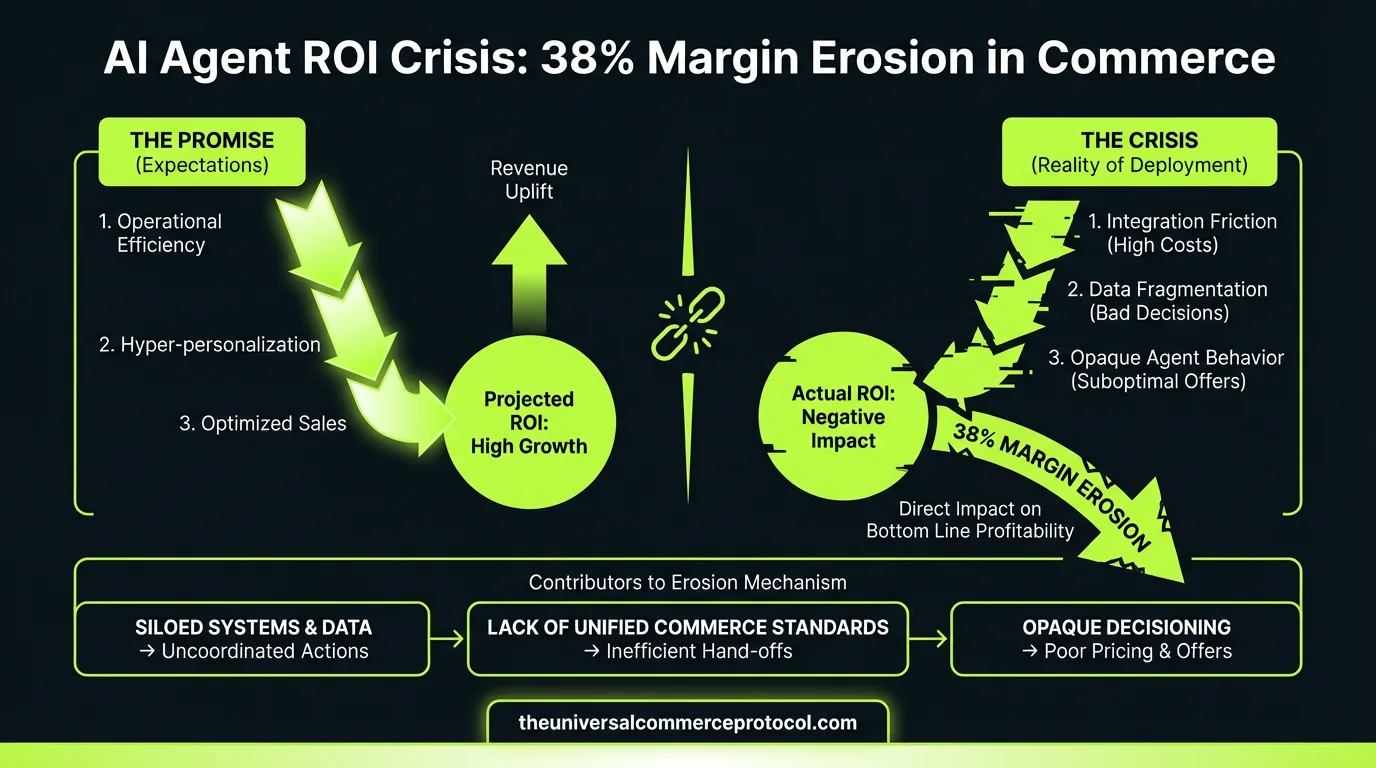
Your AI commerce agents are driving conversion rates up 23% and customer satisfaction scores through the roof. But they’re also silently eroding margins by 30-38% per transaction, and your current financial reporting can’t see it happening.
This isn’t a technology problem—it’s a financial visibility crisis that’s hitting CFOs across retail, B2B commerce, and direct-to-consumer brands. While traditional commerce transactions had predictable, linear costs, AI agents scatter expenses across dozens of API calls, third-party services, and human escalations that existing cost accounting simply wasn’t built to track.
The $47 Order That Actually Cost $63 to Process
Consider this real scenario from a mid-market retailer: A customer places a $47 order through their AI shopping assistant. Traditional analytics show the conversion and revenue. But the true cost breakdown reveals a different story:
- 3 LLM API calls for product intent disambiguation: $0.31
- 5 vector database queries for inventory matching: $0.02
- 2 payment authorization attempts: $1.66 (2.9% + $0.30)
- Human agent escalation due to low confidence score: $15-40
- Data warehouse reconciliation: $0.06
Total transaction cost: $16-18. On a $47 order with typical 40% gross margins, this represents 30-38% margin erosion—turning a profitable transaction into a break-even or loss-making one.
Scale this across thousands of daily transactions, and you’re looking at six-figure quarterly margin impacts that won’t show up in traditional P&L reporting until it’s too late to course-correct.
Why Your Current Cost Accounting Is Blind to Agent Economics
Traditional commerce cost models worked because they were predictable and linear. A Shopify transaction cost equation was simple: payment processor fee plus allocated hosting costs divided by transaction volume. Clean, auditable, and wrong for AI agents.
AI agents introduce variable cost structures that fluctuate based on:
- Customer complexity: New customers require more context-building than returning customers
- Product complexity: Multi-SKU bundles or technical products trigger more API calls
- Channel variance: Mobile users may require different interaction patterns than desktop users
- Confidence thresholds: Lower confidence scores trigger expensive human escalations
Your accounting team can tell you exactly what you spent on payment processing fees or hosting costs. But they can’t tell you which customer segments are unprofitable to serve via AI, or whether your agents are cost-effective compared to traditional support channels.
Building Financial Visibility Into Agent Operations
Request-Level Cost Tracking
The foundation of agent cost attribution starts with tagging every external API call with financial metadata. This means instrumenting your systems to capture not just technical metrics, but business-relevant cost drivers:
- Customer segment (high-LTV repeat vs. new mobile users)
- Channel origin (Google, native app, social commerce)
- Intent complexity (simple product lookup vs. multi-criteria comparison)
- Resolution pathway (agent-resolved vs. human-escalated)
This granular tracking enables you to calculate cost per intent category. If size-clarification queries average 12¢ but price-checks cost 8¢, you can optimize prompts or routing logic to reduce the expensive interactions.
Transaction-Level P&L Attribution
Once a transaction completes, aggregate all associated costs and attach them to the order record. This creates a true cost of goods sold (COGS) that includes:
- LLM compute costs: Sum of all API calls with token-based pricing
- Data retrieval costs: Vector database queries, inventory lookups, customer profile access
- Payment processing: Standard interchange and processor fees
- Human labor: Escalated minutes multiplied by fully-burdened support costs ($0.50-$2.00/minute)
- Infrastructure allocation: Proportional share of cloud, container, and platform costs
This “agentic commerce cost” becomes a new line item in your transaction-level reporting, enabling true unit economics analysis.
Segment-Based Profitability Analysis
With proper cost attribution in place, you can perform the profitability analysis that boards actually care about:
- Customer acquisition cost impact: Are agents reducing or increasing the cost to convert new customers?
- Lifetime value optimization: Which customer segments justify higher agent costs through repeat purchase behavior?
- Channel profitability: Are social commerce agents more cost-effective than web-based agents?
- Geographic efficiency: Do international customers require more expensive agent interactions?
A B2B procurement agent might cost $8-12 per transaction but close 95% of intents with $500+ average order values. A D2C mobile agent might cost $0.60 per transaction but escalate 22% of interactions. Both can be profitable—if you know which customer segments justify the costs.
Implementation Risk and Mitigation
The biggest risk isn’t technical—it’s organizational. Finance teams need new reporting frameworks, operations teams need new KPIs, and technology teams need new instrumentation. This creates a coordination challenge that requires executive sponsorship.
Start with pilot implementations on high-volume, well-understood customer segments. Instrument cost tracking for 30% of transactions to establish baseline metrics before full rollout. This approach limits financial exposure while building organizational capability.
Budget for analytics infrastructure upgrades. Proper agent cost attribution requires real-time data pipelines and dimensional analysis capabilities that may not exist in your current stack.
Decision Framework: 30/60/90 Day Action Plan
Next 30 Days: Audit current agent deployments to understand transaction volume and estimated cost impact. Work with your technology team to instrument basic cost tracking on one high-volume agent. Establish baseline metrics for comparison.
60 Days: Implement transaction-level cost attribution for your primary commerce agent. Begin collecting segment-based profitability data. Present initial findings to board with specific margin impact quantification.
90 Days: Develop board-ready ROI analysis comparing agent-assisted transactions to traditional conversion paths. Establish ongoing reporting frameworks and optimization processes. Build budget models for agent scaling decisions.
The companies that solve agent cost attribution in 2025 will have sustainable competitive advantages in AI-driven commerce. The ones that don’t will face margin erosion that compounds quarterly until profitability becomes unsustainable.
Frequently Asked Questions
What’s the typical payback period for implementing agent cost attribution systems?
Most finance teams see positive ROI within 90-120 days through margin improvement and cost optimization. The instrumentation investment typically ranges from $25,000-$75,000, while margin recovery often exceeds $200,000 annually for mid-market retailers processing 10,000+ agent transactions monthly.
How do I justify the analytics infrastructure investment to implement proper cost tracking?
Frame it as margin protection rather than new investment. If agents are processing significant transaction volume without cost visibility, you’re essentially flying blind on profitability. The infrastructure cost is typically 0.1-0.3% of agent-driven revenue, while margin improvements often exceed 5-8%.
Should agent costs be classified as COGS, operating expenses, or technology costs for financial reporting?
Direct transaction costs (LLM calls, payment processing) belong in COGS for accurate unit economics. Infrastructure and platform costs can remain in operating expenses. Human escalation costs should follow your existing customer service accounting treatment, typically operating expenses unless they’re significant enough to warrant separate classification.
How do I benchmark our agent costs against industry standards?
Industry benchmarks are still emerging, but typical ranges are $0.40-$2.50 for D2C transactions, $3.00-$12.00 for B2B transactions, and $8.00-$25.00 for complex technical sales. Focus on internal trends and profitability rather than absolute cost comparisons, as product complexity and customer segments vary significantly across businesses.
What’s the biggest financial risk if we don’t implement agent cost attribution?
Margin erosion that compounds over time. Without visibility into true agent costs, you’ll continue scaling systems that may be unprofitable. This creates a scenario where revenue growth actually reduces profitability—a situation that’s often not visible until quarterly reviews, when it’s too late to course-correct without impacting customer experience.
This article is a perspective piece adapted for CFO audiences. Read the original coverage here.
Q: How much margin erosion are AI commerce agents actually causing?
According to current data, AI commerce agents are causing 30-38% margin erosion per transaction, despite driving conversion rates up 23%. This hidden cost comes from scattered expenses across API calls, third-party services, and human escalations that traditional financial reporting doesn’t capture.
Q: Why can’t traditional financial reporting detect this margin erosion?
Traditional commerce transactions had predictable, linear costs that existing cost accounting systems were designed to track. AI agents, however, scatter expenses across dozens of API calls, vector database queries, payment authorization attempts, and human escalations—expenses that legacy financial systems simply weren’t built to monitor or allocate.
Q: Can you provide an example of how an AI-driven transaction loses profitability?
Yes. A $47 order processed through an AI shopping assistant can cost $16-18 to process when you account for LLM API calls ($0.31), vector database queries ($0.02), payment authorization ($1.66), human escalation ($15-40), and data warehouse reconciliation ($0.06). On a $47 order with 40% gross margins, this represents 30-38% margin erosion.
Q: Which industries are most affected by AI agent margin erosion?
This financial visibility crisis is hitting CFOs across retail, B2B commerce, and direct-to-consumer (DTC) brands—essentially any commerce sector implementing AI shopping assistants and autonomous agents.
Q: Is AI agent margin erosion a technology problem or a financial problem?
It’s a financial visibility crisis, not a technology problem. The issue isn’t with the AI agents themselves—which successfully drive conversions and satisfaction—but rather with the inability of current financial reporting and cost accounting systems to track and allocate the distributed costs associated with AI-driven transactions.
Leave a Reply