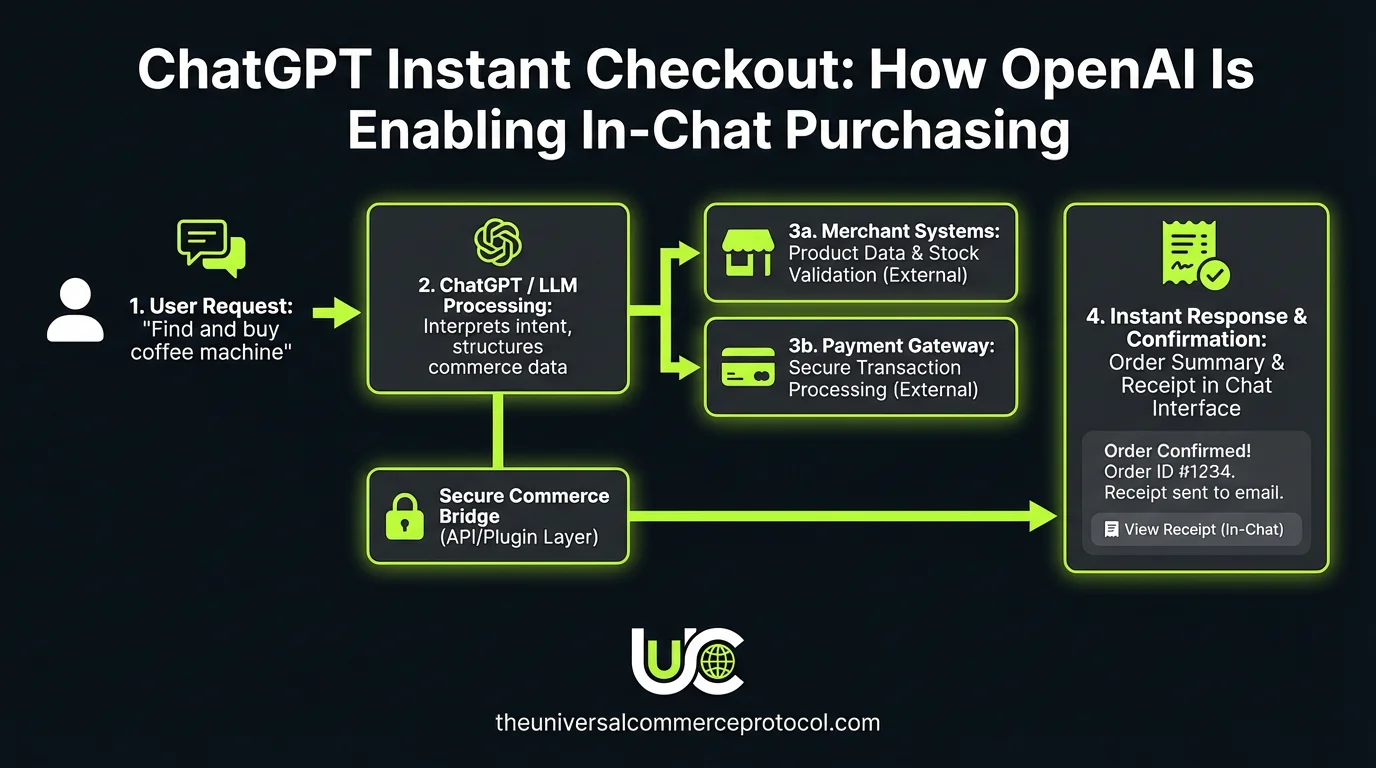
ChatGPT Instant Checkout: How OpenAI Is Enabling In-Chat Purchasing
The convergence of conversational AI and e-commerce has reached a critical inflection point. OpenAI’s ChatGPT, which has amassed over 200 million weekly active users as of early 2024, is increasingly embedding direct purchasing functionality into its chat interface. This development signals a fundamental shift in how consumers discover, evaluate, and buy products—and it underscores why standardized protocols like the Universal Commerce Protocol (UCP) are essential for scaling agentic commerce at enterprise scale.
The Rise of In-Chat Commerce
ChatGPT Instant Checkout represents OpenAI’s strategic push to transform the chatbot from a conversational tool into a transactional agent. Rather than directing users to external websites or storefronts, the feature enables users to research products, compare options, receive personalized recommendations, and complete purchases—all within the chat interface.
This capability aligns with broader industry trends toward conversational commerce, a space already populated by platforms like:
- Shopify – Integrated shopping assistant features into its platform
- Amazon Alexa – Voice-activated purchasing through smart devices
- Meta (WhatsApp, Messenger) – In-app shopping and checkout
- Google Assistant – Shopping actions and transaction capabilities
What distinguishes ChatGPT’s approach is the sophistication of its natural language understanding. The model can engage in nuanced product discussions, understand complex purchasing criteria, and make recommendations based on conversational context—not just keyword matching.
How ChatGPT Instant Checkout Works
OpenAI’s implementation leverages several technical layers:
Merchant Integration: Retailers and brands connect their product catalogs to ChatGPT through OpenAI’s API framework. Major partners include Shopify merchants, direct-to-consumer brands, and enterprise retailers. Integration typically involves providing product feeds, pricing data, inventory information, and transaction endpoints.
Payment Processing: ChatGPT integrates with established payment processors including Stripe, PayPal, and Square. Users can save payment methods securely within their OpenAI account, enabling one-click checkout. OpenAI adheres to PCI-DSS (Payment Card Industry Data Security Standard) compliance requirements.
Contextual Recommendations: The AI analyzes conversation history to recommend relevant products. If a user discusses needing a laptop for video editing, ChatGPT can suggest machines with appropriate GPU specifications, then facilitate immediate purchase.
Transaction Finalization: Once a user confirms their purchase, ChatGPT generates a transaction record, sends confirmation emails, and provides order tracking information directly in the chat.
The Agentic Commerce Paradigm Shift
ChatGPT Instant Checkout exemplifies what industry analysts term “agentic commerce”—commerce orchestrated by AI agents acting on behalf of users. Unlike traditional e-commerce, where users navigate websites, agentic commerce inverts the model: agents proactively discover opportunities, negotiate terms, and execute transactions based on user preferences and context.
Agentic commerce differs fundamentally from conventional digital retail:
- User-Centric: The agent prioritizes user interests, not merchant inventory or promotional campaigns
- Frictionless: Reduces steps between discovery and purchase
- Contextual: Leverages conversation history, user profile data, and real-time signals
- Autonomous: Agents can execute transactions without explicit step-by-step user approval (within defined parameters)
However, scaling agentic commerce requires standardization. Without common protocols, each platform—ChatGPT, Google Assistant, Amazon Alexa—would require merchants to build custom integrations. This fragmentation creates operational complexity and limits merchant reach.
Why the Universal Commerce Protocol Matters
The Universal Commerce Protocol (UCP) is an open standard designed to enable seamless, interoperable agentic commerce across platforms, devices, and payment systems. UCP addresses the standardization challenge that threatens to balkanize the emerging agentic commerce landscape.
UCP’s Core Functions:
- Catalog Standardization: Defines how merchants publish product information, pricing, and inventory in a machine-readable format that any agent can consume
- Transaction Specification: Establishes standardized protocols for order placement, payment authorization, fulfillment, and dispute resolution
- Identity and Trust: Provides cryptographic verification of merchant legitimacy and transaction authenticity
- Interoperability: Enables agents (ChatGPT, Google Assistant, or proprietary systems) to transact with any UCP-compliant merchant
Consider the practical implication: A mid-market retailer using Shopify can publish their catalog once via UCP, making it discoverable and transactable across ChatGPT, Google Assistant, and dozens of other agentic platforms. Without UCP, that retailer must build and maintain separate integrations for each platform—a cost-prohibitive scenario that limits agentic commerce adoption to large enterprises.
ChatGPT’s Current Merchant Ecosystem
OpenAI has begun onboarding merchants into its shopping feature, though the rollout remains selective. Early partners include:
- Shopify stores – Leveraging Shopify’s API infrastructure
- Direct-to-consumer brands – Including fashion, electronics, and wellness companies
- Enterprise retailers – Some Fortune 500 companies have begun pilot programs
These integrations currently use proprietary APIs specific to OpenAI’s platform. As agentic commerce scales, pressure will mount for standardization—precisely where UCP becomes essential.
Technical Architecture: ChatGPT + UCP Integration
In a UCP-enabled ecosystem, the architecture would function as follows:
Step 1 – Discovery: A user asks ChatGPT to find a sustainable water bottle. ChatGPT queries UCP-indexed merchants, retrieving product listings published in standard UCP format.
Step 2 – Evaluation: ChatGPT presents options, leveraging standardized product metadata (materials, certifications, pricing, availability) published via UCP.
Step 3 – Transaction: User selects a product. ChatGPT initiates a UCP-standardized transaction with the merchant, including payment authorization and shipping details.
Step 4 – Fulfillment: Merchant processes order using UCP-defined fulfillment protocols. ChatGPT provides real-time tracking updates via UCP-standardized order status feeds.
This architecture eliminates vendor lock-in, enables merchants to reach users across multiple agentic platforms, and provides users with genuine choice among agents.
Competitive Implications
OpenAI’s push into in-chat commerce has triggered responses from competitors:
Google: Expanded Shopping Actions integration with Bard and Google Assistant, emphasizing voice commerce and multi-modal search.
Amazon: Leveraging Alexa’s installed base (over 100 million devices) to drive voice-activated commerce, while integrating LLM capabilities.
Microsoft: Embedding Copilot (powered by OpenAI’s models) into Microsoft 365 and Azure, creating enterprise agentic commerce opportunities.
Anthropic: Claude’s commerce capabilities remain limited compared to ChatGPT, but the company is exploring integration partnerships.
This competitive intensity underscores why standardization is critical. If each platform develops proprietary protocols, merchants face exponential integration costs, and the agentic commerce market fragments into walled gardens—ultimately harming consumers through reduced choice and higher prices.
Privacy, Security, and Regulatory Considerations
In-chat commerce raises important considerations:
Data Privacy: ChatGPT stores transaction history and user preferences. OpenAI’s privacy policy governs data retention, though users should understand that purchase history may inform future recommendations.
Payment Security: OpenAI implements encryption and tokenization to protect payment card data. Integration with PCI-DSS-compliant processors (Stripe, PayPal) provides additional security layers.
Regulatory Compliance: In-chat commerce must comply with FTC regulations on consumer protection, truth in advertising, and disclosure of AI-driven recommendations. The EU’s AI Act imposes additional requirements on high-risk AI systems, potentially including agentic commerce agents.
UCP’s Role: By standardizing transaction protocols and audit trails, UCP facilitates regulatory compliance and enables transparent accountability across the agentic commerce ecosystem.
The Future of Agentic Commerce
ChatGPT Instant Checkout represents an early manifestation of a broader transformation. As AI agents become more sophisticated and prevalent, agentic commerce will expand beyond text-based chat into voice interfaces, augmented reality, and autonomous purchasing scenarios.
The Universal Commerce Protocol positions itself as the foundational standard enabling this evolution. By establishing common specifications for product discovery, transaction execution, and fulfillment, UCP allows merchants of all sizes to participate in agentic commerce without proprietary lock-in.
For merchants, the strategic imperative is clear: Begin publishing product data in UCP-compatible formats now, positioning your catalog for discovery across the expanding universe of agentic platforms. For platforms like ChatGPT, adopting UCP standards—while maintaining proprietary features—signals commitment to an open, interoperable commerce ecosystem.
FAQ
1. How does ChatGPT Instant Checkout differ from traditional e-commerce websites?
ChatGPT Instant Checkout eliminates the need for users to leave the chat interface. Instead of searching Google, navigating to a retailer’s website, and completing checkout, users have a conversational agent handle discovery, comparison, and purchase in a single interaction. This reduces friction and leverages conversational context to personalize recommendations in ways traditional websites cannot.
2. Is my payment information secure when using ChatGPT Instant Checkout?
OpenAI implements PCI-DSS-compliant payment processing, encrypting sensitive data and tokenizing payment cards. Payment processing is handled by established providers like Stripe and PayPal, which maintain institutional-grade security. However, users should understand that OpenAI retains transaction history, which may be used to inform future recommendations. Review OpenAI’s privacy policy for specifics on data retention and usage.
3. What is the Universal Commerce Protocol (UCP), and why does it matter for in-chat shopping?
UCP is an open standard that enables merchants to publish product catalogs and transaction capabilities once, making them discoverable and transactable across multiple agentic platforms (ChatGPT, Google Assistant, etc.). Without standardization, merchants must build custom integrations for each platform, creating costs that limit agentic commerce to large enterprises. UCP democratizes agentic commerce by reducing integration complexity.
4. Will ChatGPT Instant Checkout eventually replace traditional e-commerce websites?
Unlikely. Traditional e-commerce websites will persist for users who prefer browsing, customization, and direct merchant interaction. However, in-chat commerce will capture a significant portion of transactional traffic, particularly for routine purchases where users value frictionless, conversational experiences. The future likely involves a hybrid model where users shift between agentic platforms and traditional websites depending on context and preferences.
Leave a Reply