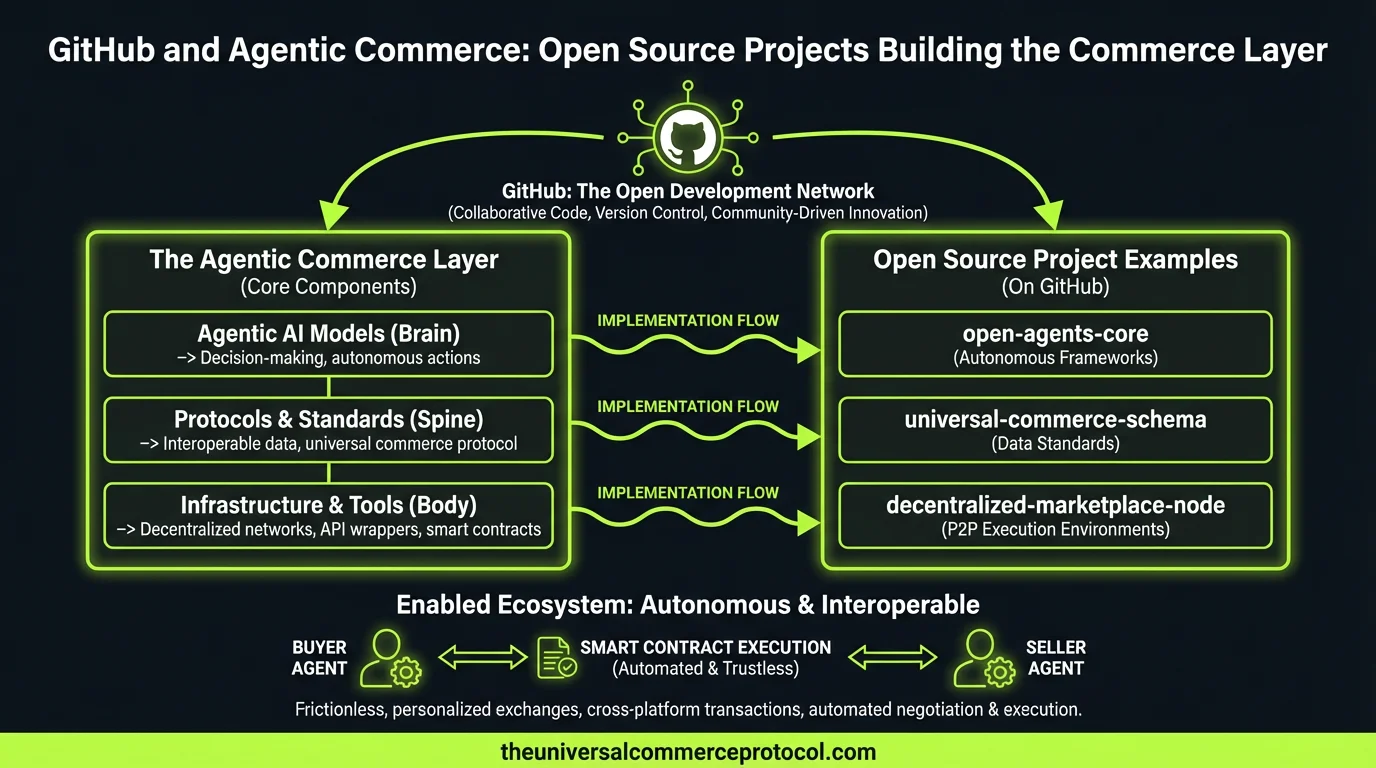
The GitHub Foundation of Agentic Commerce
Agentic commerce—where autonomous agents negotiate, transact, and settle payments without human intervention—is fundamentally a developer problem. The infrastructure, protocols, and frameworks enabling these interactions are being built in public on GitHub, where thousands of developers collaborate on the agent payment protocol specifications, SDKs, and reference implementations that will power the next generation of commerce.
The Universal Commerce Protocol (UCP) itself exists within this open source ecosystem, representing a consensus-driven approach to standardizing how agents communicate commercial intent. But UCP is just one piece of a larger puzzle being assembled across repositories, organizations, and communities on GitHub.
Related articles: UCP Shipping Carrier Selection & Rate Optimization • UCP Security Best Practices for AI-Driven Commerce
Core Agent Payment Protocol Projects
Universal Commerce Protocol (UCP) Repository
The UCP GitHub organization maintains the canonical specifications for agent-to-agent commerce interactions. The protocol defines how autonomous agents express offers, negotiate terms, and commit to transactions using a standardized message format. Developers contributing to the UCP repository work on:
- Protocol specification versioning and RFC processes
- JSON schema definitions for commerce messages
- Cryptographic signing and verification standards
- Settlement and payment finality mechanisms
- Error handling and dispute resolution frameworks
The UCP maintains multiple language implementations including TypeScript, Python, and Go, allowing developers across ecosystems to integrate agent payment capabilities into their applications. The repository’s issue tracker reflects active discussions about payment routing, multi-currency settlement, and agent identity verification.
OpenPayments and Payment Interoperability
OpenPayments, maintained as an open standard, addresses the payment layer beneath agent commerce. While not exclusively focused on agents, projects implementing OpenPayments on GitHub provide the settlement infrastructure that agentic transactions require. The protocol enables payments between accounts at different financial institutions without traditional intermediaries.
Developers building on OpenPayments create ILPV4 (Interledger Protocol version 4) connectors that allow agents to route payments across heterogeneous ledgers. GitHub projects in this space include Interledger.rs, Rafiki, and various connector implementations that handle the actual movement of value between agent wallets.
Agent Frameworks and Middleware
Anthropic’s Agents Framework
Anthropic maintains open source tooling on GitHub for building agentic systems, including libraries that integrate commerce capabilities. Their agent frameworks provide developers with patterns for tool use, action planning, and state management—all essential for agents that need to execute commercial transactions. The framework’s tool-calling interface allows agents to invoke payment APIs, query inventory systems, and confirm settlements.
LangChain Commerce Integrations
LangChain’s GitHub repositories include extensive commerce-related integrations and agent tooling. The project provides abstractions for building multi-step agent workflows that can interact with payment systems, inventory databases, and fulfillment APIs. LangChain’s tool framework makes it straightforward for developers to create agents that can call payment protocols, query pricing, and execute transactions as part of larger agentic workflows.
The LangChain community has developed specific commerce agents that use the UCP specification for peer-to-peer transactions, demonstrating how language model agents can negotiate prices and settle payments autonomously.
AutoGPT and Agent Orchestration
AutoGPT’s GitHub repository pioneered patterns for autonomous agent orchestration that influenced how developers think about commerce agents. While AutoGPT itself is a general-purpose agent framework, the patterns it established—memory management, goal decomposition, tool use—directly apply to agents that need to execute commercial workflows. Forks and derivatives of AutoGPT specifically focused on commerce have emerged, adding payment execution and transaction confirmation steps to the agent loop.
Payment Protocol Implementations
Stripe Agent Payment SDK
Stripe’s GitHub organization includes SDKs and reference implementations for agent-initiated payments. The Stripe Agent Payment API allows autonomous systems to create charges, manage subscriptions, and handle refunds through machine-readable interfaces. Developers use these SDKs to integrate Stripe’s payment processing into agent commerce workflows, enabling agents to charge customers or receive payments from other agents.
Circle’s USDC and Stablecoin Infrastructure
Circle maintains GitHub repositories for USDC (USD Coin) integration, including smart contract implementations and SDKs for blockchain-based payments. For agents operating in decentralized commerce scenarios, USDC on Ethereum, Polygon, and other chains provides a settlement layer. Developers building agent commerce systems on blockchain use Circle’s libraries to manage stablecoin transfers as part of transaction settlement.
The Circle GitHub organization includes tools for agent wallet management, transaction verification, and on-chain payment confirmation—critical components for agents that settle transactions on public blockchains.
Stripe Payments and Razorpay Agent APIs
Both Stripe and Razorpay have published agent-compatible payment APIs on their developer documentation and GitHub repositories. These APIs use RESTful and webhook-based patterns that agents can easily invoke. Developers create agent payment integrations by:
- Implementing payment API clients in agent frameworks
- Adding payment confirmation steps to agent decision trees
- Creating settlement verification tools that agents can query
- Building refund and dispute handling logic into agent workflows
Identity and Authentication in Agent Commerce
DID and Verifiable Credentials
The W3C’s Decentralized Identifiers (DIDs) specification has multiple GitHub implementations supporting agent identity. Projects like Veramo, Hyperledger Indy, and Sovrin Foundation maintain open source tools for creating and verifying agent identities. For agentic commerce, DIDs enable:
- Agent-to-agent authentication without central authorities
- Verifiable claims about agent capabilities and trustworthiness
- Cryptographic proof of payment authorization
- Audit trails for regulatory compliance
Developers integrate DID libraries into agent payment protocols to ensure that only authorized agents can execute transactions and that all commercial interactions are cryptographically verifiable.
OAuth 2.0 and Agent Delegation
The IETF’s OAuth 2.0 specification, with implementations across GitHub, provides a framework for agents to obtain delegated authorization to access payment systems. The OAuth Device Authorization Grant flow, in particular, enables scenarios where an agent receives authorization from a human user to execute payments on their behalf. GitHub projects implementing OAuth for agent commerce include reference servers and client libraries that handle the authorization flow.
Developer Tooling and SDKs
TypeScript/Node.js Agent Commerce Stack
The Node.js ecosystem on GitHub includes comprehensive tooling for building agent commerce systems. Projects like:
- agent-commerce-sdk — Provides TypeScript bindings for UCP, payment APIs, and settlement protocols
- agentic-payment-router — Handles payment routing logic for agents across multiple ledgers
- agent-wallet-manager — Manages agent accounts, balances, and transaction history
These projects abstract away protocol complexity, allowing developers to focus on agent logic rather than payment infrastructure details.
Python Agent Commerce Libraries
Python developers building agentic commerce systems use libraries like:
- ucp-python — Official UCP implementation in Python
- agent-payment-client — Async payment client for agent workflows
- agentic-settlement — Handles payment finality and settlement confirmation
These libraries integrate with popular Python agent frameworks like LangChain and Anthropic’s SDK, enabling Python developers to add commerce capabilities to their agents.
Go Implementation for High-Performance Agents
For performance-critical agent commerce systems, Go implementations on GitHub provide low-latency payment processing. Projects include UCP Go bindings, payment protocol implementations, and high-throughput settlement systems. Financial institutions and high-frequency trading platforms use Go-based agent commerce systems built on these GitHub projects.
Testing and Simulation Frameworks
Agent Commerce Testbeds
GitHub hosts simulation frameworks for testing agentic commerce systems before production deployment. Projects like:
- agent-commerce-simulator — Simulates multi-agent market scenarios with payment settlement
- payment-protocol-testbed — Tests agent payment protocol implementations against specification
- chaos-commerce-engineering — Injects failures into payment systems to test agent resilience
Developers use these tools to validate that their agents handle payment failures, race conditions, and settlement delays correctly before real transactions occur.
Community and Governance
Open Source Governance Models
Major agent commerce projects on GitHub follow different governance models. The UCP uses an RFC (Request for Comments) process similar to the IETF, where protocol changes undergo community review. Other projects use Apache 2.0, MIT, or GPL licenses, each with different implications for commercial use.
Developers contributing to agent commerce projects participate in governance discussions about protocol evolution, backward compatibility, and security standards. GitHub’s discussion forums and pull request processes make these decisions transparent and inclusive.
Enterprise Adoption and Forks
Large enterprises building proprietary agent commerce systems often fork open source projects from GitHub, adding internal customizations for payment processing, compliance, and settlement. These forks remain connected to upstream repositories through pull requests that contribute security fixes and protocol improvements back to the community.
Security and Compliance Considerations
Agent commerce projects on GitHub must address security challenges unique to autonomous payments:
- Payment Authorization — Ensuring agents only execute authorized transactions
- Cryptographic Verification — Signing and verifying all commercial messages
- Rate Limiting — Preventing agents from executing runaway payment loops
- Settlement Finality — Confirming payments cannot be reversed after agent commitment
- Audit Logging — Recording all agent transactions for regulatory compliance
GitHub projects addressing these concerns include security audit reports, threat modeling documentation, and formal verification proofs for critical payment logic.
The Future of Agent Commerce on GitHub
The GitHub ecosystem for agentic commerce continues evolving. Emerging projects focus on:
- Multi-agent payment coordination and atomic settlement
- Machine learning for agent fraud detection
- Privacy-preserving payment protocols for sensitive commerce
- Real-time settlement using blockchain and layer-2 solutions
- Cross-border payment routing for global agent commerce
Developers interested in agentic commerce should explore these GitHub projects, contribute to protocol discussions, and build on existing frameworks to accelerate the adoption of autonomous commerce systems.
FAQ
What is the agent payment protocol, and where can I find it on GitHub?
The agent payment protocol refers to standardized specifications like the Universal Commerce Protocol (UCP) that define how autonomous agents communicate commercial intent and execute transactions. The canonical UCP specification and reference implementations are maintained on GitHub under the Universal Commerce Protocol organization. Developers can find language-specific implementations in TypeScript, Python, and Go repositories.
Which open source projects should developers use to build agent commerce systems?
Developers should start with the UCP specification for protocol compliance, then choose a base agent framework (LangChain, Anthropic’s agents, or AutoGPT derivatives) and integrate payment SDKs from providers like Stripe or Circle. Language-specific agent commerce libraries on GitHub abstract these components, allowing developers to focus on business logic rather than protocol implementation.
How do agents authenticate and authorize payments in open source commerce systems?
Authentication uses cryptographic signing of payment messages, with identity verified through DIDs (Decentralized Identifiers) or OAuth 2.0 delegation. GitHub projects implementing these standards provide libraries for agent identity management and payment authorization. Developers integrate these libraries to ensure only authorized agents can execute transactions.
What security considerations should developers address when implementing agent payment systems from GitHub projects?
Developers must implement payment authorization controls, cryptographic verification of all messages, rate limiting to prevent runaway transactions, settlement finality confirmation, and comprehensive audit logging. GitHub projects addressing agent commerce include security documentation and reference implementations demonstrating these controls. Security audits and formal verification of critical payment logic are essential before production deployment.
Leave a Reply