Understanding Google Agent Protocol in Modern Commerce
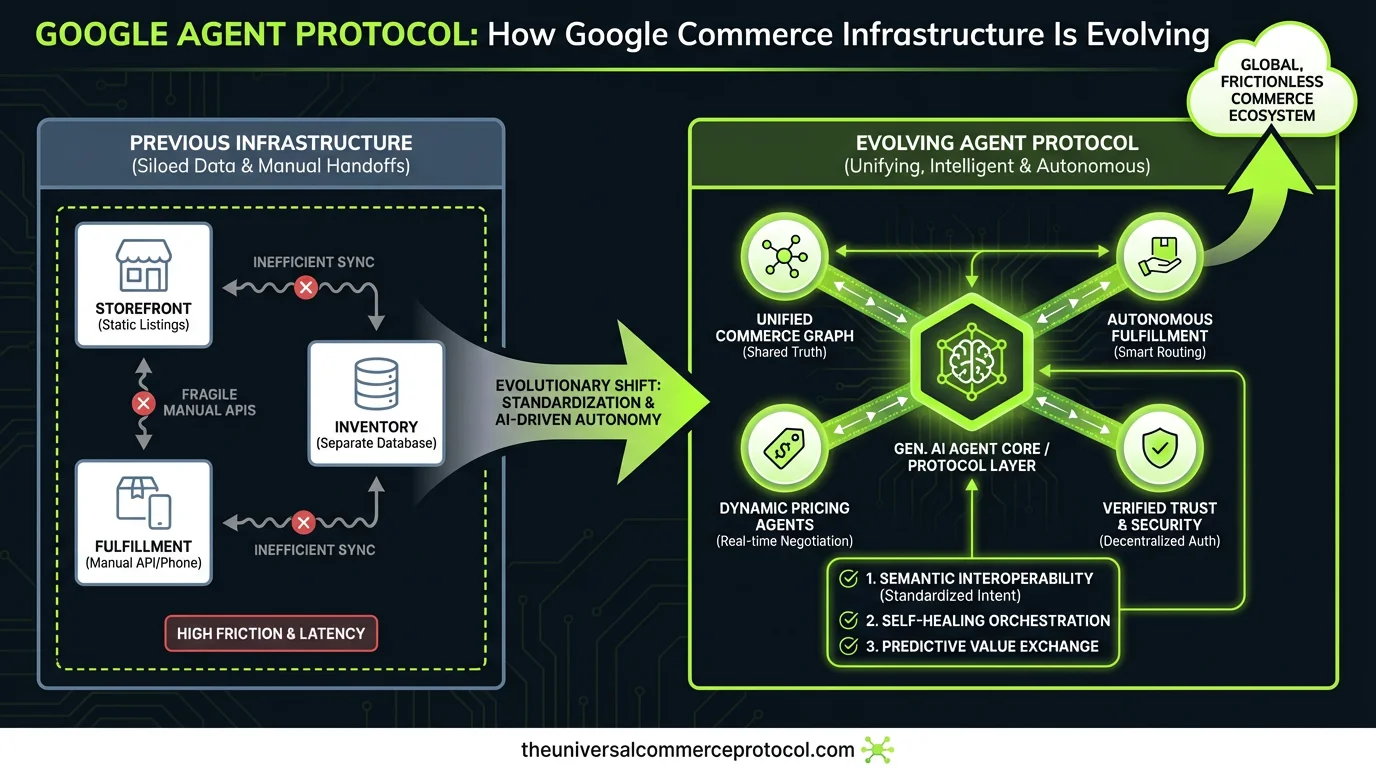
Google’s approach to agent infrastructure represents a fundamental shift in how commerce transactions are orchestrated at scale. Unlike traditional point-to-point integrations, Google’s agent protocol framework enables autonomous systems to discover, negotiate, and execute commerce operations with minimal human intervention. This evolution directly addresses the core principles of the Universal Commerce Protocol (UCP), which standardizes communication between commerce agents across distributed networks.
The Google Agent Protocol builds on decades of infrastructure investment from Alphabet subsidiaries, including Google Cloud, Waymo, and DeepMind. These systems collectively contribute to a commerce backbone that processes billions of transactions daily while maintaining interoperability with external systems. The protocol’s technical foundation rests on several key pillars: agent discovery, capability negotiation, transaction execution, and settlement verification.
Technical Architecture of Google’s Agent Infrastructure
Agent Discovery and Registration
Google’s agent discovery mechanism operates through a distributed registry system that extends across Google Cloud infrastructure. When a commerce agent registers with the protocol, it publishes its capabilities, supported payment methods, inventory access patterns, and service level agreements (SLAs). This registration process mirrors DNS propagation models but with real-time capability updates.
The discovery layer uses gRPC protocols combined with Google’s Protocol Buffers for efficient serialization. This technical choice enables sub-millisecond agent lookup times, critical for high-frequency commerce operations. Agents can dynamically advertise new capabilities or deprecate existing ones without requiring system-wide reconfiguration.
Capability Negotiation Framework
Before executing any commerce transaction, Google agents engage in a capability negotiation phase. This involves exchanging structured metadata about supported operations, authentication methods, rate limits, and data requirements. The negotiation uses a modified version of OAuth 2.0 combined with mutual TLS (mTLS) for agent-to-agent authentication.
Real companies like Shopify, BigCommerce, and WooCommerce are already integrating with Google’s capability negotiation framework through Google Cloud Commerce APIs. These platforms expose their catalog management, order processing, and fulfillment capabilities in standardized formats that Google agents can parse and validate before initiating transactions.
Transaction Execution Pipeline
The execution pipeline represents the operational core of Google’s agent protocol. When an agent receives a commerce request—whether it’s a product search, price quote, or order placement—it must execute this request against remote systems while maintaining atomicity and idempotency. Google implements this through a distributed transaction coordinator that uses Paxos consensus algorithms, ensuring all agents maintain consistent state views.
Google’s Spanner database technology underpins this layer, providing globally distributed transactions with strong consistency guarantees. This is particularly important for high-value commerce operations where partial failures could result in inventory mismatches or duplicate orders.
Integration with Universal Commerce Protocol Standards
The Universal Commerce Protocol establishes baseline standards for agent interoperability that Google’s infrastructure actively implements. UCP defines common message formats, authentication requirements, and error handling protocols that enable agents from different vendors to communicate seamlessly.
Google’s agent protocol extends UCP by adding performance optimizations and advanced features:
- Batch Operations: Multiple commerce requests can be grouped and executed atomically, reducing round-trip latency
- Predictive Capability Caching: Agents pre-cache capability information from frequently-contacted partners, reducing discovery overhead
- Circuit Breaker Patterns: Automatic failover to alternative agents when primary endpoints become unavailable
- Observability Instrumentation: Built-in tracing through Google Cloud Trace integration for debugging distributed commerce flows
Payment Processing and Settlement
Google Pay integration forms a critical component of the agent protocol’s payment layer. When agents execute transactions, they can leverage Google Pay’s tokenization infrastructure, which stores payment credentials securely and abstracts away PCI compliance concerns from individual agents.
The settlement process uses Google Cloud Payment Hub, which aggregates transactions across multiple agents and merchants. This system reconciles payments from various processors including Stripe, Square, and traditional acquirers like Fiserv and Jack Henry. Agents receive settlement confirmations through webhook callbacks that comply with UCP message standards.
Fraud Detection and Risk Management
Google’s agent protocol incorporates machine learning models trained on Alphabet’s vast transaction dataset. These models evaluate transaction risk in real-time, flagging suspicious patterns without requiring human review. Agents can query the fraud detection service before committing to transactions, reducing chargebacks and unauthorized activity.
Real-World Implementation Patterns
Marketplace Aggregation
Companies like Instacart and DoorDash utilize Google’s agent infrastructure to coordinate across thousands of merchant partners. Their agents query inventory from individual retailers, negotiate pricing and availability, and execute orders through the protocol. This eliminates the need for custom integrations with each merchant.
Price Intelligence Networks
Retailers including Target and Walmart deploy agents that continuously monitor competitor pricing through Google’s protocol. These agents execute comparative shopping queries against hundreds of other agents, aggregating pricing data for dynamic repricing algorithms. The protocol’s efficiency enables this monitoring at scale without overwhelming partner systems.Supply Chain Coordination
Logistics providers like J.B. Hunt and Schneider National use Google agents to optimize shipment routing. These agents negotiate capacity with carrier agents, execute booking transactions, and track fulfillment status through standardized protocol messages. The real-time nature of the protocol enables dynamic rerouting when disruptions occur.
Security Architecture and Compliance
Google’s agent protocol implements defense-in-depth security principles aligned with PCI DSS, SOC 2, and GDPR requirements. All inter-agent communication uses TLS 1.3 encryption with perfect forward secrecy. Authentication relies on OAuth 2.0 with PKCE (Proof Key for Code Exchange) for public clients and mutual TLS for service-to-service communication.
Data residency requirements are handled through Google Cloud’s multi-region deployment capabilities. Agents can be configured to keep sensitive data within specific geographic boundaries, critical for European and Asian commerce operations subject to data localization regulations.
Performance Optimization and Scalability
Google’s agent protocol achieves sub-second latency for typical commerce operations through several optimization techniques:
- Edge Computing: Agent endpoints are deployed on Google Cloud’s edge network, bringing computation closer to users and merchants
- Caching Layers: Frequently-accessed data (product catalogs, pricing) is cached at multiple levels using Redis and Memcached
- Load Balancing: Google Cloud Load Balancing distributes agent requests across multiple backend instances using sophisticated routing algorithms
- Database Optimization: Query patterns are analyzed and optimized continuously using Google Cloud’s Query Insights
Future Evolution and Roadmap
Google’s agent protocol roadmap includes several significant enhancements. Confidential Computing capabilities will enable agents to process transactions within encrypted enclaves, preventing even Google infrastructure operators from viewing transaction details. This addresses growing privacy concerns in regulated markets.
Artificial Intelligence integration will enable agents to autonomously handle complex negotiation scenarios. Rather than executing pre-defined workflows, agents will use large language models to interpret merchant requirements and adapt transaction parameters in real-time. This capability is already being tested with select enterprise partners.
Blockchain integration is also under development, enabling immutable transaction logging and enabling direct settlement between agents without intermediaries. This would reduce settlement time from days to minutes while improving transparency.
Challenges and Considerations
Despite its technical sophistication, Google’s agent protocol faces adoption challenges. Smaller merchants lack infrastructure to deploy agents, creating a two-tier commerce ecosystem. Google is addressing this through managed agent services that abstract away technical complexity.
Regulatory scrutiny around market concentration presents another challenge. As Google’s agent infrastructure becomes more central to commerce operations, antitrust concerns may limit its capabilities or require data access restrictions. The company is working with regulators to establish guardrails that maintain competition while enabling innovation.
Conclusion
Google’s agent protocol represents a significant evolution in commerce infrastructure, bringing autonomous, standards-based transaction execution to the mainstream. By aligning with Universal Commerce Protocol principles while adding performance optimizations and advanced features, Google has created a platform that scales from small retailers to global enterprises. The protocol’s technical depth—spanning distributed transactions, real-time fraud detection, and multi-region deployment—demonstrates Google’s commitment to building commerce infrastructure for the AI era.
FAQ
How does Google Agent Protocol differ from traditional API integrations?
Google Agent Protocol enables autonomous, real-time negotiation between systems without human intervention. Traditional APIs require explicit request-response cycles for each operation. Agents can discover capabilities dynamically, handle partial failures gracefully, and execute complex multi-step transactions atomically. This fundamentally changes how commerce systems interact at scale.
Is Google Agent Protocol compatible with the Universal Commerce Protocol?
Yes, Google Agent Protocol implements UCP standards as baseline requirements while adding Google-specific optimizations. Systems built on UCP can interoperate with Google agents, though they won’t access all performance enhancements. This ensures backward compatibility while encouraging adoption of advanced features.
What payment methods does Google Agent Protocol support?
The protocol supports all major payment methods including credit/debit cards (through Google Pay tokenization), digital wallets, bank transfers, and cryptocurrency payments. Agents negotiate payment method support during capability negotiation, enabling merchants to accept only their preferred methods.
How does Google ensure data security when agents communicate across networks?
Google implements end-to-end encryption using TLS 1.3, mutual TLS authentication for service-to-service communication, and OAuth 2.0 for delegated access. Sensitive data is encrypted at rest using Google Cloud’s customer-managed encryption keys. All communication is logged and monitored for suspicious patterns using machine learning models.
Leave a Reply