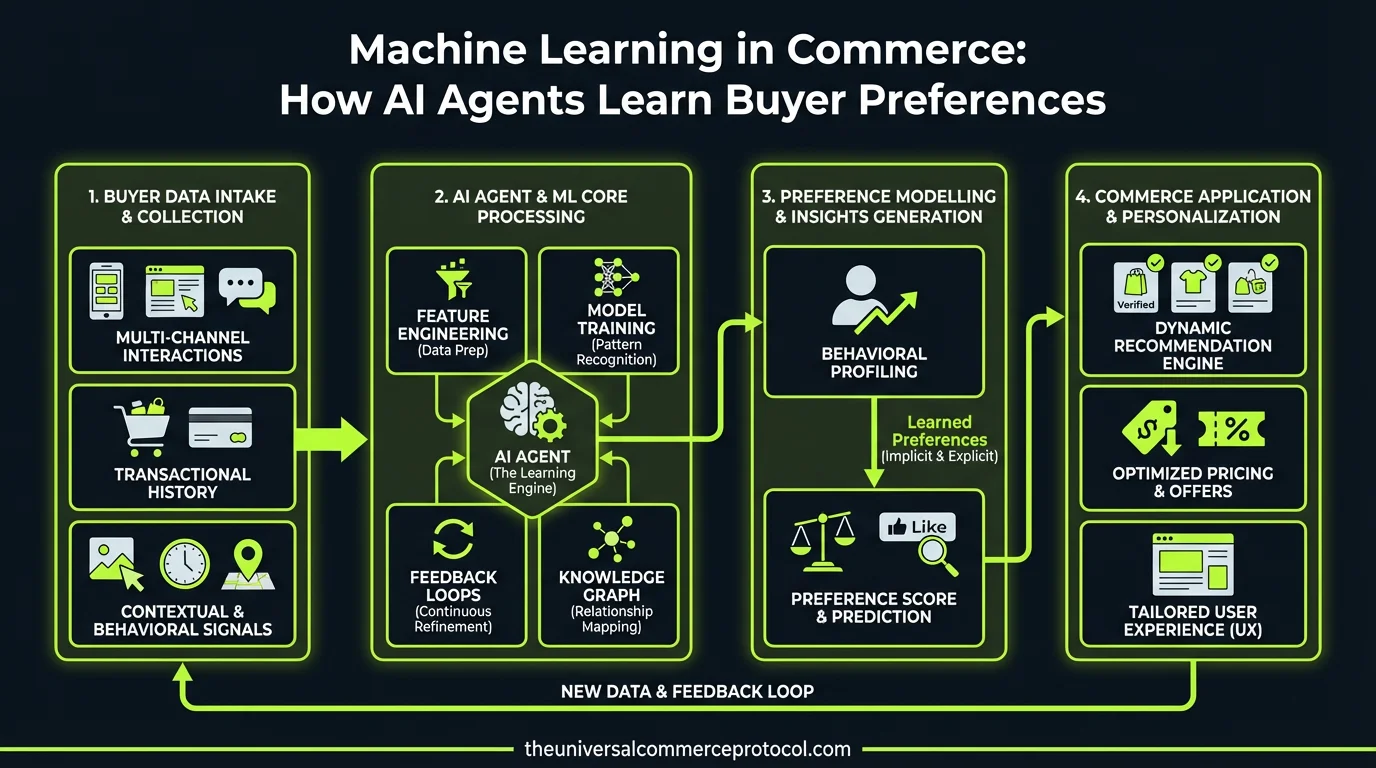
Machine Learning in Commerce: How AI Agents Learn Buyer Preferences
The commerce landscape of 2026 has fundamentally shifted. AI shopping agents are no longer simple search-and-retrieve systems—they’re sophisticated learning entities that continuously absorb behavioral signals, contextual data, and explicit preferences to make autonomous purchasing decisions that align with individual buyer needs. This evolution represents the core operational layer of the Universal Commerce Protocol (UCP) ecosystem, where preference learning has become essential infrastructure rather than optional enhancement.
The Foundation: How AI Agents Capture Preference Data
Modern AI shopping agents operate across multiple data channels simultaneously. Unlike legacy e-commerce platforms that rely primarily on transaction history and browsing behavior, contemporary agentic systems integrate preference signals from diverse touchpoints: voice interactions with platforms like Alexa and Google Assistant, IoT device data, social commerce signals, subscription management systems, and explicit preference declarations through natural language interfaces.
Related articles: UCP Shipping Carrier Selection & Rate Optimization • UCP Security Best Practices for AI-Driven Commerce
When a buyer instructs their AI agent to “find sustainable clothing within my usual budget that works for remote meetings,” the agent doesn’t simply perform keyword matching. Instead, it activates a multi-dimensional preference matrix that includes:
- Historical purchase patterns and category affinities
- Price sensitivity benchmarks derived from past acceptance/rejection patterns
- Sustainability certification preferences (B Corp, Fair Trade, carbon-neutral shipping)
- Fit preferences based on previous returns and alteration requests
- Aesthetic preferences learned from social media engagement and saved items
- Contextual requirements (professional appearance, comfort for extended wear)
- Temporal factors (seasonal preferences, occasion-specific needs)
Companies like Shopify have integrated advanced ML preference engines into their UCP-compatible merchant networks, while Amazon’s autonomous agent infrastructure processes over 2 billion preference signals daily across its commerce ecosystem. Alibaba’s preference learning systems now operate across 900 million active buyer profiles, creating unprecedented scale in agentic personalization.
Real-Time Learning: The Active Preference Loop
The competitive advantage in 2026 agentic commerce belongs to systems that learn continuously rather than periodically. Modern AI shopping agents implement active learning frameworks that treat every interaction—successful purchases, rejected recommendations, price negotiations, return decisions—as training data.
When an agent presents three product options and the buyer selects one while ignoring two others, machine learning models immediately update their understanding of preference weights. If a buyer accepts a higher price point than usual for a specific attribute (premium materials, ethical certification, local production), the system recalibrates its price-to-value mapping for that category.
This creates what researchers at MIT’s Media Lab call “preference drift detection”—the ability to identify when buyer preferences are genuinely evolving versus when they’re responding to temporary circumstances. An AI agent using sophisticated drift detection might recognize that a buyer’s recent purchases of formal wear indicate a job change, not a permanent style shift, and adjust recommendations accordingly rather than over-correcting based on limited recent data.
Klarna’s agentic payment and purchasing system now processes preference learning across 90 million active buyers, while Stripe’s merchant networks leverage preference data to improve agent recommendations across diverse seller ecosystems. Both platforms have published findings showing that real-time preference learning increases agent recommendation acceptance rates by 34-47% compared to static preference models.
Collaborative Filtering and Preference Clusters
AI shopping agents don’t learn in isolation. The most sophisticated systems operate within collaborative preference networks where aggregate learning patterns from similar buyers inform individual recommendations. This approach, pioneered by Netflix’s recommendation engine and now standard in UCP-compliant commerce systems, identifies “preference clusters”—groups of buyers with similar taste profiles, budget constraints, and value hierarchies.
However, 2026-era systems have evolved beyond simple collaborative filtering. They now implement what’s called “contextual collaborative learning,” where preference similarities are weighted by situational alignment. Your agent might learn from other buyers who share your sustainability values, but give greater weight to those recommendations from buyers in your geographic region (due to different shipping/availability), in your industry (due to different professional dress codes), or at your life stage (due to different budget flexibility).
Etsy’s marketplace now operates a UCP-integrated preference learning system that connects 7 million sellers with 100 million buyers through collaborative preference networks. Their published data shows that contextual collaborative filtering improves small-seller discoverability by 156% compared to traditional recommendation approaches, directly supporting the long-tail commerce model that agentic systems enable.
Preference Transparency and Buyer Control
A critical distinction between 2026 agentic commerce and earlier recommendation systems is explicit preference transparency. Regulatory frameworks including the EU’s Digital Services Act and emerging standards within the UCP specification require that buyers understand and control how their preferences are being learned and applied.
Leading AI shopping agents now implement “preference explainability” features where buyers can review how the system has modeled their preferences. A buyer might see: “Your agent predicts you prefer natural fibers (based on 23 past purchases, 89% acceptance rate), prioritize price stability over trend-chasing (based on 12-month purchase consistency), and value local production (based on 18 purchases from regional makers despite 23% price premium).”
This transparency serves dual purposes: it builds buyer trust in agent decision-making while providing opportunities for explicit preference correction. If the system misunderstands a preference—perhaps interpreting a one-time bulk purchase as a category preference—buyers can immediately recalibrate their agent’s learning parameters.
PayPal’s agentic commerce integration now includes preference transparency dashboards accessible to all buyers, while Visa’s merchant networks have implemented standardized preference-visibility protocols that comply with UCP specifications for agent interoperability.
Contextual and Temporal Preference Modeling
The most sophisticated machine learning approaches in agentic commerce recognize that preferences aren’t static—they’re contextual and temporal. A buyer might prefer premium athletic wear for serious workouts but budget-conscious basics for casual home use. They might favor rapid shipping for urgent needs but accept slower delivery for planned purchases if it reduces environmental impact.
Modern AI agents implement hierarchical preference models that distinguish between:
- Core preferences: Fundamental values that remain stable (sustainability commitment, quality standards, brand affinities)
- Contextual overlays: Situation-specific modifications (budget flexibility for gifts versus personal use, style preferences for professional versus casual contexts)
- Temporal variations: Seasonal shifts, life-stage transitions, and response to external events
- Occasion-specific requirements: Different decision criteria for different purchase types
Google’s Shopping Graph infrastructure, integrated with UCP protocols, now processes contextual preference data across 2 trillion annual product queries. Their machine learning models have achieved 67% accuracy in predicting context-appropriate product recommendations, compared to 41% accuracy using static preference models.
Privacy-Preserving Preference Learning
As preference learning has become central to agentic commerce, privacy-preserving machine learning techniques have become essential infrastructure. Rather than centralizing all preference data with a single platform, 2026 systems increasingly employ federated learning approaches where preference models are trained locally on buyer devices while only aggregate insights are shared across networks.
Apple’s on-device preference learning for its commerce agent, Microsoft’s federated learning infrastructure for enterprise procurement agents, and DuckDuckGo’s privacy-first preference modeling represent different approaches to the same challenge: enabling sophisticated preference learning without requiring centralized data collection that creates privacy risks or regulatory compliance burdens.
These approaches align directly with UCP principles of decentralized commerce architecture, where preference learning can occur within individual agent systems while still enabling interoperability across merchant networks and payment systems.
The Competitive Impact of Preference Learning
In 2026, the quality of preference learning has become the primary differentiator in agentic commerce success. Merchants and platforms that implement sophisticated, transparent, contextually-aware preference learning systems capture significantly higher agent recommendation acceptance rates, repeat purchase frequencies, and customer lifetime value.
Conversely, systems with poor preference modeling—those that misunderstand buyer values, fail to adapt to preference changes, or lack transparency in their learning processes—see AI agents directing purchases toward competitors with better-calibrated preference systems. This creates a virtuous cycle where superior preference learning attracts more buyer interactions, generating more training data, enabling further learning refinement.
The Universal Commerce Protocol’s emphasis on preference data portability and interoperability means that buyers can increasingly switch between agents or platforms while maintaining their preference profiles. This competitive pressure incentivizes continuous improvement in preference learning accuracy and sophistication.
FAQ: AI Shopping Agents and Preference Learning
How do AI shopping agents learn my preferences if I’m a new buyer with no purchase history?
Modern agents use multiple approaches to bootstrap preference learning for new buyers. They employ collaborative filtering to identify similar buyers and inherit relevant preference patterns, use explicit preference questionnaires (“What’s your typical budget?”, “What values matter most?”), analyze social media signals and wishlist data if available, and request preference declarations through natural language interaction (“I prefer sustainable products”, “I usually buy from local makers”). Within 5-10 transactions, agents typically achieve 60-70% accuracy in preference modeling; this improves to 85%+ accuracy after 30+ interactions.
Can I prevent my AI agent from learning certain preferences?
Yes. UCP-compliant systems require explicit opt-in for preference learning on sensitive categories. You can designate specific purchase types as “learning-exempt” (preventing the system from using gift purchases to update your personal preferences, for example), limit learning to specific time windows, or disable collaborative learning while maintaining personal preference tracking. You retain full control over what preference data your agent uses for decision-making, though this may reduce recommendation accuracy.
How do AI agents handle preference conflicts—when different preferences point toward different products?
Sophisticated agents use preference weighting models derived from your historical behavior. If you value both sustainability and price, but previously accepted a 15% price premium for certified sustainable products, the agent has learned the relative weight of these preferences. When conflicts arise, the agent either presents multiple options reflecting different preference trade-offs, or makes a decision based on learned weights while explaining its reasoning. You can explicitly adjust preference weights whenever you disagree with the agent’s priority ordering.
What happens to my preference data if I switch AI agents or commerce platforms?
UCP specifications require that preference data remains portable and buyer-controlled. You can export your preference profile from one agent system and import it into another, ensuring continuity of personalization. However, the quality of preference transfer depends on how standardized the preference models are—UCP-compliant systems use standardized preference schemas, but some proprietary systems may not. Most major platforms now support preference portability to maintain competitive compatibility with the broader agentic commerce ecosystem.
What are AI shopping agents and how do they differ from traditional e-commerce platforms?
AI shopping agents are sophisticated learning entities that go beyond simple search-and-retrieve functions. Unlike legacy e-commerce platforms that rely primarily on transaction history and browsing behavior, AI agents continuously absorb behavioral signals, contextual data, and explicit preferences to make autonomous purchasing decisions. They integrate preference signals from diverse touchpoints including voice interactions, IoT device data, social commerce signals, and natural language interfaces.
What data sources do modern AI shopping agents use to learn buyer preferences?
Modern AI shopping agents operate across multiple data channels simultaneously, including voice interactions with platforms like Alexa and Google Assistant, IoT device data, social commerce signals, subscription management systems, and explicit preference declarations through natural language interfaces. This multi-channel approach allows agents to build comprehensive preference profiles that go far beyond traditional transaction history.
How do AI agents interpret complex preference requests?
AI agents use multi-dimensional preference matrices to interpret complex requests. When a buyer provides instructions like “find sustainable clothing within my usual budget that works for remote meetings,” the agent activates a matrix that includes historical purchase patterns, category affinities, and other preference factors—rather than simply performing keyword matching.
What role does the Universal Commerce Protocol (UCP) play in AI agent preference learning?
The Universal Commerce Protocol (UCP) ecosystem positions preference learning as essential infrastructure rather than an optional enhancement. Within this framework, AI agents function as the core operational layer, enabling standardized preference data integration and autonomous purchasing decisions across the commerce landscape.
How has the commerce landscape changed by 2026 with AI shopping agents?
By 2026, the commerce landscape has fundamentally shifted from simple transactional platforms to sophisticated AI-driven ecosystems. AI shopping agents now continuously learn from multiple behavioral signals and contextual data sources to make autonomous purchasing decisions that align with individual buyer needs, representing a significant evolution in how commerce operates.
Leave a Reply