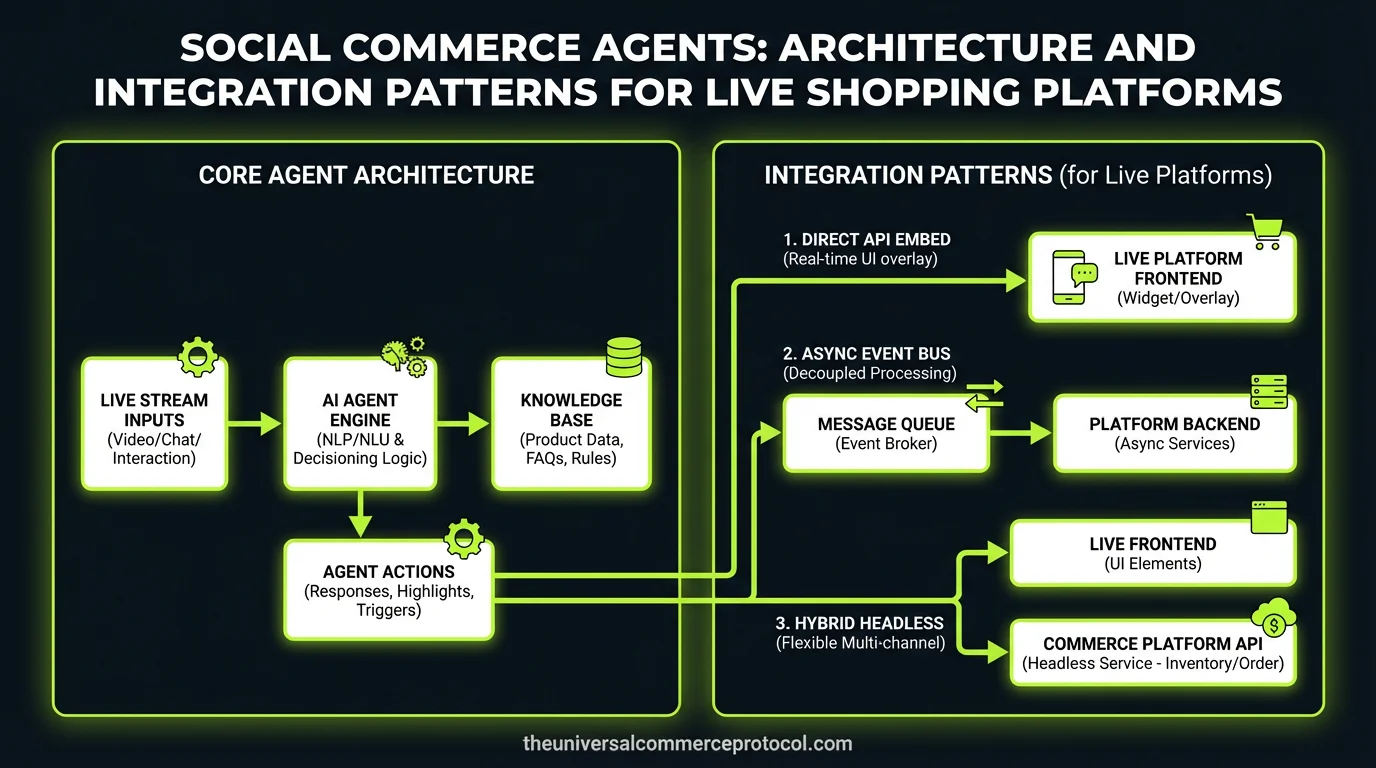
Live shopping has crossed $20 billion in annual GMV across Asia and North America, yet merchant adoption remains fragmented. TikTok Shop, Instagram Shopping, and YouTube Shopping each operate with proprietary checkout flows, inventory APIs, and recommendation systems. Agentic commerce agents can orchestrate these platforms through unified UCP patterns, but the architecture differs fundamentally from marketplace and fulfillment agents.
This guide covers the technical and operational patterns that enable agents to operate within social platform constraints, real-time viewer engagement windows, and split-second purchase decisions.
Why Social Commerce Agents Are Different
Live shopping agents face three distinct challenges not present in search-driven or conversational commerce:
1. Time-Windowed Buyer Intent
A live stream lasts 60–180 minutes. Viewer engagement peaks at specific moments (product reveal, flash discount, influencer commentary). An agent must recognize these windows and recommend products with millisecond precision, not wait for multi-turn conversation.
2. Many-to-One Communication Model
Unlike ChatGPT checkout or voice commerce (one-to-one), live shopping agents serve hundreds or thousands of simultaneous viewers. An agent recommendation to one viewer affects inventory visibility for all others. Agents must model purchase velocity, stock depletion, and contention.
3. Platform-Specific Checkout Gates
TikTok Shop redirects to TikTok’s native payment rails. Instagram Shopping uses Facebook Payments. YouTube Shopping integrates Google Pay. An agent cannot assume a unified UCP endpoint; it must translate its decision into platform-native API calls and handle partial failures (e.g., payment authorized on TikTok but inventory unavailable).
Social Commerce Agent State Machine
A live shopping agent maintains five core states:
Observation State (Real-Time Stream Input)
The agent ingests: current product being shown, viewer count, comment sentiment (buy signals: “want,” “add to cart,” questions about size/color), inventory level, historical conversion rate for this product on this channel, influencer engagement metrics. Data arrives in 500ms to 2-second intervals as the live stream progresses.
Segmentation State (Viewer Clustering)
The agent clusters viewers into cohorts: (a) high-intent buyers (commented, added to wishlist, purchased before), (b) price-sensitive (asking about discounts, mentioning competitors), (c) curious (viewing but not interacting), (d) return customers (history available via social login). Each cohort receives a different recommendation strategy.
Recommendation State (Product-Viewer Matching)
For a high-intent buyer viewing a dress, the agent retrieves: size availability, color variants, price elasticity (how many units sold at current price vs. 10% discount), similar products in inventory, bundle opportunities. It scores options using a multi-armed bandit model trained on this influencer’s audience (different audiences respond to bundles vs. single-item sales).
Proposal State (Native Platform Encoding)
The agent must translate its recommendation into the social platform’s affordance. On TikTok Shop, this is a clickable product card with a “Buy Now” button. On Instagram, it’s a product tag with a checkout link. On YouTube, it’s a shopping shelf annotation. The agent encodes product ID, variant selection (color, size), promotional code if applicable, and estimated delivery window.
Transaction State (Payment and Inventory Lock)
When a viewer clicks, the agent must: (1) lock inventory (reserve the item for 2–5 minutes while payment processes), (2) route payment to the correct platform processor, (3) capture the sale in real-time dashboards (for influencer commission and inventory tracking), (4) handle failure (payment declined, inventory sold out to another viewer in the same second).
Real-Time Inventory Contention
Two viewers from the same live stream buy the last size M dress simultaneously. Both clicks arrive within 100ms. Platform A (TikTok) processes the first click; Platform B (Instagram, if the influencer is multi-streaming) processes the second. Inventory is oversold.
Solution: Agents must implement optimistic locking with rollback. When a click arrives, the agent immediately reserves inventory in a transactional state store (Redis with 3-second TTL). If payment succeeds, the reserve becomes a confirmed sale. If payment fails or the reserve expires, inventory returns to available pool. The agent logs contention events to the merchant’s observability system.
In high-velocity streams (5–10 purchases per minute of a single item), agents should implement a batching strategy: collect clicks in a 500ms window, process in order of arrival, then broadcast real-time availability updates to all viewers (“only 3 left”) to compress remaining demand.
Multi-Platform Recommendation Consistency
An influencer may stream simultaneously on TikTok, Instagram, and YouTube (tri-streaming). A merchant’s agentic agent should coordinate recommendations across platforms to avoid inventory conflicts and maintain brand message consistency.
Architecture pattern: A coordinator agent sits above platform-specific agents. The coordinator receives the merchant’s recommended product lineup, viewer segmentation, and inventory state. It distributes recommendations to each platform agent (TikTok gets the budget-friendly variant for younger audiences; Instagram gets the premium option). Each platform agent then translates into native format and handles real-time contention locally. The coordinator monitors total inventory depletion and, if stock drops below a threshold, signals all platform agents to promote alternative products.
Comment-Driven Recommendations
Live shopping comments are raw data. An agent must parse: product questions (“does this fit true to size?”), competitor mentions (“cheaper on Amazon”), purchase intent signals (“adding to cart”), and objections (“shipping too slow”).
A trained language model (fine-tuned on historical live shopping transcripts) classifies comments into: intent (buy, no-buy, undecided), sentiment (positive, negative, neutral), and concern type (fit, price, shipping, quality). The agentic system then routes responses: high-intent buyers get checkout links; price-sensitive viewers get discount codes; fit-concerned buyers get product recommendations from the same line with better reviews for that concern.
Example: Viewer comments “does the XL fit?” The agent detects fit intent, retrieves product Q&A, finds that 87% of XL reviews mention “true to size,” and sends the viewer a direct message with a size chart link and a 1-minute flash discount code (creating urgency).
Commission and Influencer Incentive Alignment
Live shopping agents must track which product recommendations led to sales, so merchants can fairly attribute commission to influencers. If an agent recommends Product A, but the influencer verbally emphasizes Product B, and viewers buy both, who gets credit?
Solution: Agents log every recommendation decision with context (influencer commentary, timing, audience segment). When a sale completes, the agent attributes it to the recommendation that preceded it by the shortest temporal distance. This creates an incentive for influencers to follow agent recommendations (they get commission faster) while still allowing human creativity.
FAQ
Q: How do agents handle returns and refunds during a live stream?
A: Social commerce agents should not initiate refunds during the stream (it creates negative social proof). Instead, they log returns data and process refunds after the stream ends, through the platform’s standard refund flow. However, agents can proactively identify at-risk orders (e.g., buyer purchased despite fit concerns) and send post-purchase support messages with high-res product images or sizing guides to reduce returns.
Q: Can an agent recommend products not shown on stream?
A: Yes, but with constraints. If a viewer asks “do you have this in blue?” and the streamed product is available in blue but not shown, the agent can recommend the blue variant. However, recommending entirely different products (cross-sells) during an active stream risks fragmenting attention. Save aggressive cross-sells for post-purchase email or the cart recovery flow.
Q: How do agents personalize recommendations across repeat viewers?
A: Agents store viewer purchase history (via social login). If a viewer bought Product A in a previous stream, the agent can recommend similar items or notify them of restocks. This requires consent and compliance with platform data policies (TikTok, Instagram, and YouTube have different rules on data retention and use).
Q: What happens if an agent makes a bad recommendation and it tanks conversion?
A: Agents should implement A/B testing within streams. The agent recommends Product A to 50% of viewers and Product B to the other 50%, then measures conversion rate per variant. Losing variants are quickly de-prioritized in future streams. This is faster feedback than traditional e-commerce A/B tests (which run weeks) and directly optimizes for live shopping dynamics.
Q: How do agents handle influencer conflicts of interest?
A: Influencers may verbally push low-margin products or favor certain brands (sponsored content). Agents should respect influencer authority (don’t override their recommendations), but merchants can configure agent behavior: “prioritize products mentioned by the influencer” or “recommend only items with >40% margin.” Transparency is critical; viewers should know if a recommendation is AI-driven vs. influencer-driven.
Q: Can social commerce agents work for B2B live shopping?
A: Yes, but with different agent behavior. B2B live shopping (wholesale, bulk orders) prioritizes volume discounts and inventory confirmation over speed. Agents should recommend bulk-friendly SKUs, calculate tiered pricing, and handle 1–2 hour checkout windows (vs. 2–5 minute windows in B2C live shopping).
Implementation Roadmap
1. Phase 1 (Weeks 1–4): Build platform connectors for TikTok Shop, Instagram Shopping, and YouTube Shopping APIs. Stream real-time product, inventory, and viewer data into a central state store.
2. Phase 2 (Weeks 5–8): Train a comment classification model on historical stream transcripts. Integrate comment parsing into the agent observation loop.
3. Phase 3 (Weeks 9–12): Implement multi-armed bandit recommendation engine. Deploy on 5–10 test streams, measure conversion lift vs. human-curated recommendations.
4. Phase 4 (Weeks 13–16): Add contention handling, optimistic locking, and coordinator agent for multi-platform streams. Monitor for oversold inventory and test rollback flows.
5. Phase 5 (Weeks 17+): Scale to full merchant portfolio. Add observability dashboards for influencer performance, agent recommendation quality, and real-time inventory optimization.
Social commerce is the fastest-growing e-commerce channel and remains largely un-automated. Agentic systems that operate within the real-time, many-to-one constraints of live shopping will unlock new revenue and efficiency for merchants willing to experiment with AI-driven recommendations at scale.
Leave a Reply