Tag: AI agents
-
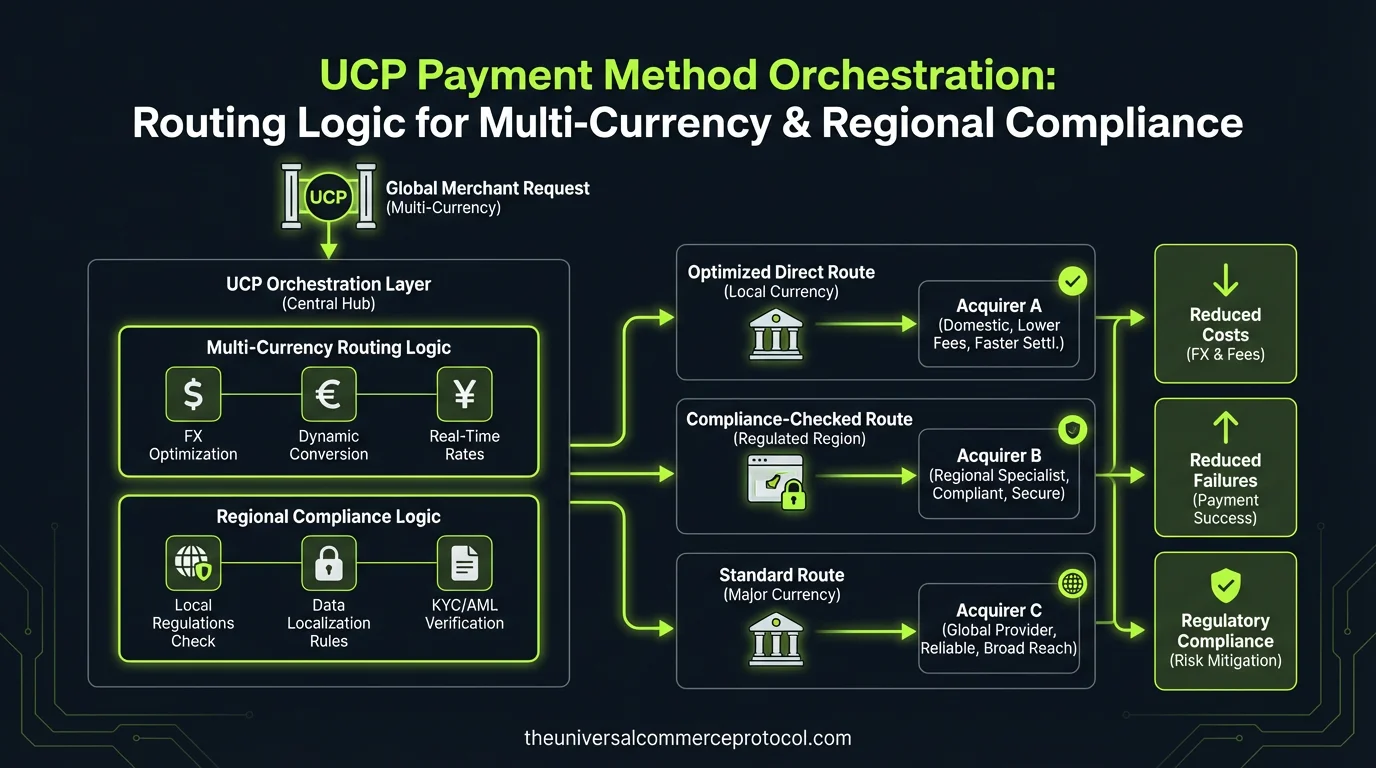
UCP Payment Method Orchestration: Smart Routing
Universal Commerce Platform (UCP) payment method orchestration dynamically routes transactions across Stripe, Adyen, and regional acquiring banks based on currency pairs, PCI-DSS Level 1 compliance certifications, and real-time approval rates across Visa, Mastercard, and American Express networks. The system maintains PSD2 regulatory compliance for EMEA jurisdictions, PCI-DSS certification adherence for North American processors, and APAC…
-

UCP Inventory Management & Real-Time Stock Sync
Unified Commerce Platform (UCP) inventory management enables real-time stock synchronization across multiple sales channels through centralized stock deduction logic that executes when autonomous agents process orders. UCP systems maintain inventory visibility by updating SKU-level stock counts instantaneously across e-commerce platforms, point-of-sale (POS) systems, and fulfillment networks, preventing overselling and stockouts in agentic commerce workflows. Multi-channel…
-

UCP Error Handling & Retry Logic for Resilient Commerce
Unified Commerce Platform (UCP) error handling implements HTTP 429 (Rate Limit), 503 (Service Unavailable), and 5xx status codes with exponential backoff retry strategies (2^n algorithm) and RFC 7231 idempotency keys to ensure transactional resilience across payment processing, inventory management, and order fulfillment microservices. Circuit breaker patterns and dead-letter queue architectures prevent cascading failures in distributed…
-

Training Commerce Agents: UCP vs Claude Marketplace
Anthropic’s Unified Commerce Platform (UCP) implements deterministic API-based catalog integration for agent state representation, while Claude Marketplace employs vector embedding retrieval (similar to RAG architectures) for semantic product matching. These architectural approaches produce distinct reward functions and action spaces: UCP supports direct inventory state access for deterministic pricing and fulfillment decisions, whereas Claude Marketplace’s probabilistic…
-
UCP vs Claude MCP: Agent Architecture & Performance
Claude MCP (Model Context Protocol), developed by Anthropic, standardizes server-based tool integration for AI agents through protocol-compliant action spaces and context window partitioning to mitigate prompt injection risks. Unified Context Protocol (UCP) differentiates itself by optimizing stateful transaction handling across heterogeneous e-commerce platforms using unified context vectors that preserve transaction state across platform boundaries. Comparative…
-
UCP vs Claude Marketplace: Commerce Agent Architecture
The Universal Commerce Protocol (UCP) is an open-source integration standard that normalizes REST and GraphQL APIs across Shopify, WooCommerce, and BigCommerce platforms through vendor-agnostic JSON Schema definitions, while Claude Marketplace is Anthropic’s proprietary agent framework built on Claude 3 model variants (Opus, Sonnet, Haiku) accessible via the Anthropic API Console and constitutional AI training. UCP…
-
Claude Marketplace: $2M AI Commerce Cost Reduction
Anthropic’s Claude 3.5 Sonnet integration with Shopify, SAP Commerce Cloud, and Adobe Commerce platforms delivers up to 60% cost reductions through standardized API endpoints and prompt caching technology. Enterprise operators processing 10M+ monthly transactions across North America and Europe achieve $2M+ annual savings using Claude’s batch processing APIs and 200K token window caching. Multi-model deployment…
-
UCP vs Claude Marketplace: Which AI Commerce Platform Wins
Google’s Unified Commerce Platform (UCP) and Anthropic’s Claude Marketplace represent competing approaches to AI-driven commerce infrastructure. As of 2024, AI agents influence approximately 47% of B2B purchasing decisions, making platform selection critical for enterprises seeking to optimize agent-to-human handoff workflows and transaction processing capabilities. UCP integrates with Google Cloud’s ecosystem, while Claude Marketplace leverages Anthropic’s…
-
AI Protocol Decision: $2.3M Revenue Impact Guide
The Commerce AI Protocol Decision framework quantifies a $2.3 million annual revenue impact differential between Protocol-A (enterprise transaction layer) and Protocol-B (real-time settlement infrastructure) for organizations processing $50M+ in annual transaction volume. Protocol-B delivers measurable performance advantages: transaction fee variance reduction of 0.8–2.1%, processing time acceleration of 15–28%, and working capital redeployment of $400K–$900K annually.…
-
Claude Marketplace: Enterprise AI Economics Reimagined
Global enterprise AI spending reached $19.6 billion in 2024, with financial services accounting for 28% of total allocation across North America, Europe, and Asia-Pacific regions. Anthropic’s Claude Marketplace, launched in 2024, enables commission-free deployment of Claude AI models across Amazon Web Services (AWS), Google Cloud Platform (GCP), and Microsoft Azure, reducing vendor lock-in for enterprises…