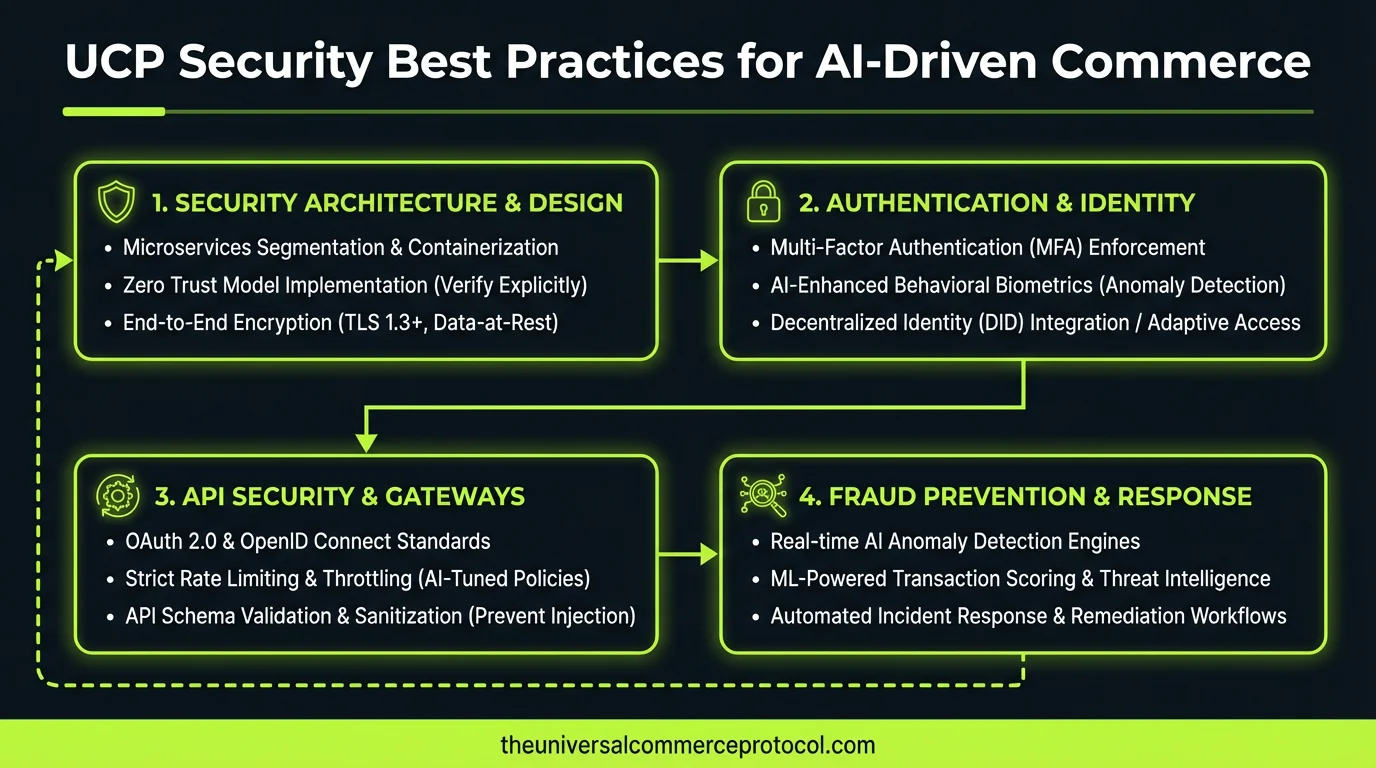
UCP Security Best Practices for AI-Driven Commerce
The Universal Commerce Protocol (UCP) is revolutionizing how businesses conduct transactions and manage data in the age of artificial intelligence. As AI-driven commerce becomes increasingly prevalent, ensuring robust UCP security is paramount. This article delves into the essential security best practices that organizations must adopt to protect their UCP implementations from evolving threats, maintain data integrity, and foster customer trust. By implementing these guidelines, businesses can confidently leverage the power of AI while mitigating potential risks associated with sophisticated cyberattacks and data breaches.
Key Takeaways
- Implement robust encryption protocols for data in transit and at rest.
- Utilize multi-factor authentication (MFA) to secure user access.
- Regularly conduct vulnerability assessments and penetration testing.
- Establish a comprehensive incident response plan.
- Comply with relevant data privacy regulations like GDPR and CCPA.
- Monitor UCP traffic for anomalous activity using AI-powered threat detection tools.
Understanding the UCP Security Landscape
The Universal Commerce Protocol (UCP) facilitates seamless data exchange and transaction processing across diverse systems and platforms. However, this interconnectedness also introduces potential security vulnerabilities. AI-driven commerce, with its reliance on vast datasets and complex algorithms, amplifies these risks. A successful attack on a UCP-enabled AI system could lead to data breaches, financial losses, reputational damage, and regulatory penalties. Therefore, a proactive and multi-layered approach to UCP security is essential.
Key challenges in securing UCP for AI-driven commerce include:
- Data Breaches: AI algorithms rely on massive datasets, making them attractive targets for cybercriminals seeking sensitive customer information or proprietary business data.
- AI Model Manipulation: Adversaries may attempt to manipulate AI models to generate biased or malicious outputs, leading to incorrect decisions and financial losses.
- Denial-of-Service Attacks: UCP systems can be overwhelmed by distributed denial-of-service (DDoS) attacks, disrupting commerce operations and causing significant downtime.
- Insider Threats: Malicious or negligent employees can compromise UCP security by stealing data, misconfiguring systems, or bypassing security controls.
- Compliance Requirements: Organizations must comply with various data privacy regulations, such as GDPR, CCPA, and PCI DSS, which impose strict requirements for data protection and security.
Essential UCP Security Best Practices
Data Encryption and Protection
Data encryption is a fundamental security control that protects sensitive information from unauthorized access. All data transmitted over UCP should be encrypted using strong encryption protocols such as TLS 1.3 or higher. Data at rest, including databases, file systems, and backups, should also be encrypted using AES-256 or a similar encryption algorithm. Implement key management practices to securely store, manage, and rotate encryption keys. Furthermore, consider data masking and tokenization techniques to protect sensitive data elements, such as credit card numbers and social security numbers, during processing and storage. Regularly audit encryption implementations to ensure they are functioning correctly and providing adequate protection.
Access Control and Authentication
Implement strict access control policies to limit user access to UCP resources based on the principle of least privilege. Utilize role-based access control (RBAC) to assign permissions based on job function and responsibilities. Enforce multi-factor authentication (MFA) for all user accounts, including administrators and developers, to prevent unauthorized access even if passwords are compromised. Regularly review and update access control policies to reflect changes in job roles and responsibilities. Implement strong password policies that require users to create complex passwords and change them regularly. Monitor user activity for suspicious behavior and investigate any anomalies promptly.
Vulnerability Management and Penetration Testing
Regularly conduct vulnerability assessments and penetration testing to identify and remediate security weaknesses in UCP systems and applications. Use automated vulnerability scanners to identify known vulnerabilities in software and hardware components. Perform manual penetration testing to simulate real-world attacks and identify more complex vulnerabilities that automated tools may miss. Prioritize remediation efforts based on the severity of the identified vulnerabilities. Establish a process for promptly patching and updating software to address known security flaws. Conduct regular security audits to ensure that security controls are implemented effectively and are functioning as intended.
Incident Response and Disaster Recovery
Develop a comprehensive incident response plan that outlines the steps to be taken in the event of a security breach or other security incident. The plan should include procedures for identifying, containing, eradicating, and recovering from incidents. Establish clear roles and responsibilities for incident response team members. Regularly test and update the incident response plan to ensure its effectiveness. Implement a disaster recovery plan to ensure business continuity in the event of a major outage or disaster. The disaster recovery plan should include procedures for backing up and restoring data, failover to redundant systems, and communication with stakeholders. Regularly test the disaster recovery plan to ensure its effectiveness.
AI-Powered Threat Detection and Monitoring
Leverage AI-powered threat detection tools to monitor UCP traffic and identify anomalous activity that may indicate a security breach. These tools can analyze large volumes of data in real-time and identify patterns that are indicative of malicious behavior. Configure alerts to notify security personnel of suspicious activity. Integrate threat intelligence feeds to stay informed about the latest threats and vulnerabilities. Use machine learning algorithms to identify and block malicious traffic. Continuously train and update AI models to improve their accuracy and effectiveness in detecting threats. Regularly review and analyze security logs to identify and investigate potential security incidents.
Compliance and Governance
Ensure compliance with all relevant data privacy regulations, such as GDPR, CCPA, and PCI DSS. Implement appropriate security controls to protect sensitive data and prevent unauthorized access. Conduct regular security audits to ensure compliance with regulatory requirements. Establish a data governance framework that defines policies and procedures for data management, security, and privacy. Provide regular security awareness training to employees to educate them about security risks and best practices. Implement a process for reporting and investigating security incidents. Regularly review and update security policies and procedures to reflect changes in the threat landscape and regulatory requirements.
FAQ
What is the Universal Commerce Protocol (UCP)?
The Universal Commerce Protocol (UCP) is a standardized set of rules and guidelines designed to facilitate seamless and secure data exchange and transaction processing across diverse systems and platforms in the context of e-commerce and digital business. It aims to create interoperability and streamline communication between different applications, services, and organizations involved in the commerce ecosystem.
Why is UCP security important for AI-driven commerce?
UCP security is crucial for AI-driven commerce because AI systems rely on vast amounts of data, making them attractive targets for cybercriminals. A security breach could compromise sensitive customer information, disrupt business operations, and damage an organization’s reputation. Robust UCP security measures are essential to protect data, prevent unauthorized access, and ensure the integrity of AI models.
What are some common UCP security threats?
Common UCP security threats include data breaches, AI model manipulation, denial-of-service attacks, insider threats, and compliance violations. Cybercriminals may attempt to steal sensitive data, manipulate AI models to generate biased outputs, overwhelm UCP systems with DDoS attacks, or exploit vulnerabilities in software and hardware components. Organizations must also comply with data privacy regulations such as GDPR and CCPA.
How can organizations improve their UCP security posture?
Organizations can improve their UCP security posture by implementing strong encryption protocols, enforcing multi-factor authentication, conducting regular vulnerability assessments and penetration testing, establishing a comprehensive incident response plan, leveraging AI-powered threat detection tools, and complying with relevant data privacy regulations. Security awareness training for employees is also crucial to educate them about security risks and best practices.
Conclusion
Securing the Universal Commerce Protocol in the age of AI-driven commerce requires a proactive and comprehensive approach. By implementing the best practices outlined in this article, organizations can mitigate potential risks, protect sensitive data, and maintain customer trust. Embracing a security-first mindset is essential for realizing the full potential of UCP and AI in the evolving landscape of digital commerce.
Ready to fortify your UCP security? Contact our team of experts at theuniversalcommerceprotocol.com today for a comprehensive security assessment and customized solutions to protect your AI-driven commerce platform.
🎙️ The UCP Brief — Audio Summary
Read transcript
Welcome to The UCP Brief.
Today we’re diving into UCP security best practices for AI-driven commerce. The Universal Commerce Protocol is changing the game, but with AI in the mix, we’re facing a whole new level of potential vulnerabilities. The biggest takeaway? Proactive, multi-layered security isn’t optional anymore; it’s the price of admission to this new era of commerce.
One critical area to focus on is data encryption. Think of it as digital armor for your sensitive information. If you’re not encrypting data both in transit and at rest, you’re essentially leaving the front door wide open for attackers. Strong protocols like TLS 1.3 are your first line of defense.
But it’s not just about encryption. We need to be hyper-vigilant about monitoring UCP traffic. AI-powered threat detection tools can be a game-changer here, helping you spot anomalies and potential breaches before they escalate. It’s like having a 24/7 security guard that never blinks, constantly learning and adapting to new threats.
I’m Will Tygart. Stay curious.
Leave a Reply