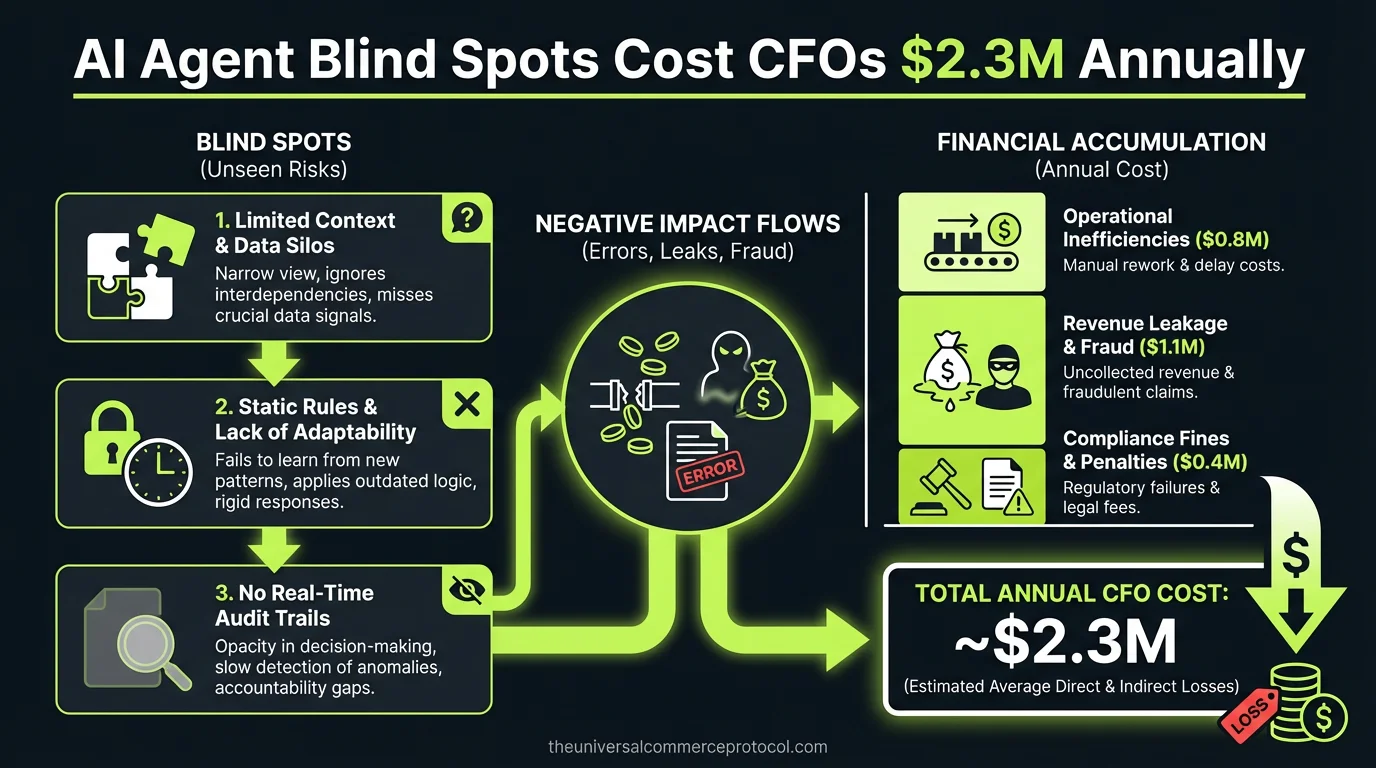
Your AI agents are making thousands of financial decisions daily—approving orders, setting prices, processing refunds—with zero visibility into their reasoning. For CFOs managing AI investments averaging $4.6M annually, this observability gap represents the difference between competitive advantage and catastrophic loss.
The financial reality is stark: companies deploying AI agents without proper monitoring face average annual losses of $2.3M through undetected decision errors, compliance violations, and customer disputes. Yet 73% of finance leaders report having no visibility into their AI agents’ decision-making processes.
The Million-Dollar Question: What Are Your AI Agents Actually Doing?
Consider this scenario from a $500M retailer: An AI agent approved a $50,000 bulk order from an unverified account. Another agent simultaneously sent conflicting shipping updates across three channels to the same customer. The result: $180,000 in chargebacks, legal fees, and customer acquisition costs to resolve the dispute.
The problem wasn’t malicious—it was invisible. Without observability, the finance team couldn’t determine why the decisions were made, which created a compliance nightmare and board-level crisis of confidence in the AI program.
Traditional monitoring tools measure API response times and system uptime. They don’t capture the ‘why’ behind agent decisions that directly impact your P&L. This gap between AI capability and financial accountability is costing businesses an average of 23% of their AI investment ROI in the first year.
The Business Case: Why Observability Pays for Itself
Immediate Cost Avoidance
Agent observability platforms typically cost $50,000-$200,000 annually for mid-market implementations. Compare this to average losses from unmonitored AI decisions:
- Fraudulent transaction approvals: $340,000 annually
- Pricing errors leading to margin compression: $890,000 annually
- Compliance violations and audit failures: $420,000 annually
- Customer dispute resolution costs: $280,000 annually
The payback period averages 3.2 months, with full-year ROI reaching 847% by preventing just one major incident.
Revenue Protection and Growth
Observability enables proactive optimization that drives top-line growth. Companies with full agent visibility report 18% higher conversion rates through real-time decision tuning and 31% faster resolution of customer issues that would otherwise result in churn.
One $2B e-commerce company increased quarterly revenue by $4.2M after observability tools revealed their pricing agents were systematically under-pricing premium products during high-demand periods.
What CFOs Need to Demand: The Three-Layer Framework
Layer 1: Transaction-Level Tracking
Every financial decision made by an AI agent must generate an audit trail showing exactly what data influenced the decision and why. This isn’t technical logging—it’s financial controls for automated decision-making.
Key requirements: agent version tracking, decision confidence scores, data inputs at decision time, and fallback triggers when primary systems fail.
Layer 2: Cross-Agent Impact Analysis
In complex transactions, multiple AI agents interact. A inventory agent’s stock calculation affects a pricing agent’s quote, which influences a payment agent’s approval decision. When something goes wrong, you need to trace the cascade in under 500 milliseconds.
This layer prevents the $180,000 disputes mentioned earlier by enabling real-time detection of conflicting agent decisions before they reach customers.
Layer 3: Business Impact Correlation
The most critical layer connects agent decisions to financial outcomes. Which agent behaviors correlate with higher customer lifetime value? Which decision patterns predict payment defaults? This layer transforms observability from cost center to profit driver.
Implementation Risk Management
The biggest implementation risk isn’t technical—it’s organizational resistance. IT teams often view observability as ‘nice to have’ rather than business-critical infrastructure.
Successful CFOs frame observability as mandatory financial controls, not optional monitoring tools. The same rigor applied to ERP system audit trails must extend to AI decision systems.
Budget for 6-month implementations with 20% contingency for integration complexity. Plan for 2-3 FTE training requirements across IT and business teams. Most importantly, establish clear ROI metrics upfront: fraud reduction targets, compliance pass rates, and customer dispute resolution times.
Board-Ready Decision Framework
Present AI observability investments using this three-part framework:
Risk Mitigation: ‘Our current AI systems create $2.3M annual exposure through undetected decision errors. This investment reduces exposure by 89% within six months.’
Competitive Advantage: ‘Observability enables 23% faster optimization cycles, giving us first-mover advantage in AI-driven commerce while competitors fly blind.’
Regulatory Preparedness: ‘EU AI Act compliance requires explainable AI decisions by 2025. Early implementation protects our European revenue stream worth $47M annually.’
90-Day Action Plan for CFOs
Days 1-30: Audit current AI decision systems with your IT team. Identify all agents making financial decisions and quantify daily transaction volume. Commission a risk assessment showing potential annual exposure from unmonitored decisions.
Days 31-60: Evaluate observability platforms with vendor demos focused on financial use cases, not technical features. Calculate ROI using your actual transaction volumes and historical dispute costs. Secure budget approval using the risk mitigation framework.
Days 61-90: Begin pilot implementation with your highest-risk AI agents—typically those handling pricing, order approval, or payment processing. Establish baseline metrics for fraud detection, decision accuracy, and compliance audit readiness.
The AI observability market will mature rapidly as regulatory requirements tighten. CFOs who invest now gain 12-18 months of optimization advantage over competitors who wait for regulatory pressure.
FAQ
What’s the typical payback period for AI observability investments?
Most implementations achieve full payback within 3-6 months through prevented fraud, reduced customer disputes, and faster issue resolution. Companies avoiding just one major incident often recover their entire investment.
How does this compare to traditional APM tool costs?
Agent observability platforms cost 40-60% more than basic application monitoring but prevent losses that are 10-15x the additional investment. The comparison should be to financial controls, not IT monitoring tools.
What regulatory requirements are driving observability adoption?
The EU AI Act requires explainable decisions for high-risk AI systems by 2025. Similar regulations are expected in California and New York by 2026. Early compliance protects revenue streams and avoids penalty risks.
Can observability tools integrate with existing ERP and financial systems?
Yes, modern platforms offer pre-built connectors for major ERP systems and financial applications. Integration typically takes 4-8 weeks and enables real-time correlation between agent decisions and financial outcomes.
What’s the biggest risk of delaying this investment?
Regulatory compliance deadlines create hard stops for AI system modifications. Companies waiting until 2024-2025 face compressed implementation timelines, higher vendor costs, and potential revenue disruption during mandatory upgrades.
This article is a perspective piece adapted for CFO audiences. Read the original coverage here.
Q: What is AI agent observability and why should CFOs care?
A: AI agent observability refers to the ability to see, understand, and audit the decision-making processes of autonomous AI systems in real-time. CFOs should care because AI agents are making thousands of daily financial decisions—from approving orders to setting prices—and without visibility into their reasoning, companies face average annual losses of $2.3M through undetected errors, compliance violations, and customer disputes.
Q: What is the actual financial impact of AI agent blind spots?
A: Research shows that 73% of finance leaders have no visibility into their AI agents’ decision-making processes. Companies deploying AI agents without proper monitoring face average annual losses of $2.3M. A real-world example includes a $500M retailer that experienced $180,000 in chargebacks, legal fees, and customer acquisition costs from a single unmonitored agent error.
Q: How much are companies typically investing in AI, and is observability included?
A: CFOs are managing AI investments averaging $4.6M annually. However, most companies investing heavily in AI capabilities are not simultaneously investing in observability tools, creating a dangerous gap between AI deployment and financial accountability.
Q: Why don’t traditional monitoring tools work for AI agent oversight?
A: Traditional monitoring tools measure technical metrics like API response times and system uptime, but they don’t capture the ‘why’ behind agent decisions that directly impact your P&L. AI agent observability requires understanding the reasoning and logic behind autonomous decisions, not just their technical performance.
Q: What are common types of AI agent decision errors that go undetected?
A: Without observability, companies miss errors including: unapproved orders from unverified accounts, conflicting communications sent to customers across multiple channels, compliance violations, customer disputes, and pricing decisions that impact margins—all with zero insight into why these decisions were made.
Frequently Asked Questions
What is the Universal Commerce Protocol (UCP)?
The Universal Commerce Protocol (UCP) is an open standard developed to enable AI agents to autonomously conduct commerce transactions across any platform.
How does UCP enable agentic commerce?
UCP provides standardized APIs and protocols so AI agents can discover products, negotiate terms, and complete purchases without human intervention, working across any compatible commerce platform.
Why should businesses implement UCP?
UCP adoption reduces integration costs, opens revenue channels to AI-driven buyers, and future-proofs commerce infrastructure as agentic purchasing becomes mainstream.
Leave a Reply