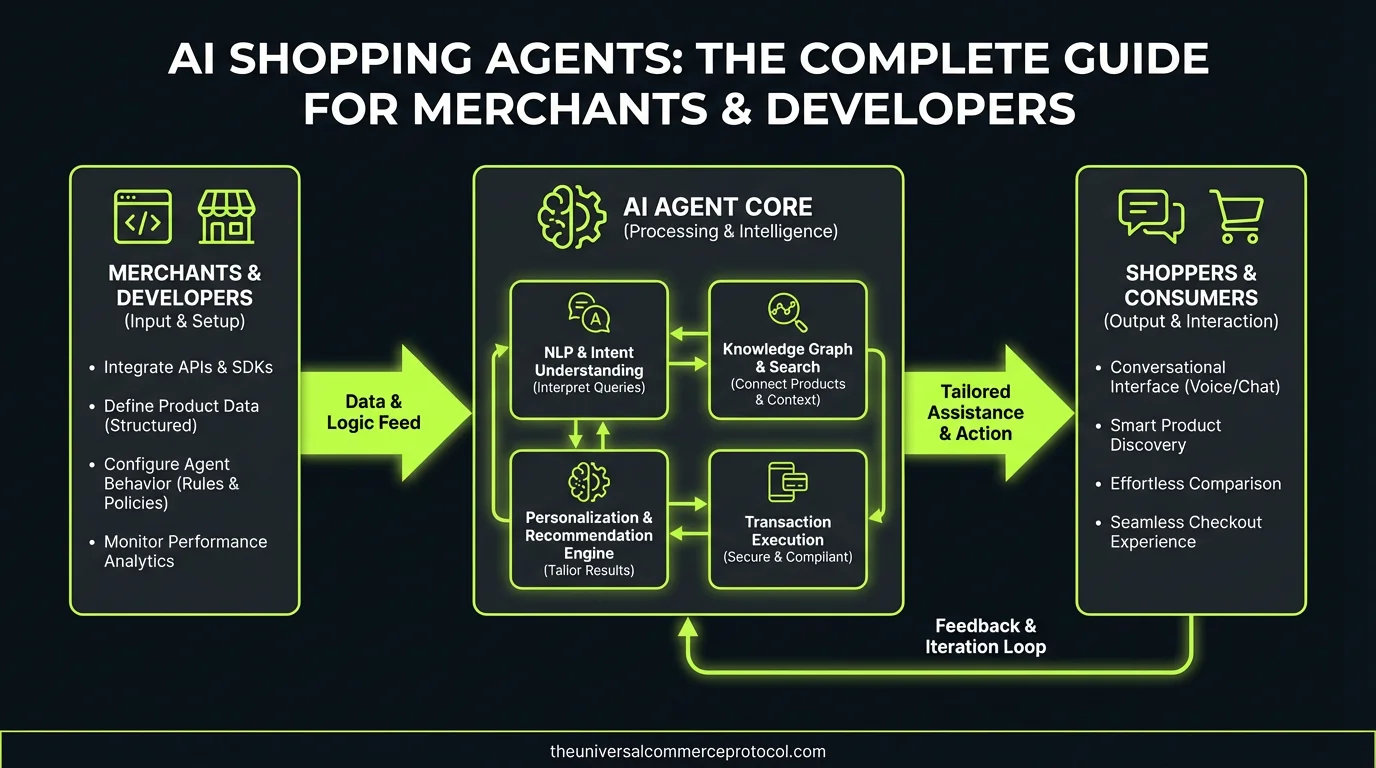
What Are AI Shopping Agents?
AI shopping agents are autonomous software systems powered by large language models (LLMs) and machine learning that can understand natural language requests, search product catalogs, compare options, and complete purchase transactions on behalf of users. Unlike traditional e-commerce interfaces that require customers to navigate websites or apps, AI shopping agents interpret conversational commands and execute commerce actions with minimal human intervention.
These agents represent a fundamental shift in how commerce happens. Rather than customers coming to merchants, merchants’ product catalogs become accessible through AI intermediaries that operate across multiple channels—voice assistants, messaging platforms, mobile apps, and web interfaces. The Universal Commerce Protocol (UCP) is emerging as a key standard for enabling these agents to interact with merchant systems in a standardized, interoperable way.
Core Capabilities of AI Shopping Agents
Natural Language Understanding
AI shopping agents process conversational requests in plain English (and other languages), extracting intent, product preferences, budget constraints, and delivery requirements. When a user says “I need running shoes under $150 for a 10K race next month,” the agent parses multiple data points simultaneously: product category, price range, use case, and urgency.
Catalog Search and Product Discovery
Agents query merchant product databases, apply filters, and rank results based on relevance, availability, price, and user history. Advanced agents use semantic search to understand that “lightweight trainers” might match “mesh running shoes” even without exact keyword matches. They integrate with inventory management systems to provide real-time availability data.
Comparison and Recommendation
Rather than presenting a single product, sophisticated agents compare multiple options across dimensions like price, reviews, shipping time, and return policies. They can access product data from competitors and present trade-offs transparently, building customer trust through informed decision-making.
Transaction Execution
AI agents can complete full purchase workflows: adding items to carts, applying discounts, selecting shipping methods, processing payments, and generating order confirmations. They integrate with payment processors like Stripe, Square, and PayPal, as well as fulfillment systems.
Post-Purchase Support
Agents can track orders, handle returns, answer product questions, and manage customer service interactions. This reduces support ticket volume while providing immediate assistance.
How AI Shopping Agents Work
The Technical Architecture
Modern AI shopping agents operate on a multi-layer architecture. The foundation is an LLM (such as OpenAI’s GPT-4, Anthropic’s Claude, or open-source models like Llama) that powers natural language understanding. Above this sits an orchestration layer that manages tool calling—the agent’s ability to invoke APIs and integrations.
When a user makes a request, the agent:
- Parses the input using the LLM
- Determines which tools/APIs to call (product search, inventory check, price lookup)
- Executes those calls against merchant systems
- Synthesizes results into a natural language response
- Handles follow-up questions or refinements
Integration with Merchant Systems
AI agents must connect to multiple backend systems: product information management (PIM) systems, inventory management, order management systems (OMS), customer relationship management (CRM) platforms, and payment gateways. The Universal Commerce Protocol standardizes these connections, allowing agents to work with any merchant system that implements UCP endpoints.
Without standardization, each merchant integration requires custom API development. UCP solves this by defining standard commerce operations—product search, cart management, checkout, order tracking—that agents can call consistently across any compliant merchant system.
Merchant Implications and Opportunities
New Sales Channels
AI agents represent entirely new distribution channels. Merchants no longer rely solely on customers visiting their website or app. Instead, products become discoverable through third-party agents—whether that’s Amazon’s Alexa, Google Assistant, ChatGPT plugins, or specialized commerce agents built on platforms like Anthropic’s Claude or open-source frameworks.
Companies like Shopify are investing heavily in agent integration, allowing merchants to reach customers through multiple AI interfaces. Early adopters gain first-mover advantage in voice commerce and conversational shopping.
Enhanced Customer Data Collection
AI agents generate rich behavioral data: what customers search for, how they compare products, what questions they ask, and what factors influence their decisions. This data is more granular than traditional web analytics, providing merchants with insights into customer intent at the moment of decision-making.
Merchants can use this data to optimize product listings, improve search relevance, and personalize recommendations. Privacy-compliant data sharing (respecting regulations like GDPR and CCPA) becomes a competitive advantage.
Operational Efficiency
AI agents reduce customer service costs by handling routine inquiries, product questions, and order tracking automatically. They also improve inventory visibility—agents can check real-time stock levels and suggest alternatives when items are unavailable, reducing lost sales.
Pricing and Margin Challenges
As AI agents become ubiquitous, they will enable transparent price comparison across merchants. This commoditizes products and puts downward pressure on margins. Merchants must compete on factors beyond price: brand, quality, customer service, and unique product offerings.
Some merchants may use dynamic pricing strategies to remain competitive in agent-driven commerce, while others will differentiate through exclusive products or superior customer experiences.
Integration Requirements for Merchants
API Standardization
Merchants need to expose standardized APIs that AI agents can call. The Universal Commerce Protocol defines these standards, covering:
- Product catalog queries (search, filter, sort)
- Inventory availability checks
- Shopping cart operations (add, remove, modify)
- Checkout and payment processing
- Order tracking and fulfillment status
- Customer account management
Data Quality and Enrichment
AI agents perform better when product data is complete, accurate, and well-structured. Merchants should invest in:
- Comprehensive product descriptions and specifications
- High-quality images and videos
- Structured data markup (Schema.org, JSON-LD)
- Accurate inventory and pricing data
- Customer reviews and ratings
Security and Authentication
Agents need secure access to customer data and payment systems. Merchants must implement OAuth 2.0 for authentication, encryption for data in transit and at rest, and fraud detection systems. PCI DSS compliance is essential for payment processing.
Rate Limiting and Load Management
Multiple agents querying merchant systems simultaneously can create traffic spikes. Merchants need robust infrastructure with rate limiting, caching, and load balancing to handle agent traffic alongside traditional customer traffic.
Real-World Examples and Market Leaders
Several companies are pioneering AI shopping agents:
- Amazon Alexa enables voice shopping through integrated e-commerce capabilities
- Google Assistant integrates with Google Shopping and partner retailers
- OpenAI’s ChatGPT has plugins that allow commerce interactions
- Shopify is building agent-ready infrastructure for its merchant ecosystem
- Anthropic’s Claude is being integrated into commerce platforms by developers
- Stripe is positioning its platform as infrastructure for agent-driven commerce
Emerging startups like Simpl, Wizard, and Keeper are building specialized AI shopping agents focused on specific use cases like grocery, fashion, and B2B procurement.
The Role of Standards: UCP and Beyond
The Universal Commerce Protocol is gaining adoption as the standard for agent-merchant communication. By defining common API specifications, data formats, and commerce workflows, UCP enables:
- Faster agent integration with new merchants
- Reduced development costs for both agents and merchants
- Interoperability across different agent platforms
- Consumer choice and competition
Merchants implementing UCP-compliant APIs can work with any UCP-compatible agent, rather than building custom integrations for each agent platform. This is similar to how payment processors like Stripe and Square work—they provide standardized interfaces that merchants implement once and work with multiple payment methods.
Preparing Your Business for AI Shopping Agents
Audit Your Current Systems
Evaluate your PIM, OMS, inventory management, and payment systems. Determine which can expose APIs and which need upgrades. Prioritize systems that directly impact customer-facing commerce.
Invest in Data Quality
Clean, structured product data is the foundation of agent-driven commerce. Audit product descriptions, ensure consistency across channels, and implement data governance practices.
Choose an Integration Strategy
Decide whether to build custom agent integrations, adopt UCP standards, or use middleware platforms that abstract away integration complexity. For most merchants, UCP adoption is the most scalable approach.
Monitor and Optimize
Track agent-driven sales separately from traditional channels. Analyze customer behavior, identify friction points, and continuously optimize your product data and APIs based on agent feedback.
Frequently Asked Questions
What’s the difference between an AI shopping agent and a chatbot?
Chatbots typically respond to user queries within a single conversation thread and may not execute transactions. AI shopping agents are autonomous systems that can complete full purchase workflows, integrate with multiple merchant systems, and operate across channels without constant human direction. Agents can make decisions independently and proactively suggest products based on user intent.
How do AI agents handle payment security?
AI agents never store payment information directly. Instead, they integrate with PCI-compliant payment processors (Stripe, Square, PayPal) that handle sensitive data. Agents use tokenization and OAuth authentication to securely access customer accounts and initiate transactions without exposing credentials.
Will AI shopping agents eliminate the need for merchant websites?
Not entirely, but they will reduce reliance on traditional websites for certain use cases. Agents excel at transactional commerce (quick purchases, reorders) but may be less suitable for discovery-driven shopping or complex product research. Merchants should maintain websites while also optimizing for agent compatibility.
How does the Universal Commerce Protocol benefit smaller merchants?
UCP reduces integration costs for small merchants by providing a standardized API specification. Rather than building custom integrations with each agent platform, merchants implement UCP once and work with all UCP-compatible agents. This democratizes access to agent-driven commerce channels that were previously only available to large enterprises.
Leave a Reply