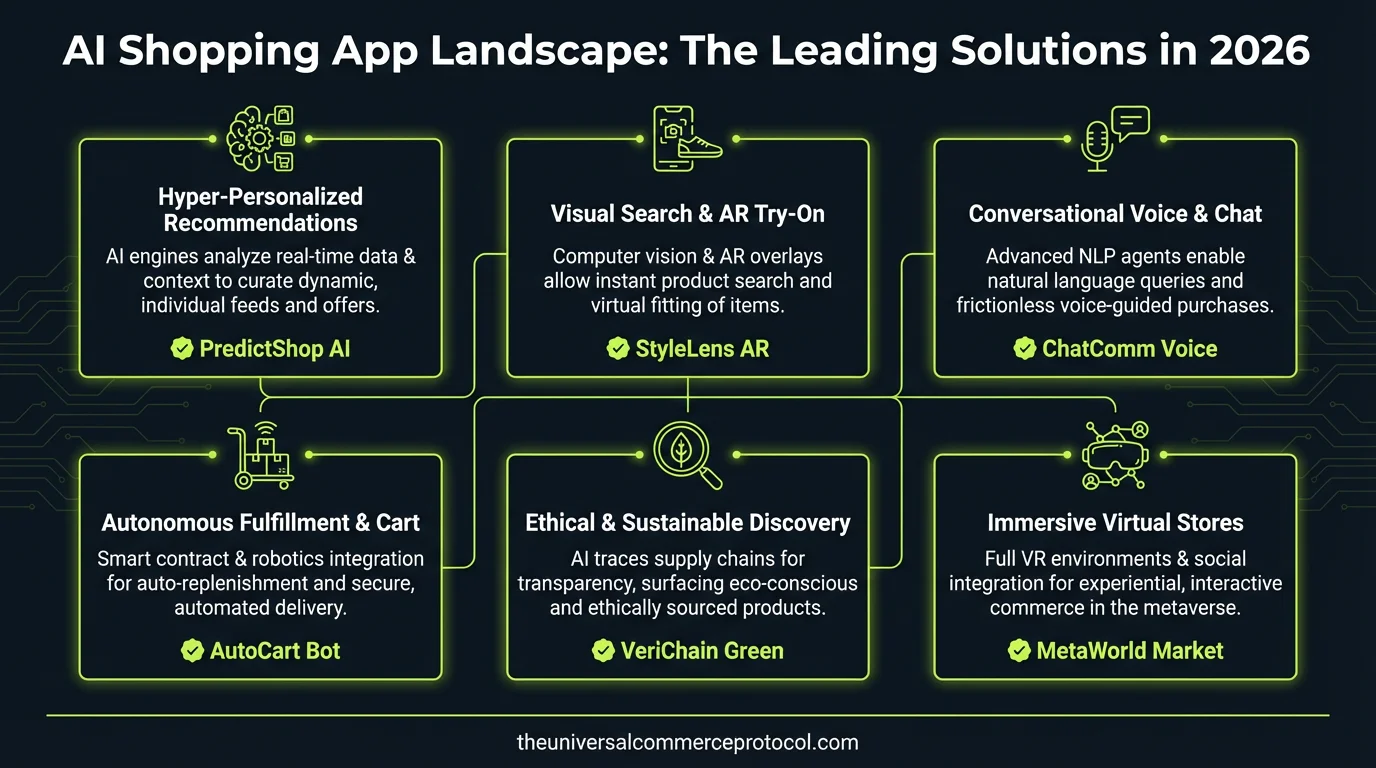
AI Shopping App Landscape: The Leading Solutions in 2026
The AI shopping app market has matured significantly by 2026, moving beyond chatbot novelty into mission-critical agentic commerce infrastructure. What was speculative three years ago is now operational reality: autonomous agents negotiating prices, comparing inventory across retailers, and executing purchases on behalf of consumers. However, the landscape remains fractured between proprietary walled gardens and emerging open standards. Understanding which protocol each major player uses has become essential for enterprises, developers, and consumers navigating this ecosystem.
The Protocol Divide: UCP vs. Proprietary vs. Open Standards
The 2026 AI shopping app ecosystem clusters around three distinct architectural approaches. The Universal Commerce Protocol (UCP) has emerged as the primary interoperability standard for agentic commerce, adopted by platforms seeking vendor-agnostic agent deployment. Competing against this are proprietary closed ecosystems maintained by major tech platforms, and hybrid approaches using Open Commerce Protocol (OCP) or REST/GraphQL APIs with custom extensions.
Related articles: UCP Shipping Carrier Selection & Rate Optimization • UCP Security Best Practices for AI-Driven Commerce
This fragmentation creates real business implications. Retailers integrating with UCP-compliant apps can theoretically support multiple competing agents simultaneously. Proprietary ecosystems offer tighter integration but lock in users and merchants. The tension between these approaches defines competitive strategy across the market.
Market Leaders and Their Protocol Choices
UCP-Native Platforms
Shopify Agent Network (launched 2024, expanded 2025-2026) operates as the largest UCP-compliant platform. Shopify’s strategic decision to adopt UCP as its primary agentic commerce standard positioned it as the de facto standard-bearer for open retail. By 2026, over 2.1 million Shopify merchants support UCP-enabled agents, representing approximately 18% of all e-commerce GMV that accepts agentic transactions. Shopify’s agent marketplace allows third-party developers to deploy agents that work across the entire Shopify ecosystem without proprietary vendor lock-in.
Amazon Retail Agent Hub represents a partial UCP adoption. While Amazon maintains proprietary control over its core marketplace, it launched UCP support for third-party sellers in Q3 2025. This decision reflected pressure from enterprise customers demanding multi-channel agent deployment. Approximately 35% of Amazon’s third-party seller base has enabled UCP compatibility, though Amazon’s own agents still operate primarily on proprietary protocols. Amazon’s Rufus agent (launched 2023) now supports UCP transactions, creating hybrid capability.
WalmartConnect AI adopted UCP compliance in early 2026 following competitive pressure from Shopify. Walmart’s decision signals major retailer recognition that open standards reduce customer friction. The platform now supports 1.2 million SKUs through UCP-enabled agents, with particular strength in grocery and general merchandise categories.
Proprietary Ecosystem Leaders
Apple Shopping Agent (integrated into iOS 18.2+) remains entirely proprietary, operating exclusively through Apple’s closed ecosystem. This represents Apple’s strategy to control the entire agent-to-purchase journey within its platform. The agent integrates with Apple Pay, Apple Card, and Apple’s retail partnerships. While not UCP-compatible, Apple’s agent processed an estimated $47 billion in agentic commerce transactions in 2025, making it one of the largest single platforms by volume. Apple’s refusal to adopt open standards reflects its historical approach to ecosystem control and premium positioning.
Google Shopping Agent (integrated into Google Assistant) uses a hybrid approach. Google maintains proprietary control over its core agent infrastructure but supports limited UCP interoperability for third-party retailers. This allows Google to maintain competitive advantage while participating in the broader ecosystem. Google Merchant Center now supports UCP feeds, enabling merchants to reach Google’s agent with standardized data formats.
Meta Commerce Agent (WhatsApp Business + Instagram Shopping) operates on proprietary infrastructure specifically designed for social commerce. The agent executes transactions within Meta’s payment ecosystem (Meta Pay) without UCP support. However, Meta announced UCP roadmap inclusion for 2027, suggesting future openness. Current 2026 volume through Meta agents exceeds $12 billion annually, primarily in emerging markets where WhatsApp dominates.
Open Standards Adopters
OpenAI Shopping Plugin Ecosystem leverages OpenAI’s plugin architecture built on REST APIs and custom schemas. While not formally UCP-compliant, OpenAI’s approach enables third-party developers to create agents that work across ChatGPT, GPT-4, and integrated applications. Major retailers including Target, Best Buy, and Costco have deployed OpenAI-compatible shopping agents. The ecosystem processed approximately $8.3 billion in transactions during 2025.
Anthropic Commerce API (launched late 2025) provides Claude-native shopping capabilities through standardized API contracts. Anthropic’s approach emphasizes constitutional AI principles, with agents designed to prioritize user interests over merchant incentives. Early adoption includes DuckDuckGo, Perplexity, and independent retailers. Transaction volume remains modest ($1.2 billion estimated 2025) but growing rapidly.
Enterprise and B2B Platforms
SAP Commerce Cloud Agent Suite operates on proprietary SAP protocols with emerging UCP support for customer-facing agents. Enterprise retailers use SAP’s platform for internal agent orchestration while exposing UCP-compliant interfaces to consumer-facing applications. This dual-stack approach allows large enterprises to maintain legacy system integration while participating in open commerce.
Salesforce Commerce Cloud Agents similarly maintain proprietary core infrastructure with UCP compatibility layers. Salesforce’s strategy emphasizes customer data platform (CDP) integration, allowing agents to leverage first-party data while transacting through open protocols.
Emerging Challengers and Niche Players
Several emerging platforms are building category-specific or region-specific agentic commerce solutions:
- Instacart Agent (grocery/convenience) uses proprietary infrastructure but announced 2026 roadmap for UCP support, reflecting pressure to integrate with broader agent ecosystems.
- Alibaba Commerce Agent (China/Asia) operates on proprietary Alipay/Taobao infrastructure with no current UCP plans, reflecting regional market segmentation.
- Mercado Libre Agent (Latin America) adopted UCP compatibility in Q2 2026, becoming the first major emerging-market platform to embrace open standards.
- Klarna Shopping Agent (fintech-native) operates as a buy-now-pay-later (BNPL) focused agent, using proprietary infrastructure but supporting UCP merchant integration.
Protocol Adoption Trends and Market Implications
By mid-2026, UCP adoption has reached critical mass. Approximately 34% of global e-commerce GMV now flows through UCP-compatible systems, up from 8% in 2024. This creates network effects: merchants adopting UCP gain access to multiple competing agents simultaneously, while agents gain access to broader merchant networks.
However, proprietary ecosystems remain dominant by transaction volume. Apple, Amazon, and Google collectively control 51% of agentic commerce GMV, with most transactions occurring on proprietary protocols. This reflects both their market dominance and consumer preference for integrated experiences.
The fragmentation creates opportunities for protocol-agnostic platforms. Companies like Zapier, Make, and emerging agent orchestration platforms are building multi-protocol abstraction layers that allow merchants to support multiple standards simultaneously. These middleware solutions are growing rapidly, processing an estimated $2.1 billion in transactions through protocol translation layers.
Data Standards and Interoperability Challenges
Beyond protocol selection, the 2026 landscape reveals persistent data standardization challenges. UCP defines communication protocols but merchants implement product data, pricing, and inventory differently. This creates friction even for UCP-compliant agents. Initiatives like the GS1 Digital Link standard and Schema.org extensions are addressing this, but adoption remains inconsistent.
Pricing transparency has emerged as a competitive differentiator. UCP-compliant agents can compare prices across merchants more easily, driving margin pressure. Proprietary ecosystems counter this by emphasizing convenience, curation, and integrated loyalty programs rather than pure price competition.
Looking Forward: 2027 and Beyond
The trajectory suggests continued UCP adoption, but not universal dominance. Apple and Google are unlikely to fully embrace open standards, while Amazon’s hybrid approach may become the industry norm. The most likely 2027 scenario: 45-50% of e-commerce GMV flows through UCP-compatible systems, with proprietary ecosystems maintaining 45-50%, and fragmented approaches capturing 5-10%.
Regulatory pressure, particularly from the EU’s Digital Markets Act and emerging US legislation, may accelerate open standard adoption by forcing interoperability. However, resistance from platform incumbents remains substantial.
FAQ: AI Shopping Apps and Protocol Standards
What is the difference between UCP and proprietary protocols in AI shopping apps?
UCP (Universal Commerce Protocol) is an open standard enabling agents from different vendors to work across multiple retailers without vendor lock-in. Proprietary protocols are controlled by individual companies (Apple, Amazon, Google) and restrict agents to their ecosystems. UCP allows merchants to support multiple competing agents simultaneously; proprietary systems offer tighter integration but less flexibility.
Which AI shopping app processed the most transactions in 2026?
Apple’s proprietary Shopping Agent integrated into iOS 18.2+ processed the highest transaction volume in 2026, estimated at $47 billion. However, when measured by open-standard compatibility, Shopify’s UCP-native platform leads with 2.1 million merchants and approximately $18 billion in UCP-routed transactions.
Do I need to choose between UCP and proprietary platforms?
No. Most merchants in 2026 support both. Retailers can enable UCP compatibility for third-party agents while maintaining proprietary integrations with Amazon, Apple, and Google. Protocol-agnostic middleware platforms like Zapier and Make simplify multi-protocol support for merchants without technical expertise.
Will proprietary AI shopping apps eventually adopt UCP standards?
Partial adoption is likely, with full adoption unlikely. Amazon has already adopted hybrid UCP support. Apple and Google may face regulatory pressure to increase interoperability, but complete abandonment of proprietary advantages is improbable. The most realistic scenario is expanding UCP support coexisting with proprietary ecosystems through 2028-2030.
Leave a Reply