Category: Developer Guides
-

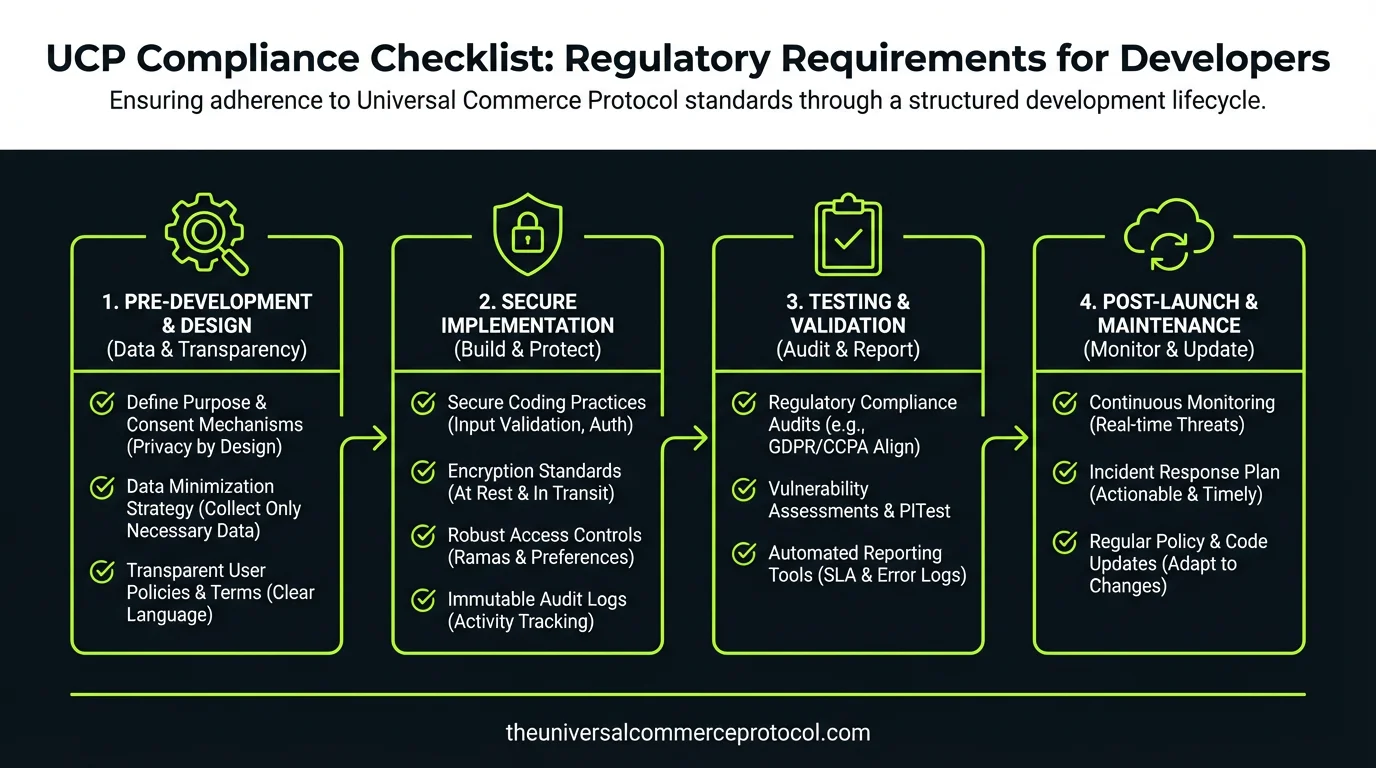
UCP Compliance Checklist: Developer Regulatory Requirements
UCP 500 compliance mandates PCI-DSS v3.2.1 cardholder data protection and GDPR Article 32 encryption, with jurisdiction-specific requirements: NACHA ACH and OFAC in North America, SEPA Direct Debit and PSD2 Open Banking in the EU, RBI Payment Systems Act 1998 in India, and MAS Payment Systems Act 1985 in Singapore. Developers must implement ISO/IEC 27001:2022 certified…
-

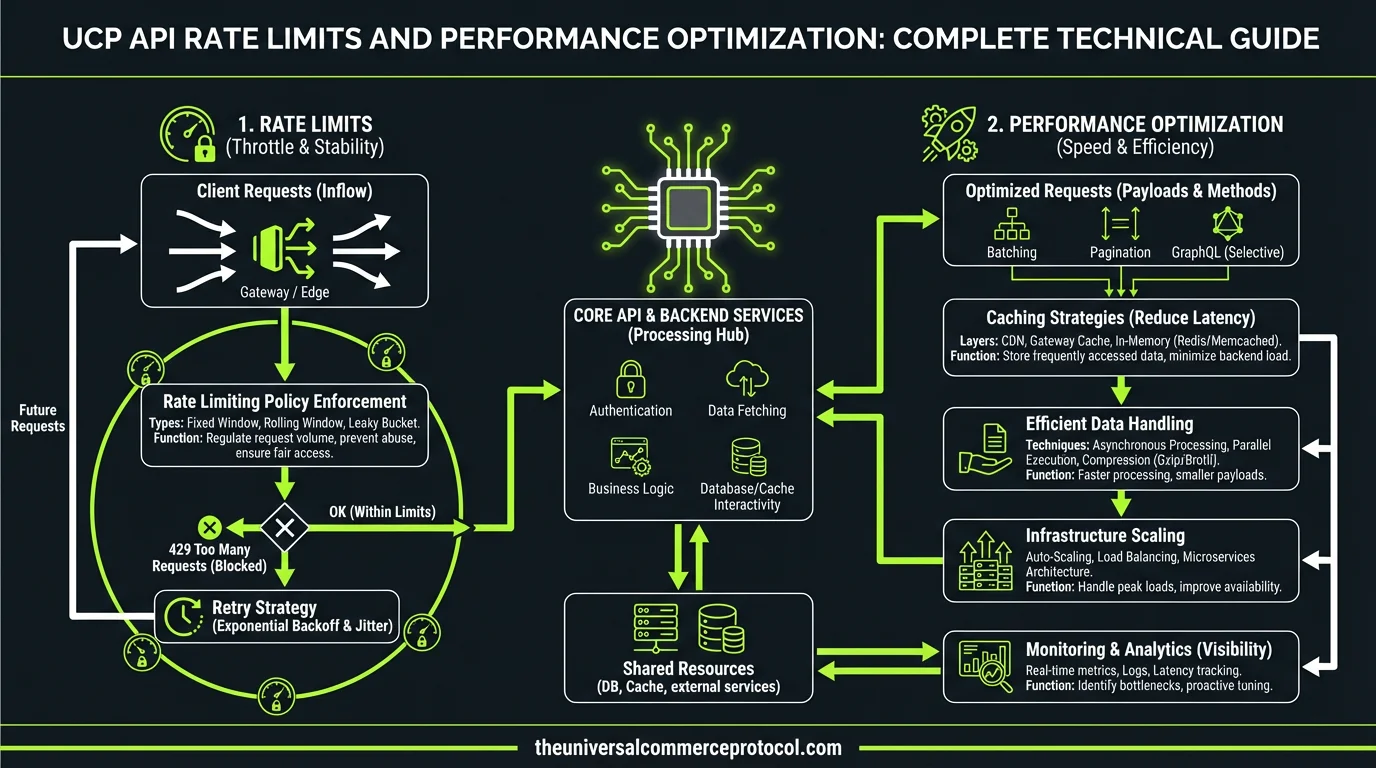
UCP API Rate Limits & Performance Optimization Guide
The Universal Commerce Protocol (UCP) API implements tiered rate limiting with standard tiers of 100 requests per second for standard accounts and 1,000 RPS for enterprise deployments, with burst capacity handling via token bucket algorithms. Performance optimization requires implementing request batching, connection pooling, and Redis-based caching layers to reduce P95 latency below 200ms while maintaining…
-

Testing UCP Integrations with Sandbox Environments
Universal Commerce Protocol (UCP) integrations must be validated in PCI DSS Level 1-compliant sandbox environments before production deployment, including transaction testing across payment gateways (Stripe, Square, PayPal), API endpoint verification against OpenAPI 3.0 specifications, and staging environment parity checks for inventory synchronization (SKU mapping, stock levels) and order management systems (OMS). Critical validation includes testing…
-

UCP API Rate Limits & Performance Optimization
The Universal Commerce Protocol (UCP) API enforces rate limiting through token bucket and sliding window algorithms, allocating 1,000 requests/minute for Standard tier and 10,000 requests/minute for Enterprise tier customers. Redis-based distributed caching combined with request batching and connection pooling optimizations achieve 40-60% throughput improvements and sub-100ms latency. Enterprise deployments must implement exponential backoff retry logic,…
-

UCP ERP Integration: Complete Implementation Guide
Step-by-step guide to integrating the Universal Commerce Protocol (UCP) with SAP, Oracle NetSuite, Microsoft Dynamics 365, and legacy ERP systems. Includes compatibility table, implementation phases, architecture patterns, and FAQ.
-

UCP Developer Sandbox & Testing Environment Guide
The Universal Commerce Protocol (UCP) Developer Sandbox, maintained by the UCP Technical Steering Committee, is a PCI DSS Level 1-certified pre-production environment that allows merchants to test REST and GraphQL API integrations against simulated payment processors including Stripe, PayPal, and Square. It supports complete order lifecycle testing—from transaction authorization and settlement reconciliation to webhook routing…
-

UCP Webhooks for Real-Time Order Updates: Technical Guide
Universal Commerce Protocol (UCP) webhooks transmit real-time order status events through REST API endpoints and asynchronous message brokers, enabling bidirectional integration between Order Management Systems (OMS), Fulfillment Management Systems (FMS), and Payment Service Providers (PSPs) while maintaining PCI DSS Level 1 compliance through HMAC-SHA256 cryptographic signatures. Standard UCP webhook implementations enforce event idempotency via unique…
-

UCP Webhooks for Real-Time Order Updates: Complete Guide
Universal Commerce Protocol (UCP) webhooks transmit standardized order events—order.created, order.paid, order.shipped, and order.cancelled—via HMAC-SHA256-secured HTTP POST callbacks to Stripe, Square, and PayPal Commerce Platform integrations, enabling real-time order synchronization between payment processors and merchant order management systems. Webhook endpoints must implement RFC 7231 idempotency keys, exponential backoff retry mechanisms, and maintain PCI DSS Level 1…
-

UCP Developer Guide: Building Agentic Commerce
The Universal Commerce Protocol (UCP) is a developer framework that enables autonomous transaction execution through the Agent Payments Protocol, incorporating OAuth 2.0 and API key authentication mechanisms with REST API endpoints for merchant system integration. This 2026 guide details UCP deployment on Ethereum, Polygon, and Solana networks, covering ISO 20022 payment message formatting, real-time payment…
-

Native vs. Embedded Checkout Paths: A Developer’s Decision Matrix
Comparing the two primary implementation strategies for UCP: Native Agent execution versus Embedded checkout frames.