Category: Merchant Integration
-

UCP Investment Framework: CFO’s $200K ROI Guide
Mid-market merchants with $10M–$500M annual revenue implementing Unified Commerce Platform (UCP) solutions achieve 239% average annual ROI according to Forrester Research and Gartner benchmarks, with 6–12 month payback periods and $200K minimum ROI thresholds. CFO-led implementations leveraging ERP systems such as SAP, Oracle, and NetSuite deliver 30–40% inventory carrying cost reduction, 25–35% omnichannel fulfillment acceleration,…
-
UCP vs MCP: Best Protocol for Mid-Market Merchants
Mid-market merchants with $10M–$500M annual transaction volumes should evaluate UCP 600 (Uniform Commercial Code Article 5, International Chamber of Commerce standard, published 2007) against Mastercard Commerce Protocol (MCP) based on PCI DSS v3.2.1 compliance, settlement velocity (T+1 vs. T+2), and per-transaction costs. UCP 600 delivers standardized letter-of-credit governance recognized across 190+ jurisdictions under ICC administration,…
-
UCP Merchant Economics: ROI Calculator & Analysis
Unified Commerce Platform (UCP) merchants quantify ROI by benchmarking implementation costs—infrastructure investment, staff training, and software licensing—against omnichannel revenue growth, inventory carrying cost reduction, and customer lifetime value (CLV) increases. Break-even analysis using unit economics models (customer acquisition cost, average order value, gross margin per transaction, and channel-specific churn rates across POS, e-commerce, and mobile)…
-
UCP Merchant Onboarding: Step-by-Step Guide
Unified Commerce Platform (UCP) merchant onboarding integrates payment processors (Stripe, Square, PayPal), enterprise inventory systems (NetSuite, SAP Commerce Cloud), and omnichannel sales channels (Shopify, Magento, WooCommerce, POS terminals) through a four-phase implementation framework requiring 8–12 weeks for mid-market retailers ($10M–$500M revenue). This standardized deployment reduces manual order processing by 40–60% while enabling real-time inventory synchronization…
-
UCP vs MCP: Which Protocol Should Merchants Choose?
The Unified Commerce Protocol (UCP) and Merchant Commerce Protocol (MCP) are competing payment standards: UCP integrates omnichannel transaction processing with POS systems and inventory management for multi-location retailers, while MCP provides enterprise-grade, API-driven implementations supporting 10,000+ daily transactions across distributed infrastructures. MCP uniquely enables regional payment methods and regulatory compliance including PSD2, EMV 3-D Secure,…
-

Mirakl & J.P. Morgan Power Agentic Commerce
Mirakl, a marketplace-as-a-service platform headquartered in Lyon, France, partnered with J.P. Morgan Payments (a division of JPMorgan Chase & Co., NYSE: JPM) to deliver agentic commerce infrastructure enabling autonomous AI-driven transactions at enterprise scale. The integration combines Mirakl’s multi-vendor marketplace technology with JPMorgan Chase’s transaction processing and settlement capabilities for real-time, agent-controlled commerce workflows. JD…
-
AI Commerce Revenue at Risk: CFOs Must Act Now
OpenAI’s $50 million infrastructure investment and AWS, Google Cloud, and Microsoft Azure’s generative AI e-commerce integrations have driven 15-25% conversion rate improvements among early adopters, per industry analyses. McKinsey research documents that Fortune 500 retailers delaying AI commerce adoption face 10-20% revenue share erosion to competitors within 18-24 months, creating material pressure on CFO decision-making…
-
OpenAI Retreats from ChatGPT Checkout as AI Commerce Evolves
OpenAI, headquartered in San Francisco, California, has discontinued its native ChatGPT checkout feature and redirected resources toward API integrations with established payment infrastructure providers Stripe and Square, rather than building proprietary payment systems. This strategic pivot aligns OpenAI’s commerce infrastructure with industry standards for fintech interoperability, as generative AI platforms increasingly adopt modular payment architectures…
-
Shopify continues its push into agentic commerce with AI-powered tools, integrat
Shopify continues its push into agentic commerce with AI-powered tools, integrations with Google and Microsoft, and updates to its AI assistant, Sidekick
-
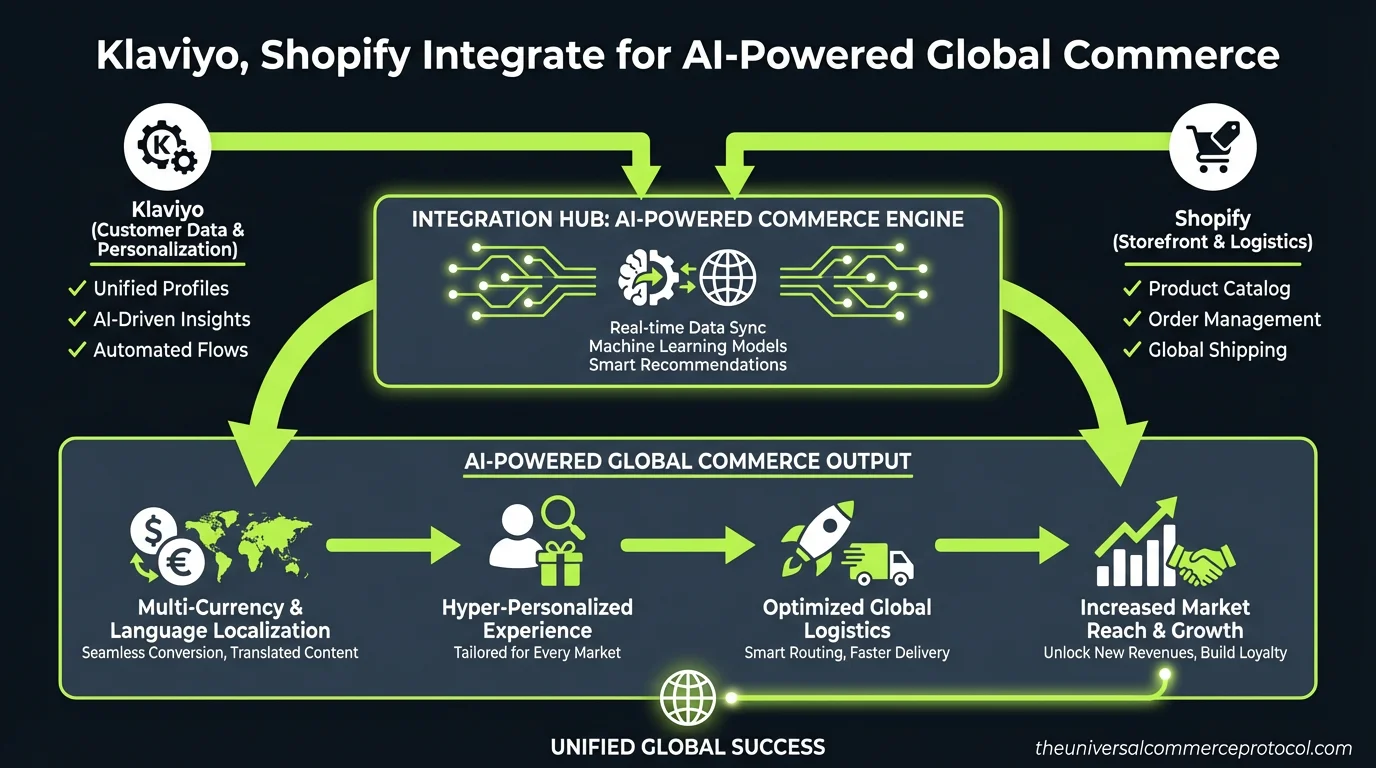
Klaviyo, Shopify Integrate for AI-Powered Global Commerce
Klaviyo and Shopify are deepening their integration to offer a unified, multi-market data foundation, enabling brands to personalize customer experiences global