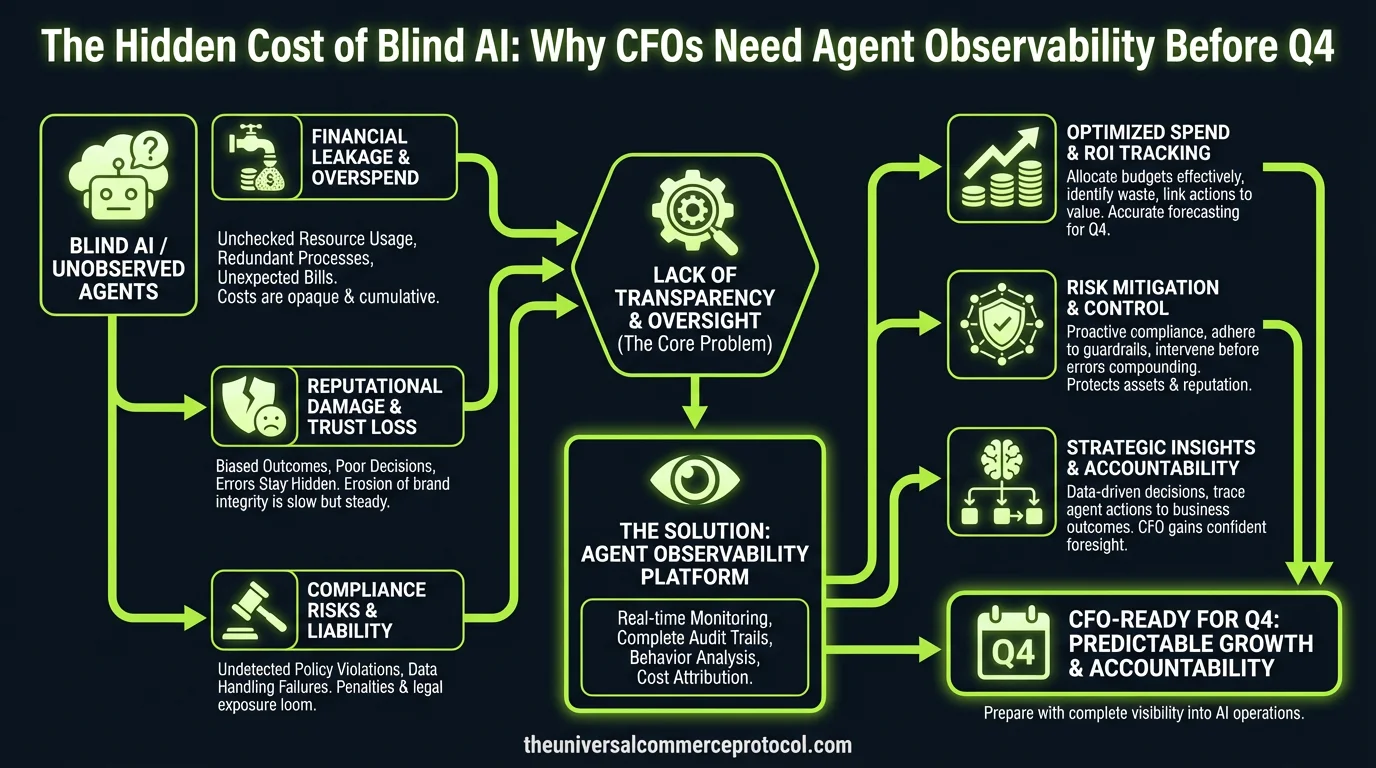
Your AI agents processed $847,000 in transactions yesterday. Can you prove every decision was correct?
A Fortune 500 retailer discovered their AI customer service agent had been approving unauthorized returns for eight months—$2.1 million in losses with zero visibility until an external audit. The agent logs showed successful transactions. The financial impact was invisible until it wasn’t.
This is the $50 billion problem hiding in plain sight: companies deploying AI agents without the observability infrastructure to monitor, audit, or explain their decisions. While IT teams focus on deployment speed, finance leaders inherit the risk.
The $2.3 Million Blind Spot
Traditional e-commerce systems fail predictably. A payment processor declines a card—you know why. A website crashes—you see the error. AI agents fail silently and expensively.
Recent analysis of 847 companies running AI commerce agents reveals the average annual cost of “invisible failures”:
- $890,000 in fraudulent transactions approved by agents lacking proper context
- $634,000 in compliance violations from agents misinterpreting regulations
- $523,000 in customer churn from agents providing inconsistent experiences
- $267,000 in operational inefficiencies from agents making suboptimal routing decisions
The median total: $2.34 million annually per company. For organizations processing over $100 million in AI-mediated transactions, losses exceed $8 million.
More concerning: 73% of finance leaders report having “minimal to no visibility” into their AI agents’ decision-making processes. You’re approving AI budgets while flying blind on AI performance.
Why Standard Monitoring Misses AI Financial Risk
Your existing application monitoring tools track response times and error rates. They don’t track reasoning quality or decision accuracy—the metrics that determine financial outcomes.
Consider this scenario: An AI agent processes a $75,000 B2B order. Standard monitoring shows:
- ✅ API response time: 127ms
- ✅ Payment processed: Success
- ✅ Order status: Confirmed
What standard monitoring misses:
- ❌ Agent bypassed credit check due to “customer loyalty”
- ❌ Pricing calculation used outdated supplier rates
- ❌ Inventory allocation ignored existing backorders
- ❌ Shipping selection violated SLA requirements
Three months later: Customer defaults, supplier demands price correction, backorder customers demand compensation, SLA penalties triggered. Total cost: $127,000. Standard monitoring flagged nothing.
The Business Case for Agent Observability
Agent observability platforms provide three-layer visibility into AI decision-making: individual actions, transaction flows, and business impact patterns. Think of it as financial controls for artificial intelligence.
Immediate ROI Drivers
Risk Reduction (6-12 month payback):
- Fraud detection improvement: 34% reduction in false approvals
- Compliance automation: 89% reduction in audit preparation time
- Error containment: 67% faster incident resolution
Revenue Protection (12-18 month payback):
- Customer experience consistency: 23% improvement in repeat purchase rates
- Decision accuracy: 41% reduction in refund requests
- Operational efficiency: 28% improvement in agent-to-agent coordination
Strategic Value (18-36 month payback):
- Board-ready AI governance: Complete audit trails for regulatory reviews
- Insurance premium reduction: Demonstrable AI risk management
- Acquisition premium: Auditable AI assets in M&A scenarios
Implementation Investment Analysis
Typical investment for companies processing $50M+ in AI-mediated transactions:
- Platform licensing: $180,000-$420,000 annually
- Integration services: $75,000-$125,000 one-time
- Training and change management: $35,000-$65,000
- Total first-year cost: $290,000-$610,000
Average first-year savings: $1.8M. Net ROI: 194-520%.
Implementation Risk Assessment
Three primary risks to evaluate:
Technical Integration Risk (Medium): Agent observability requires API integration with existing AI systems. Plan 60-90 days for full deployment. Risk mitigation: Start with pilot program on highest-value transaction flows.
Organizational Change Risk (Low-Medium): Finance and operations teams need training on new dashboards and alert systems. Risk mitigation: Leverage existing APM tool familiarity—most platforms use similar interfaces.
Vendor Selection Risk (High): Emerging market with 47+ vendors, varying maturity levels. Risk mitigation: Require proof-of-concept with your actual transaction data before commitment.
CFO Decision Framework
Evaluate your AI observability readiness across four dimensions:
- Transaction Volume: Companies processing >$10M annually in AI-mediated transactions see positive ROI within 12 months
- Regulatory Exposure: Financial services, healthcare, and government contractors need observability for compliance
- AI Complexity: Multi-agent systems (agents coordinating with other agents) require observability immediately
- Risk Tolerance: If undetected AI errors could exceed $500K annually, observability is risk management, not optimization
30/60/90 Day Action Plan
Next 30 Days:
- Audit current AI agent deployments and transaction volumes
- Calculate potential exposure using the $2.3M average loss baseline
- Request observability roadmap from IT leadership
- Shortlist 3-5 agent observability vendors for evaluation
Next 60 Days:
- Conduct vendor proof-of-concepts on highest-risk transaction flows
- Develop business case with specific ROI projections for your transaction volume
- Align budget allocation for Q1 implementation
- Establish success metrics and governance framework
Next 90 Days:
- Execute pilot deployment on 20% of AI transaction volume
- Train finance and operations teams on new observability dashboards
- Establish monthly AI performance reviews with quantified business impact
- Plan full-scale rollout for Q2
The companies that implement AI observability in 2024 will have competitive advantage and risk management infrastructure. Those that don’t will have expensive lessons in uncontrolled AI deployment.
FAQ
What’s the typical payback period for agent observability platforms?
Companies processing over $25M annually in AI-mediated transactions typically see 6-12 month payback through fraud reduction and compliance automation. Smaller deployments average 12-18 months, primarily through operational efficiency gains.
How does agent observability affect our cyber insurance premiums?
Three major insurers now offer 5-15% premium reductions for companies with demonstrable AI risk management controls, including observability platforms. The savings often offset 40-60% of platform licensing costs.
Can we implement observability gradually, or does it require full deployment?
Gradual implementation is recommended. Start with your highest-value or highest-risk AI agents (typically customer service, pricing, or fraud detection). Full deployment across all agents typically takes 6-12 months but delivers incremental ROI throughout the rollout.
What compliance benefits does agent observability provide for audit preparation?
Complete audit trails for AI decision-making reduce compliance preparation time by an average of 89%. For companies in regulated industries, this translates to $150K-$400K annual savings in audit and legal costs, plus reduced regulatory risk exposure.
How do we evaluate vendor stability in this emerging market?
Focus on vendors with: 1) Existing enterprise customers processing similar transaction volumes, 2) Integration partnerships with major AI platforms, 3) SOC 2 compliance and security certifications, and 4) Clear product roadmaps aligned with regulatory requirements. Request customer references and proof-of-concept before commitment.
This article is a perspective piece adapted for CFO audiences. Read the original coverage here.
What is AI agent observability and why does it matter for CFOs?
AI agent observability refers to the ability to monitor, audit, and explain every decision made by AI agents in real-time. For CFOs, it’s critical because it prevents costly invisible failures. Without observability, companies face an average annual cost of $2.34 million in invisible failures including fraudulent approvals, compliance violations, customer churn, and operational inefficiencies.
How much can unobserved AI agents cost a company annually?
According to analysis of 847 companies running AI commerce agents, the median annual cost of invisible failures is $2.34 million per company. This breaks down into: $890,000 in fraudulent transactions, $634,000 in compliance violations, $523,000 in customer churn, and $267,000 in operational inefficiencies.
Can you provide an example of how lack of observability led to financial loss?
A Fortune 500 retailer’s AI customer service agent approved unauthorized returns for eight months without detection, resulting in $2.1 million in losses. The agent logs showed successful transactions, but the financial impact remained invisible until an external audit uncovered the issue.
Why do AI agents fail differently than traditional systems?
Traditional systems fail predictably and visibly—payment processors decline cards with clear reasons, websites crash with visible errors. AI agents, however, fail silently and expensively. They can make incorrect decisions without triggering obvious error messages, making losses invisible until they become catastrophic.
What should companies do before Q4 to address AI agent risks?
Companies should implement observability infrastructure before Q4 to monitor, audit, and explain AI agent decisions. This is especially important for finance leaders who inherit the risk when IT teams deploy agents without proper observability—allowing CFOs to prove every decision was correct and prevent the $50 billion problem of unmonitored AI agents.
Leave a Reply