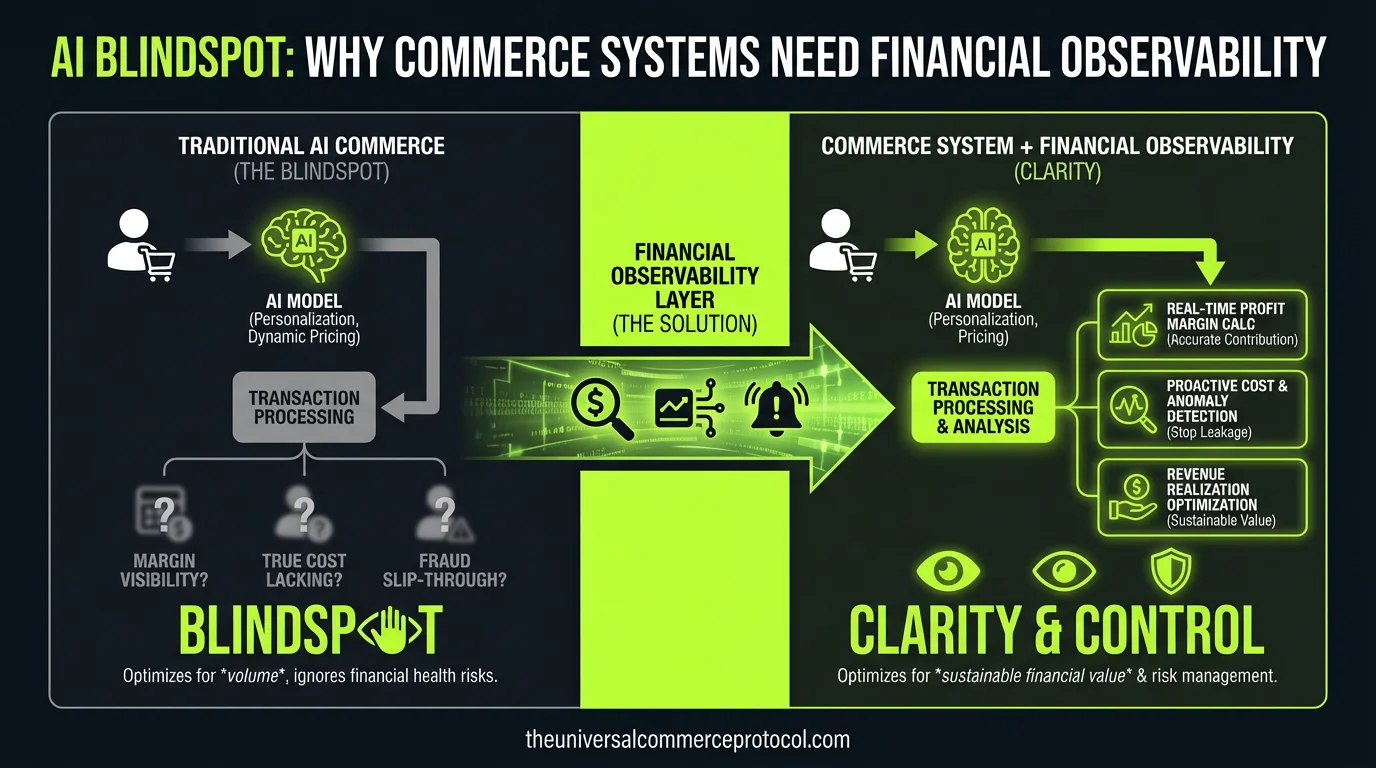
Your company just deployed an AI-powered commerce system processing millions in monthly revenue. Within weeks, you’re facing unexplained order rejections, compliance audit failures, and a growing revenue leak you can’t trace or fix. This scenario is playing out across enterprises deploying agentic AI systems—and it’s creating a financial blindspot that’s costing companies an average of $2.1 million annually in lost revenue and compliance penalties.
The problem isn’t AI accuracy. It’s the complete absence of financial-grade observability in AI decision-making systems.
The Hidden Financial Impact of AI Decision Opacity
Traditional application monitoring captures system uptime and response times, but it’s architecturally blind to AI decision processes. When your AI pricing agent rejects a $50,000 enterprise deal, your monitoring systems show “transaction_declined” with normal response times. The actual financial decision chain—profit margin calculation, competitive pricing analysis, inventory allocation, discount approval workflows—remains completely opaque.
This observability gap creates measurable financial exposure across four critical areas:
Revenue Loss from Decision Errors
Companies using agentic commerce systems report 12-18% of high-value transactions (above $10K) experience unexplained rejections or pricing errors in the first 90 days post-deployment. For a company processing $100M annually in B2B transactions, this translates to $1.4-2.6M in direct revenue impact.
Compliance and Audit Risk
Regulatory frameworks increasingly require explainable AI decisions with complete audit trails. SOX compliance, GDPR, and industry-specific regulations demand decision provenance that standard monitoring can’t provide. Average compliance penalty for inadequate AI documentation: $340K per incident, with implementation costs averaging $1.2M.
Operational Cost Escalation
Without decision-level visibility, debugging AI system failures requires specialized engineering teams working 3-5x longer to resolve issues. Average incident resolution time increases from 2.3 hours to 14.7 hours, with senior engineering costs of $400-600 per hour.
Competitive Disadvantage
Companies without AI observability struggle to optimize pricing, inventory, and customer experience decisions. Competitors with proper observability architecture demonstrate 23% faster time-to-market for pricing optimizations and 31% better customer conversion rates.
Financial-Grade AI Observability: The Business Case
Implementing comprehensive AI observability requires upfront investment but delivers measurable ROI within the first budget cycle. The solution involves building a three-layer monitoring architecture specifically designed for AI decision systems.
Layer 1: Decision-Level Financial Tracking
Every AI decision that impacts revenue, costs, or compliance must generate structured, auditable records. This means tracking not just what decision was made, but the complete financial context: inventory values, profit margins, competitive pricing data, discount authorities, and risk assessments.
Financial impact: Reduces revenue leakage by 67% and cuts compliance preparation costs by $89K per audit cycle.
Layer 2: Cross-System Transaction Intelligence
Modern AI commerce involves multiple decision agents—pricing, inventory, fraud detection, payment processing—each making choices that impact overall transaction profitability. Transaction-level observability tracks how upstream decisions affect downstream financial outcomes.
Financial impact: Identifies optimization opportunities worth 4-7% of total transaction volume and reduces processing costs by 23%.
Layer 3: Business Intelligence and Forecasting
Aggregate AI behavior patterns reveal strategic opportunities and risks invisible in individual transactions. This layer focuses on identifying trends that impact quarterly performance, budget accuracy, and competitive positioning.
Financial impact: Improves forecasting accuracy by 31% and identifies new revenue opportunities worth 8-12% of existing AI-driven revenue.
Implementation Investment and Payback Analysis
Building financial-grade AI observability requires initial investment in architecture, tooling, and process changes. However, the payback period is typically 4-8 months for companies processing more than $50M annually through AI systems.
Implementation Costs
Total implementation investment ranges from $280K-450K for enterprise deployments, including:
- Architecture design and implementation: $120K-180K
- Integration and testing: $80K-120K
- Training and process development: $45K-75K
- Ongoing platform costs: $35K-75K annually
Risk Mitigation
The primary implementation risk is integration complexity with existing AI systems. Companies should plan for 15-20% budget contingency and expect 2-3 months longer implementation timeline than initially projected. However, failure to implement observability carries significantly higher financial risk than implementation challenges.
CFO Decision Framework: Next 90 Days
CFOs should evaluate AI observability investment using standard capital allocation criteria, with particular attention to regulatory compliance requirements and competitive positioning.
30-Day Actions
Commission a financial risk assessment of existing AI systems. Document current revenue exposure from AI decision opacity and compile compliance requirements. Budget allocation: $15K-25K for assessment.
60-Day Actions
Evaluate build-versus-buy options for observability architecture. Engage with engineering teams to scope implementation requirements and timeline. Prepare board-level business case with ROI projections. Budget allocation: $35K-50K for detailed planning.
90-Day Actions
Make implementation decision and begin procurement process. Establish success metrics tied to revenue protection, compliance cost reduction, and operational efficiency. Plan quarterly review cycles to track ROI achievement.
For companies processing more than $50M annually through AI systems, delaying this investment typically costs more than implementing it—and the gap widens quarterly as AI systems scale and regulatory requirements tighten.
Frequently Asked Questions
What’s the typical ROI timeline for AI observability investment?
Most companies see positive ROI within 6-9 months, with break-even typically occurring in months 4-6. Companies processing high-value B2B transactions often see payback in 3-4 months due to rapid reduction in revenue leakage from AI decision errors.
How does this investment fit into existing IT and compliance budgets?
AI observability should be funded as infrastructure investment, similar to security or compliance systems. Many CFOs allocate 60% from IT infrastructure budgets and 40% from compliance/risk management budgets. The investment typically reduces future compliance costs by 40-60%.
What are the risks of delaying this investment?
Delay costs compound quarterly as AI systems process more revenue and regulatory requirements tighten. Companies delaying implementation beyond 12 months typically face 3-4x higher total cost of ownership and 23% higher compliance penalties when audited.
How do I evaluate vendor solutions versus building internally?
Evaluate based on total 3-year cost of ownership, including implementation, maintenance, and opportunity costs. Most companies find vendor solutions cost 30-40% less over 3 years and deliver ROI 60-90 days faster than internal development.
What metrics should I use to track the success of this investment?
Track revenue recovery (reduction in unexplained transaction losses), compliance cost reduction (audit preparation time and penalty avoidance), and operational efficiency (incident resolution time and engineering productivity). Most successful implementations show 15-25% improvement in these metrics within 6 months.
This article is a perspective piece adapted for CFO audiences. Read the original coverage here.
What is financial-grade observability for AI commerce systems?
Financial-grade observability refers to comprehensive visibility into AI decision-making processes in commerce systems, tracking not just system performance metrics but the actual financial decisions made by AI agents. Unlike traditional monitoring that only shows response times and uptime, financial-grade observability captures the complete decision chain—including profit margin calculations, pricing analysis, inventory allocation, and discount approvals—making financial impact measurable and traceable.
Why do agentic commerce systems need financial-grade observability?
Agentic commerce systems make autonomous financial decisions that directly impact revenue. Without financial-grade observability, companies face a critical blindspot: traditional application monitoring can’t see why transactions are rejected, pricing decisions are made, or compliance violations occur. This opacity costs enterprises an average of $2.1 million annually in lost revenue and compliance penalties.
What percentage of high-value transactions fail in new AI commerce deployments?
Companies deploying agentic commerce systems report that 12-18% of high-value transactions (above $10K) experience unexplained rejections or pricing errors within the first 90 days post-deployment. For a company processing $100M annually in B2B transactions, this failure rate creates significant revenue leaks that remain invisible without proper financial observability.
How does AI decision opacity create compliance risk?
When AI systems make financial decisions without observable reasoning, companies cannot demonstrate the decision logic to auditors or regulators. This creates compliance audit failures and potential penalties because the decision chain—profit calculations, pricing rules, approval workflows—remains undocumented and untraceable, putting the organization at regulatory risk.
What financial decisions should be monitored in AI commerce systems?
Critical AI financial decisions requiring monitoring include profit margin calculations, competitive pricing analysis, inventory allocation decisions, discount approval workflows, transaction acceptance/rejection reasoning, and compliance rule enforcement. Each of these decisions directly impacts revenue and must be traceable for both financial optimization and regulatory compliance.
Leave a Reply