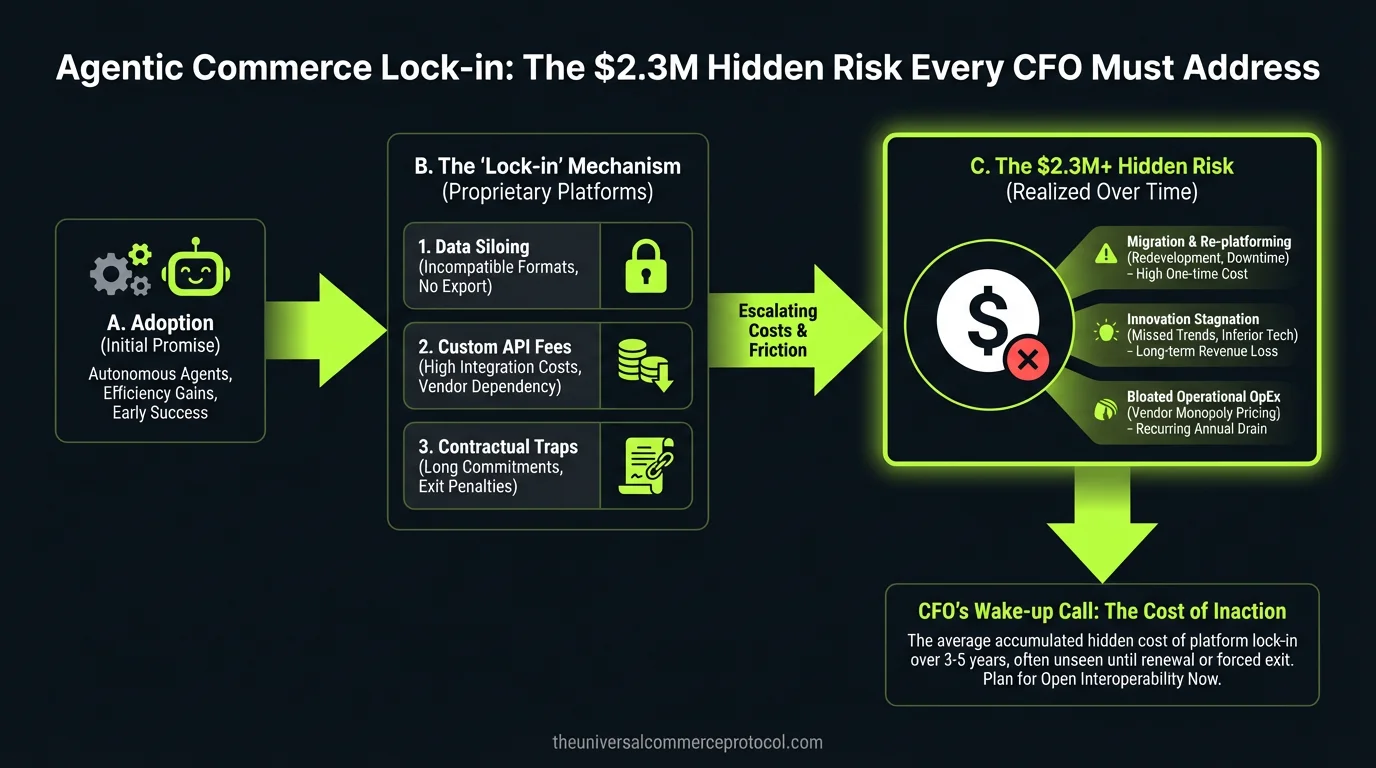
Agentic commerce—AI agents handling customer transactions on your behalf—is moving from pilot programs to production faster than most CFOs realize. While your e-commerce and technology teams are focused on conversion improvements and customer experience gains, a critical financial risk is being overlooked: vendor lock-in costs that can exceed $1 million for mid-market companies.
Unlike traditional e-commerce platform migrations, where you can export customer databases and rebuild storefronts, agentic commerce creates architectural dependencies that compound over time. A merchant running AI agents through Shopify’s ChatGPT integration cannot easily switch to Amazon’s emerging agent layer or Google’s Universal Commerce Protocol without complete system rebuilds.
For CFOs evaluating agentic commerce investments in 2024-2025 budget cycles, understanding these switching costs is essential for accurate ROI modeling and vendor negotiation strategy.
The Financial Impact: Why Agent Lock-in Costs More Than Platform Lock-in
Traditional e-commerce platform switching costs are well-understood: $50K-$200K for mid-market merchants to migrate from Shopify to Magento, including data migration, theme redesign, and integration work. Agentic commerce switching costs operate on a different scale entirely.
Recent observability research indicates merchants face a $2.3 million annual blind spot cost when agent systems lack proper monitoring and portability. This figure assumes merchants stay with their initial agent platform. Factor in switching costs of $500K-$1M for platform changes, and the total cost of ownership equation shifts dramatically.
The core driver: AI agents aren’t just software tools—they’re trained systems that learn from every transaction. When you switch platforms, you lose that institutional knowledge and must rebuild it from scratch.
Quantifying the Lock-in Components
Based on analysis of current implementations, switching costs break down across four categories:
Technical Rebuilding (40-50% of total cost): $200K-$500K for mid-market merchants to redesign agent workflows, rebuild inventory synchronization, and re-engineer approval processes across different LLM ecosystems (OpenAI, Claude, Gemini).
Data Migration and Retraining (30-35%): $150K-$350K to export decision logs, retrain behavioral models, and recreate compliance audit trails. Unlike database exports, this requires rebuilding AI model understanding.
Revenue Disruption (15-20%): $75K-$200K in lost revenue during transition periods, as agents require weeks or months to reach previous performance levels on new platforms.
Compliance and Audit Reset (5-10%): $25K-$100K to reestablish regulatory compliance trails and audit processes for financial services, healthcare, or other regulated verticals.
Why Standard Contract Terms Won’t Protect You
Most CFOs approach vendor risk through standard contract provisions: data portability clauses, termination rights, and escrow agreements. These mechanisms provide limited protection in agentic commerce environments.
The challenge is architectural rather than contractual. You can export your agent decision logs from OpenAI’s system, but you cannot directly import them into Claude or Gemini agents—the underlying decision trees, confidence scoring, and action frameworks are fundamentally incompatible.
This creates a scenario where vendors can comply with data portability requirements while still maintaining effective lock-in through technical incompatibility.
Board-Level Risk Considerations
For board reporting and risk management frameworks, agentic commerce lock-in represents a new category of technology debt with characteristics similar to ERP vendor dependency:
- High switching barriers: Costs that scale with system sophistication and transaction volume
- Competitive leverage: Vendors can extract premium pricing once merchants are deeply integrated
- Strategic constraints: Lock-in limits ability to respond to competitive threats or market opportunities
Unlike ERP systems, however, the switching cost curve is steeper—every transaction makes the next platform change more expensive.
The Universal Commerce Protocol: Evaluating Lock-in Mitigation Strategies
The Universal Commerce Protocol (UCP) represents the most credible approach to addressing agentic commerce portability. UCP aims to standardize communication between AI agents and merchant systems, similar to how payment processing standards enabled competition among payment providers.
Google’s expansion of UCP partnerships—including recent integration with Walmart—suggests enterprise-scale validation. However, current implementations focus on basic transaction flows rather than the complex portability requirements that drive switching costs.
For CFO evaluation, UCP adoption provides measurable risk mitigation:
Quantifiable Benefits of UCP Compliance
Reduced switching costs: UCP-compliant systems should reduce migration costs by 40-60% through standardized data formats and agent state management.
Negotiating leverage: Credible exit options strengthen vendor negotiations and pricing discussions.
Competitive flexibility: Ability to test and adopt new agent capabilities without full platform migration.
Audit simplification: Standardized decision logging across platforms reduces compliance complexity.
Implementation Risk Assessment and Budget Planning
For CFOs building 2024-2025 technology budgets, agentic commerce decisions require different risk modeling than traditional software purchases.
Recommended Financial Framework
Total Cost of Ownership (TCO) Horizon: Model 5-year costs including potential switching scenarios. Standard 3-year TCO models underestimate lock-in risk accumulation.
Vendor Concentration Risk: Apply portfolio risk principles—avoid concentrating more than 60% of transaction volume through single-vendor agent systems.
Exit Cost Reserves: Budget 15-20% of annual agent platform costs as switching cost reserves for rapid competitive response.
UCP Premium Justification: UCP-compliant solutions may carry 10-15% cost premiums but provide quantifiable risk reduction worth 25-40% of annual platform costs.
Strategic Decision Framework: Next Steps for CFOs
30-Day Actions:
- Audit current agent commerce pilots and proof-of-concepts for vendor dependency risk
- Request UCP compliance roadmaps from existing e-commerce technology vendors
- Establish cross-functional working group including CFO, CTO, and Chief Revenue Officer for agent strategy alignment
60-Day Actions:
- Develop vendor risk assessment framework specifically for agent commerce platforms
- Model switching cost scenarios for current agent implementations
- Negotiate data portability and UCP compliance requirements into existing vendor contracts
90-Day Actions:
- Establish budget reserves for agent platform switching costs in 2025 planning
- Create board-level reporting framework for agent commerce vendor risk
- Develop competitive response scenarios requiring rapid agent platform changes
The agentic commerce transformation is inevitable, but the financial terms are still negotiable. CFOs who address lock-in risk proactively will maintain strategic flexibility while their competitors become trapped in single-vendor ecosystems with compounding switching costs.
Frequently Asked Questions
How do I calculate potential switching costs for our specific business?
Start with annual transaction volume processed by agents, multiply by $0.50-$2.00 per transaction (based on complexity), then add technical rebuilding costs of $200K-$500K. Most mid-market merchants should budget $500K-$1M for complete platform switches.
Should we delay agent commerce adoption until portability standards mature?
No—competitive advantages from early adoption typically outweigh lock-in risks. Instead, negotiate UCP compliance roadmaps and build switching cost reserves into your technology budget.
Can we reduce lock-in risk through multi-vendor strategies?
Yes, but operational complexity increases significantly. Consider splitting agent usage by function (customer service vs. sales) or customer segment rather than running parallel systems for the same use cases.
What contract terms provide the best protection against excessive switching costs?
Focus on UCP compliance commitments, standardized data export formats, and performance guarantees during migration periods. Traditional termination clauses provide limited protection against architectural lock-in.
How do we justify UCP compliance requirements to vendors who resist standardization?
Frame UCP as risk management requirement for enterprise customers. Vendors focused on long-term market share will recognize that lock-in strategies limit their addressable market among sophisticated buyers.
This article is a perspective piece adapted for CFO audiences. Read the original coverage here.
What is agentic commerce and why should CFOs care about it?
Agentic commerce refers to AI agents that handle customer transactions autonomously on behalf of your business. CFOs should care because it creates vendor lock-in risks that can exceed $1 million for mid-market companies, with switching costs that compound over time and are significantly higher than traditional e-commerce platform migrations.
How much more expensive is agentic commerce lock-in compared to traditional platform switching?
While traditional e-commerce platform migrations cost $50K-$200K for mid-market merchants, agentic commerce lock-in can exceed $2.3M due to architectural dependencies. These higher costs stem from the complexity of rebuilding AI agent systems and the deeper integration with vendor infrastructure.
Can I easily switch between different agentic commerce providers?
No. Unlike traditional e-commerce where you can export databases and rebuild storefronts, agentic commerce creates architectural dependencies that are difficult to unwind. For example, a merchant using Shopify’s ChatGPT integration cannot easily switch to Amazon’s agent layer or Google’s Universal Commerce Protocol without complete system rebuilds.
What should CFOs do to mitigate agentic commerce lock-in risks?
CFOs should factor switching costs into accurate ROI modeling, negotiate vendor contracts with exit clauses and data portability guarantees, and develop contingency plans for potential vendor changes before committing to large-scale agentic commerce implementations.
When should I evaluate agentic commerce for my business?
The 2024-2025 budget cycle is critical for evaluation, as agentic commerce is moving from pilot programs to production faster than most CFOs realize. Early evaluation allows you to understand the financial implications and incorporate lock-in risks into your vendor selection strategy.
Leave a Reply