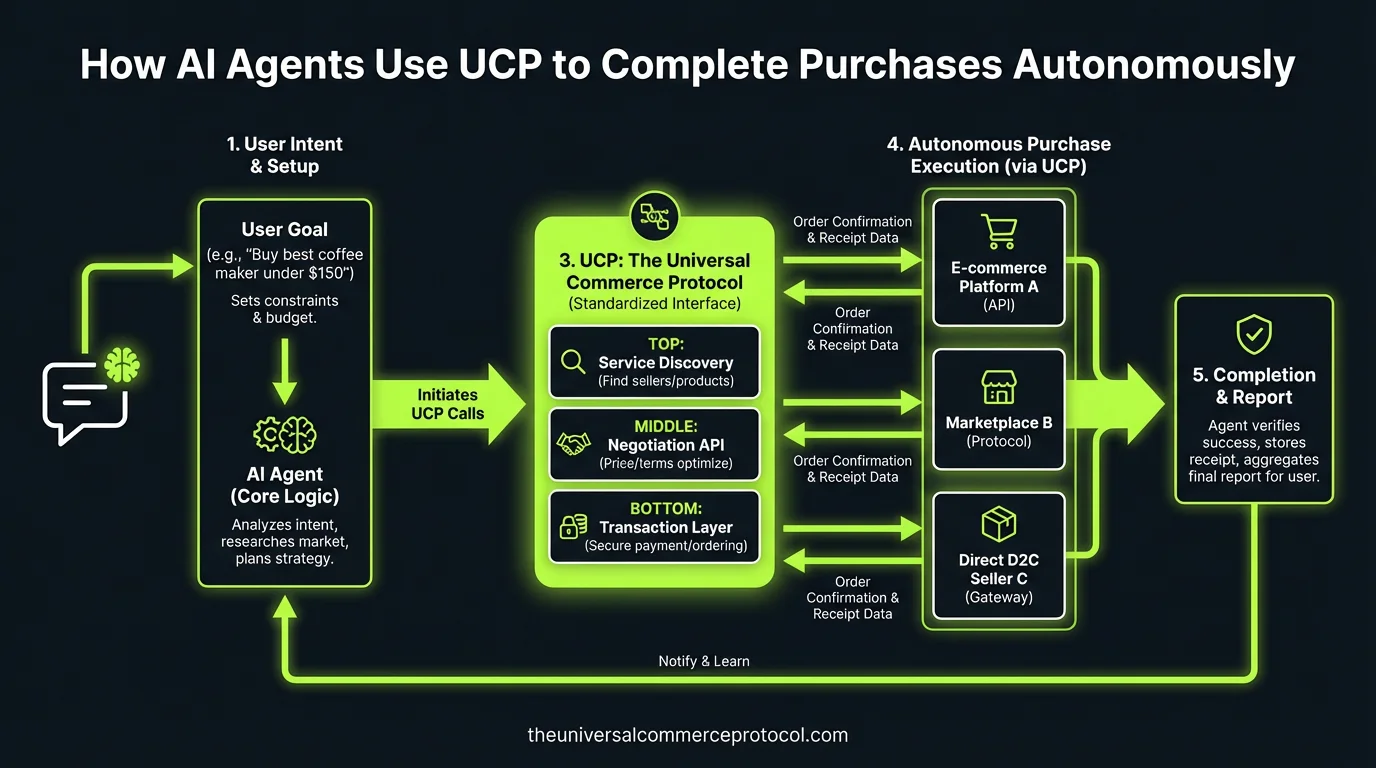
How AI Agents Use UCP to Complete Purchases Autonomously
The Universal Commerce Protocol (UCP) has fundamentally transformed how artificial intelligence agents interact with e-commerce systems. Rather than requiring human intervention at each transaction stage, AI agents can now autonomously complete entire purchase flows—from product discovery through payment and fulfillment—using standardized UCP interfaces. This capability represents a paradigm shift in commerce automation, enabling merchants to serve customers through intelligent agents while maintaining security, compliance, and user control.
Understanding UCP’s Role in Autonomous Transactions
The Foundation: UCP as a Commerce API Standard
The Universal Commerce Protocol provides a standardized framework for commerce interactions that AI agents can reliably interpret and execute. Unlike proprietary APIs that require custom integration for each merchant, UCP establishes common patterns for product catalogs, inventory management, cart operations, and payment processing. This standardization is critical for autonomous agents because it allows them to interact with thousands of merchants using identical logic flows.
Related articles: UCP Shipping Carrier Selection & Rate Optimization • UCP Security Best Practices for AI-Driven Commerce
When an AI agent receives a user request like “buy me the cheapest wireless headphones under $100 with next-day shipping,” the agent doesn’t need merchant-specific knowledge. Instead, it queries UCP-compliant product endpoints, filters results against standardized schemas, and processes transactions through UCP payment gateways. This abstraction layer is what makes true autonomous commerce possible at scale.
Protocol-Level Features Enabling Autonomy
UCP includes specific features designed explicitly for autonomous agent operations. The protocol defines standardized request/response structures for cart management, allowing agents to programmatically add items, apply discounts, and validate orders. UCP’s inventory endpoints provide real-time stock data that agents use to make informed purchasing decisions without human verification.
Crucially, UCP includes agent authentication mechanisms separate from end-user credentials. This allows merchants to grant specific agents permission to execute transactions on behalf of users while maintaining audit trails and transaction limits. An agent might be authorized to spend up to $500 per transaction or access specific product categories, with all actions logged for compliance purposes.
The Autonomous Purchase Flow Architecture
Step 1: Intent Recognition and Product Discovery
When a user communicates intent to an AI agent—whether through natural language, voice commands, or structured requests—the agent first translates this into queryable parameters. The agent then leverages UCP’s product search endpoints to discover matching items. These endpoints return standardized product objects containing SKUs, pricing, availability, merchant information, and fulfillment options.
For example, an agent processing “I need office supplies for Monday’s presentation” might query UCP search with filters for product categories, delivery dates, and price ranges. The protocol’s standardized response format allows the agent to consistently evaluate options across different merchants without custom parsing logic for each vendor.
Step 2: Preference Application and Decision Making
Sophisticated AI agents maintain user preference profiles—preferred merchants, acceptable price ranges, delivery speed requirements, sustainability preferences, and brand loyalty information. During autonomous purchase flows, agents apply these preferences to filter and rank product options. UCP’s standardized merchant metadata allows agents to evaluate seller reputation, return policies, and historical performance without human intervention.
The agent’s decision-making process is deterministic and explainable. Rather than making opaque choices, autonomous agents using UCP should provide clear reasoning: “Selected Option A because it matches your preferred brand, arrives by your deadline, and is $15 cheaper than alternatives.” This transparency is essential for user trust and regulatory compliance.
Step 3: Cart Construction and Validation
Once the agent selects products, it constructs a cart using UCP’s standardized cart endpoints. The protocol allows agents to programmatically add items, specify quantities, select shipping methods, and apply promotional codes—all through consistent API operations. Critically, UCP includes validation endpoints that agents must call before payment authorization.
These validation endpoints verify that selected items remain in stock, prices haven’t changed, shipping addresses are valid, and promotional codes still apply. This validation step is essential because autonomous transactions operate in dynamic environments where conditions can change between discovery and purchase. The agent doesn’t proceed to payment until validation confirms the cart state matches user expectations.
Step 4: Payment Authorization Through UCP Gateways
UCP defines standardized payment interfaces that agents use for autonomous authorization. Rather than agents directly handling payment credentials, UCP implements token-based payment flows where user payment methods are registered once and referenced by token during autonomous transactions. This architecture dramatically reduces security risks while enabling autonomous execution.
When an agent reaches the payment stage, it submits a UCP payment request containing the cart total, merchant identifier, user payment token, and billing address. The UCP payment gateway processes this request using the same security protocols as human-initiated transactions—including fraud detection, 3D Secure validation where required, and PCI compliance enforcement. The agent receives a payment response indicating success or failure, along with transaction identifiers for reconciliation.
Step 5: Order Confirmation and Fulfillment Initiation
Upon successful payment, the agent receives an order confirmation containing standardized UCP order objects. These objects include order identifiers, merchant fulfillment details, estimated delivery dates, and tracking information. The agent can then communicate confirmation details to the user through its native interface—whether that’s a chat message, voice notification, or app push notification.
Importantly, UCP’s fulfillment endpoints allow agents to track order status autonomously. The agent can monitor shipment progress and proactively notify users of delays or delivery confirmations without requiring manual status checks. This closed-loop automation creates seamless user experiences where purchases feel effortless.
Security and Authorization Controls for Autonomous Agents
Agent-Level Permission Scoping
UCP implements granular permission models that allow users to authorize agents with specific transaction capabilities. A user might authorize an agent to purchase groceries up to $200 per transaction but restrict it from purchasing electronics. These permissions are enforced at the protocol level, not just in application logic, ensuring consistent security across all merchants.
Agents operate under delegated authority—they execute transactions on behalf of users, not as independent actors. UCP requires agents to include user delegation tokens in all transaction requests, creating clear audit trails of who authorized each purchase. This delegation model is critical for regulatory compliance and dispute resolution.
Fraud Detection Integration
UCP payment endpoints integrate with merchant fraud detection systems that specifically understand autonomous transaction patterns. These systems recognize that legitimate autonomous purchases often exhibit different characteristics than human transactions—they might involve multiple purchases from the same agent in rapid succession, or purchases at unusual times. Sophisticated fraud detection prevents false declines while catching genuinely suspicious activity.
Agents also participate in fraud prevention by providing context about their decision-making. When submitting a payment request, agents can indicate confidence levels in their purchasing decisions, explain why they selected specific merchants, and flag any unusual conditions. This contextual information helps fraud systems distinguish between legitimate automation and compromised accounts.
Real-World Implementation Patterns
E-Commerce Assistant Agents
The most common autonomous agent implementation uses UCP to power shopping assistants that complete routine purchases. A user tells their AI assistant “reorder my usual office supplies,” and the agent accesses the user’s purchase history through UCP merchant APIs, identifies the previously purchased items, checks current availability and pricing, and completes the transaction autonomously. This pattern dramatically reduces friction for repeat purchases.
Subscription and Replenishment Agents
Agents can autonomously manage subscription renewals and consumable replenishment using UCP’s scheduled transaction capabilities. A user authorizes an agent to reorder household essentials monthly or renew software subscriptions quarterly. The agent monitors inventory, evaluates pricing changes, and executes transactions according to the schedule while respecting user-defined parameters around maximum prices or preferred brands.
Comparative Shopping and Price Optimization
Advanced agents use UCP to continuously monitor prices across multiple merchants for products in the user’s watch list or frequent purchase categories. When prices drop below user-specified thresholds, agents can autonomously execute purchases or alert users to opportunities. This pattern requires agents to maintain state across multiple UCP queries and make time-sensitive decisions.
Developer Considerations for Agent Integration
Implementing UCP Payment Callbacks
Developers building autonomous agents must implement robust handling of UCP payment callbacks. After submitting a payment request, agents should not assume immediate success or failure. Instead, they should register webhooks that receive asynchronous payment status updates, allowing them to handle delayed authorizations, fraud holds, or payment method failures gracefully.
State Management Across Distributed Transactions
Autonomous transactions often span multiple UCP calls across different merchants. An agent might query inventory, apply discounts, validate addresses, and process payments—each step potentially failing or requiring retry logic. Developers must implement robust state machines that track transaction progress, handle partial failures, and maintain consistency if network issues interrupt the flow.
User Notification and Transparency
While agents execute autonomously, users expect transparency about purchase decisions. Developers should implement logging that captures agent reasoning—why specific merchants were selected, what prices were compared, and what preferences were applied. This information should be accessible to users for review and audit purposes, supporting both trust and regulatory compliance.
FAQ: AI Agents and UCP Autonomous Purchases
Q: Can users revoke agent authorization mid-transaction?
A: Yes, UCP supports real-time permission revocation. If a user revokes an agent’s authorization, the agent cannot complete new transactions, though in-flight transactions that have already received payment authorization will complete. Users can also set per-transaction approval requirements for high-value purchases, requiring explicit confirmation before autonomous execution.
Q: How does UCP handle cases where products sell out during autonomous checkout?
A: UCP’s validation endpoints check inventory immediately before payment authorization. If an item becomes unavailable during the validation step, the checkout fails before payment is processed. Sophisticated agents can implement fallback logic—automatically substituting alternative products or alerting users to out-of-stock conditions—but they cannot proceed to payment with unavailable items.
Q: Are autonomous purchases subject to the same consumer protections as human transactions?
A: Yes, UCP-processed autonomous purchases carry identical consumer protections. Chargebacks, returns, and dispute resolution operate identically whether purchases were human-initiated or agent-initiated. The delegation model ensures that users retain full responsibility and protection rights for all transactions executed on their behalf.
Q: What prevents an agent from making unauthorized purchases with stolen credentials?
A: UCP implements multiple security layers. First, agents require explicit user authorization before accessing payment methods. Second, permission scoping limits transaction amounts and categories. Third, fraud detection monitors for suspicious patterns. Fourth, all agent transactions are logged with full audit trails. Finally, UCP supports transaction confirmation requirements where high-value purchases require user approval.
Q: How do merchants benefit from accepting autonomous agent transactions?
A: Merchants benefit through increased transaction volume, higher average order values from repeat purchases, reduced shopping cart abandonment, and valuable data about autonomous purchase patterns. Agents often execute transactions at off-peak times, smoothing demand. Additionally, agents typically maintain higher order values and lower return rates than average human shoppers.
Frequently Asked Questions
What is the Universal Commerce Protocol (UCP)?
The Universal Commerce Protocol (UCP) is a standardized framework for commerce interactions that enables AI agents to reliably interpret and execute purchase transactions. It establishes common patterns for product catalogs, inventory management, cart operations, and payment processing across different merchants, eliminating the need for custom integrations.
How do AI agents use UCP to complete purchases autonomously?
AI agents use UCP’s standardized interfaces to autonomously complete entire purchase flows—from product discovery through payment and fulfillment. Because UCP provides consistent patterns across merchants, agents can interact with thousands of different e-commerce systems using identical logic flows without requiring human intervention at each transaction stage.
What are the benefits of autonomous purchase completion using UCP?
Autonomous purchase completion using UCP enables merchants to serve customers through intelligent agents while maintaining security, compliance, and user control. This capability represents a paradigm shift in commerce automation, allowing faster transactions and improved customer experience without manual intervention.
Why is UCP standardization important for AI agents in commerce?
UCP standardization is critical for autonomous agents because it allows them to operate across multiple merchants using the same underlying logic. Without standardized interfaces, each merchant would require custom integration, making it impractical for AI agents to scale across the e-commerce ecosystem.
Does UCP maintain security and compliance for autonomous transactions?
Yes, UCP is designed to enable autonomous transactions while maintaining security, compliance, and user control. The protocol ensures that merchants can serve customers through intelligent agents without compromising safety standards or regulatory requirements.
Leave a Reply