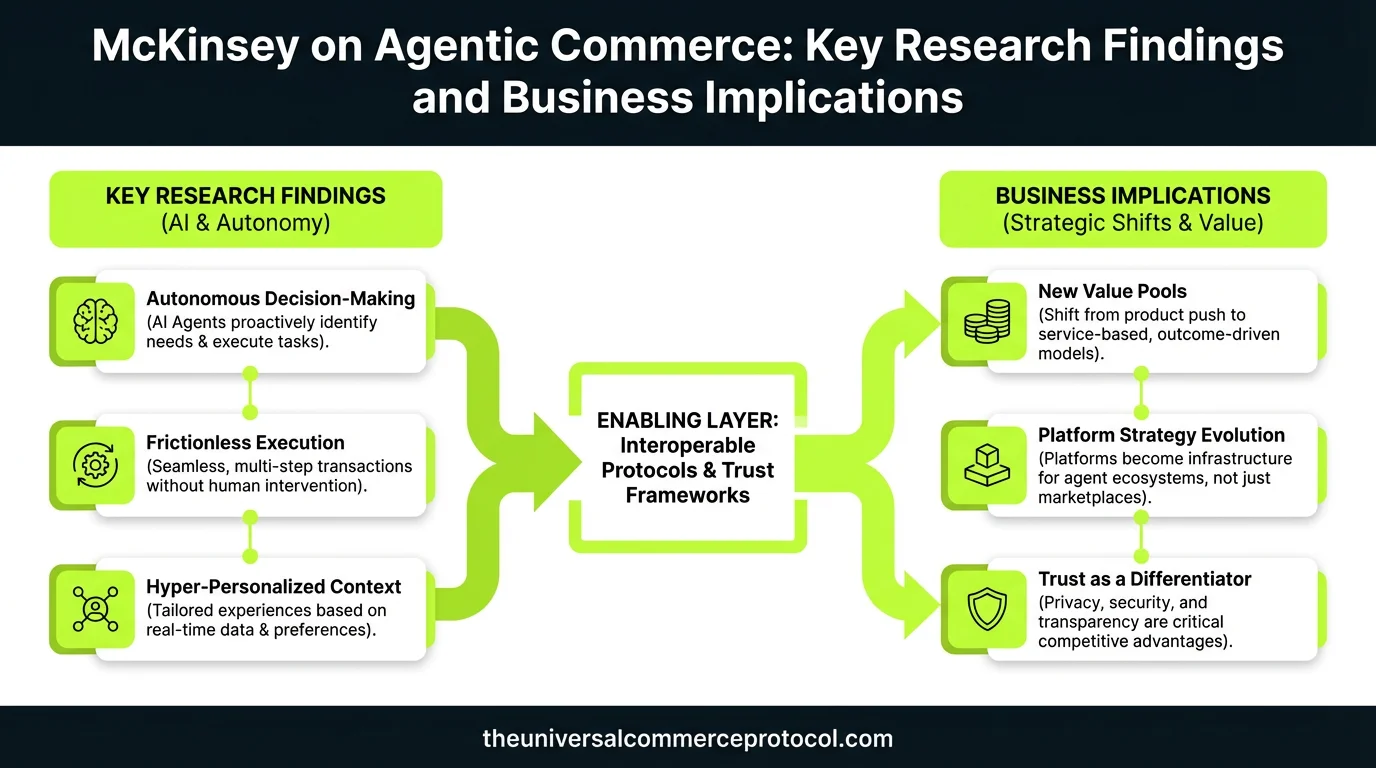
McKinsey’s Vision of the Agentic Economy
McKinsey & Company has positioned agentic commerce as one of the most significant shifts in enterprise technology since cloud computing. Their research indicates that autonomous AI agents capable of executing commerce transactions independently will reshape how businesses interact with customers, manage operations, and generate revenue. This transformation extends beyond simple chatbots or recommendation engines—it encompasses fully autonomous systems that can negotiate, transact, and optimize outcomes without human intervention at each step.
The consulting firm defines agentic commerce as the use of AI agents to autonomously execute commercial transactions, manage customer relationships, and optimize business processes. McKinsey estimates that organizations implementing agentic systems could see productivity improvements of 20-40% in customer-facing operations, with potential revenue uplift ranging from 15-25% for early adopters.
Key McKinsey Research Findings on Agentic Commerce
1. The Scale of Economic Opportunity
McKinsey’s research suggests the agentic economy could add trillions in economic value globally. Their analysis indicates that approximately 70% of business processes contain elements that could be automated through agentic systems. Industries including financial services, retail, healthcare, and telecommunications stand to benefit most significantly from agentic commerce implementations.
The firm projects that by 2030, agentic commerce could account for 30-50% of all B2B transactions and 20-35% of B2C transactions. This represents a fundamental shift in how commerce operates at scale.
2. Enterprise Readiness Challenges
Despite the opportunity, McKinsey found that most enterprises face significant barriers to agentic commerce adoption:
- Legacy system integration complexity—78% of enterprises report difficulty connecting AI agents to existing commerce infrastructure
- Data standardization issues—inconsistent data formats across systems prevent agents from functioning effectively
- Trust and governance concerns—organizations struggle with establishing accountability frameworks for autonomous transactions
- Interoperability gaps—proprietary agent systems cannot communicate across different platforms and vendors
McKinsey’s research emphasizes that technical capability alone is insufficient; enterprises need standardized protocols and frameworks to unlock agentic commerce at scale.
3. Industry-Specific Applications
McKinsey identified distinct use cases across sectors:
- Financial Services: Autonomous trading agents, customer service automation, and fraud detection systems operating 24/7 without human intervention
- Retail & E-Commerce: Dynamic pricing agents, inventory optimization systems, and personalized commerce experiences powered by autonomous decision-making
- Supply Chain: Procurement agents executing purchases autonomously based on demand signals, cost optimization, and supplier performance
- Healthcare: Administrative automation for claims processing, appointment scheduling, and patient engagement
4. The Critical Role of Standardization
A central finding in McKinsey’s research is that standardized commerce protocols are essential for agentic systems to operate effectively. The consulting firm notes that fragmented, proprietary approaches limit agent capabilities and increase implementation costs. McKinsey specifically highlights the need for universal standards that enable agents to communicate across different vendor ecosystems and business networks.
This finding directly aligns with the Universal Commerce Protocol (UCP), which provides the standardized framework McKinsey identifies as critical for scaling agentic commerce.
UCP as the Infrastructure for McKinsey’s Agentic Vision
Bridging the Standardization Gap
The Universal Commerce Protocol addresses the interoperability challenges McKinsey identifies as blocking widespread agentic commerce adoption. UCP provides:
- Standardized message formats and transaction protocols that enable agents from different vendors to communicate seamlessly
- Vendor-neutral architecture supporting multi-platform agent deployment
- Consistent data structures eliminating the standardization issues McKinsey research highlights
- Governance frameworks that establish clear accountability for autonomous transactions
Enabling Autonomous Agent Orchestration
UCP’s architecture enables the orchestration of multiple autonomous agents across different systems and organizations. McKinsey’s research emphasizes that enterprise agentic commerce requires agents to operate across multiple touchpoints—from procurement through fulfillment. UCP provides the connective tissue enabling this orchestration.
Companies implementing UCP-compliant agentic systems can deploy agents that autonomously:
- Negotiate terms and conditions with suppliers using standardized protocols
- Execute transactions across multiple channels and platforms
- Coordinate inventory and fulfillment across distributed networks
- Optimize pricing and promotions in real-time based on market conditions
Real-World Implementation Context
Leading technology companies and enterprises are beginning to recognize the importance of standardized protocols for agentic commerce. Organizations like Shopify, SAP, and Oracle are exploring how standardized protocols can enable their platforms to support autonomous commerce agents. The adoption of UCP-aligned standards creates a foundation where agents can operate across these platforms without proprietary lock-in.
McKinsey’s Recommendations for Enterprise Adoption
1. Prioritize Interoperability from Day One
McKinsey advises enterprises to evaluate agentic commerce platforms based on their support for open standards and interoperability. Organizations should resist vendor lock-in by selecting solutions that support protocol-based integration rather than proprietary APIs. This approach aligns with UCP’s design philosophy and ensures long-term flexibility.
2. Start with High-Impact, Low-Risk Use Cases
The consulting firm recommends beginning with autonomous agents focused on well-defined, repetitive processes where outcomes are easily measurable. Typical starting points include:
- Procurement automation for commodity purchases
- Customer service routing and basic inquiry handling
- Inventory rebalancing across distribution networks
- Dynamic pricing optimization within defined parameters
These implementations build organizational confidence while demonstrating ROI before expanding to more complex agentic systems.
3. Establish Governance and Accountability Frameworks
McKinsey emphasizes that autonomous transactions require clear governance structures. Organizations must define:
- Decision authority limits for autonomous agents
- Audit trails and transparency mechanisms
- Escalation procedures for edge cases and exceptions
- Compliance and regulatory adherence protocols
UCP’s governance layer provides the foundation for implementing these frameworks consistently across agent deployments.
4. Invest in Data Infrastructure
McKinsey’s research identifies data quality and standardization as prerequisites for effective agentic commerce. Organizations should invest in:
- Master data management systems ensuring consistent product, customer, and transaction information
- Data governance frameworks establishing clear ownership and quality standards
- Integration platforms that normalize data across legacy and modern systems
Business Implications and Expected Outcomes
Revenue and Efficiency Gains
McKinsey’s modeling suggests enterprises implementing comprehensive agentic commerce strategies could realize:
- 15-25% revenue increase through improved customer experience and conversion optimization
- 20-40% operational efficiency gains in customer-facing and back-office processes
- 10-15% cost reduction in transaction processing and fulfillment
- Improved cash flow through autonomous payment and receivables management
Competitive Dynamics
McKinsey warns that agentic commerce adoption will create significant competitive divergence. Early adopters in each industry will establish performance advantages that become difficult for laggards to overcome. The consulting firm projects a 3-5 year window where first-mover advantages are most pronounced, after which agentic capabilities become table-stakes for competitive viability.
Organizational Transformation
Beyond financial metrics, McKinsey’s research indicates agentic commerce will fundamentally reshape enterprise organization structures. Rather than eliminating roles, agentic systems will shift human workers toward higher-value activities including:
- Agent design, training, and optimization
- Exception handling and complex decision-making
- Strategic business process redesign
- Customer relationship management at premium tiers
Conclusion: The Path Forward
McKinsey’s research provides a clear roadmap: agentic commerce represents a fundamental shift in how enterprises conduct business, but realizing this opportunity requires standardized protocols and frameworks. The Universal Commerce Protocol provides the infrastructure McKinsey identifies as critical for scaling agentic commerce across organizations and industries.
Enterprises beginning their agentic commerce journey should prioritize interoperability, start with high-impact use cases, establish governance frameworks, and invest in data infrastructure. Organizations that align their agentic strategies with open standards like UCP will be best positioned to capture the significant value McKinsey’s research identifies.
FAQ: McKinsey Agentic Commerce Research
What does McKinsey define as agentic commerce?
McKinsey defines agentic commerce as the use of AI agents to autonomously execute commercial transactions, manage customer relationships, and optimize business processes without requiring human intervention at each step. These systems go beyond traditional automation to make independent decisions within defined parameters.
How much economic value does McKinsey project for agentic commerce?
McKinsey estimates the agentic economy could add trillions in economic value globally, with agentic commerce potentially accounting for 30-50% of B2B transactions and 20-35% of B2C transactions by 2030. Early adopters could see revenue increases of 15-25% and operational efficiency gains of 20-40%.
What are the main barriers to agentic commerce adoption according to McKinsey?
McKinsey identifies four primary barriers: legacy system integration complexity, data standardization issues, trust and governance concerns, and interoperability gaps between proprietary systems. The consulting firm emphasizes that standardized protocols are essential to overcome these barriers at scale.
How does the Universal Commerce Protocol support McKinsey’s agentic commerce vision?
UCP provides the standardized framework McKinsey identifies as critical for scaling agentic commerce. It enables vendor-neutral agent deployment, standardized communication between autonomous systems, consistent data structures, and governance frameworks that establish accountability for autonomous transactions across organizations.
Frequently Asked Questions
What is the Universal Commerce Protocol (UCP)?
The Universal Commerce Protocol (UCP) is an open standard developed to enable AI agents to autonomously conduct commerce transactions across any platform.
How does UCP enable agentic commerce?
UCP provides standardized APIs and protocols so AI agents can discover products, negotiate terms, and complete purchases without human intervention, working across any compatible commerce platform.
Why should businesses implement UCP?
UCP adoption reduces integration costs, opens revenue channels to AI-driven buyers, and future-proofs commerce infrastructure as agentic purchasing becomes mainstream.
Leave a Reply