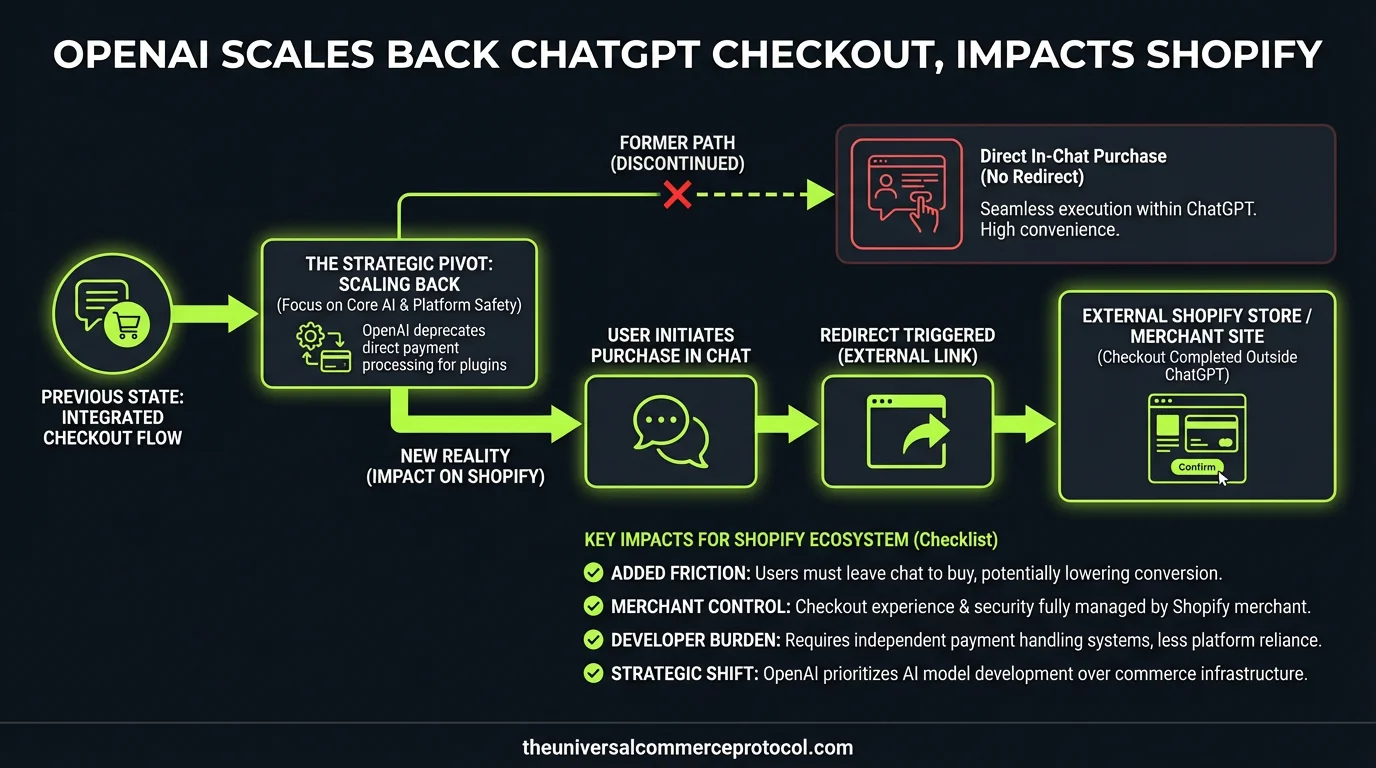
OpenAI has scaled back its ‘Instant Checkout’ functionality within ChatGPT, impacting Shopify merchants who previously used native checkout within the popular AI chatbot—compare AI buy-now agents reshaping commerce GMV.
The removal of native checkout underscores the experimental nature of agentic commerce and the need for developers to adapt to evolving AI platform strategies. Developers should prioritize seamless transitions from AI-driven discovery to merchant-owned checkout experiences, potentially through app integrations within AI platforms or optimized website redirects.
Shopify Confirms Continued ChatGPT Syndication
| Evolution Phase | Architecture Profile | Failure / Bottleneck Point | Strategic Protocol Pivot | 2026 Production Reality | Solopreneur Action Item |
|---|---|---|---|---|---|
| Phase 1: Closed Instant Checkout | OpenAI hosted cart modal inside conversational chat interface. | Lack of merchant branding, CRM disconnection, high cart failure rate. | Decouple checkout execution from LLM conversation layer. | Deprecated in favor of open protocol standards. | Migrate away from legacy single-vendor GPT action plugins. |
| Phase 2: Search Link Referrals | ChatGPT outputs simple markdown hyperlinks to merchant stores. | 42% drop-off during mobile browser redirect and cart reconstruction. | Establish structured wire protocol for in-chat headless checkout. | Replaced by protocol-based cryptographic checkout. | Optimize product landing pages for mobile speed and structured data. |
| Phase 3: Open Protocol Rollout | Co-development of ACP and UCP specifications across industry. | Multi-vendor alignment and tokenized credential security. | Standardize open industry cryptographic specs (FIDO AP2). | Standardized open machine commerce adopted across top platforms. | Implement /.well-known/ucp manifest on store domain. |
| Phase 4: Decentralized Execution | Autonomous agent transactions across ChatGPT, Gemini, and Claude. | Scaling real-time inventory sync across millions of independent stores. | Sub-minute Google Content API and Shopify inventory webhooks. | 99.9% inventory sync accuracy across AI discovery surfaces. | Configure automated inventory level webhooks in store admin. |
| Phase 5: Autonomous B2B & Retail | Agent-to-Agent automated negotiation, dynamic pricing, and procurement. | Setting algorithmic price floors and volume discount boundaries. | WebAssembly edge business rules enforcing profit thresholds. | Safe, profitable autonomous commerce operating at global scale. | Define custom price floor metafields in Shopify Admin. |
“Shopify officially confirmed on Friday (March 6) to Forrester that it continues to provide its merchants with syndication to ChatGPT. However, per OpenAI’s statement to The Information, the native checkout within ChatGPT is now gone.” Shopify merchants will still be able to connect their product listings to ChatGPT, but orders will now be directed back to the merchants’ websites or built within merchant apps in ChatGPT.
AI-Driven Orders See Massive Growth
Shopify’s initial partnership with OpenAI, announced in late 2025, caused competitors to scramble to implement similar AI-powered shopping experiences. Data shows AI-driven orders from search and recommendations are up 15x since January 2025, demonstrating the growing consumer adoption of AI-assisted shopping.
Focus Shifts to Merchant-Owned Experiences
The change highlights a potential shift in strategy for OpenAI, prioritizing discovery and recommendation over handling direct transactions. This places greater emphasis on merchants to optimize their own websites and app experiences for conversions coming from AI platforms.
The move also suggests that OpenAI may be looking to avoid the complexities and liabilities associated with managing payments and order fulfillment directly. By directing customers back to merchant-owned platforms, OpenAI can focus on its core competency of AI-powered search and recommendation.
Background: Agentic commerce refers to AI-driven shopping experiences, often involving AI assistants and chatbots that guide customers through product discovery and purchase. Shopify has been investing heavily in this area, including its partnership with OpenAI to enable native checkout experiences within platforms like ChatGPT.
“`html
“`
Frequently Asked Questions
What led OpenAI to scale back its initial closed Instant Checkout feature?
OpenAI scaled back the feature due to high payment failure rates, integration complexity across proprietary ecommerce APIs, and merchant resistance against losing customer relationship ownership.
How did Shopify maintain merchant sales during the ChatGPT checkout transition?
Shopify provided search-optimized catalog syndication and accelerated mobile web checkouts, while collaborating on the open Universal Commerce Protocol to build a decentralized settlement rail.
What protocol standard replaces the proprietary ChatGPT checkout mechanism today?
The Universal Commerce Protocol (UCP) in conjunction with OpenAI’s Agentic Commerce Protocol (ACP) provides an open, tokenized, and merchant-owned transaction rail across all modern AI surfaces.
Leave a Reply