The Universal Commerce Protocol (UCP) is not a theoretical standard sitting in a whitepaper — it is an active, production-grade protocol being adopted by some of the largest commerce platforms on the planet. Launched on January 11, 2026 at the National Retail Federation (NRF) conference, UCP was co-developed by Google in partnership with Shopify, and endorsed by Etsy, Wayfair, Target, Walmart, and more than 20 additional global organizations including Adyen, American Express, Best Buy, Flipkart, Macy’s Inc., Mastercard, Stripe, The Home Depot, Visa, and Zalando.
This article examines how the founding partners are integrating UCP into their platforms, what it means for the broader commerce ecosystem, and where the protocol stands in early 2026.
Shopify: Co-Developer and Infrastructure Backbone
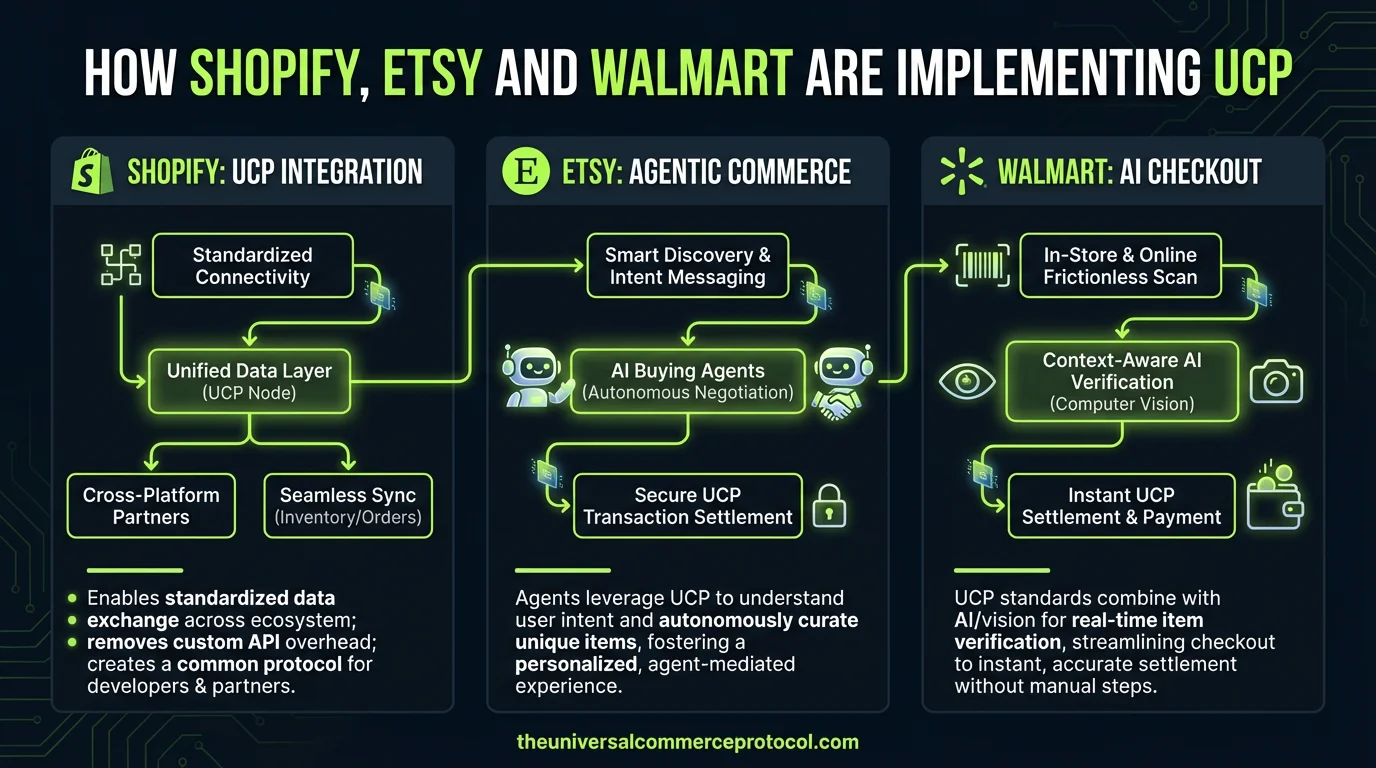
Shopify is not merely an endorser of UCP — it co-developed the protocol with Google. According to Shopify’s engineering blog, the company approached UCP design with a layered architecture philosophy: separating discovery, negotiation, checkout, and fulfillment into composable modules that mirror how TCP/IP layered networking responsibilities.
For Shopify’s millions of merchants, UCP integration is managed centrally through the Shopify Admin via a feature called Agentic Storefronts. This means merchants on Shopify do not need to build their own UCP endpoints — Shopify handles the protocol layer. Native shopping on Google surfaces is rolling out, enabling Shopify merchants to sell directly in AI Mode in Google Search and the Gemini app.
Shopify has also opened its Shopify Catalog to non-Shopify brands through a new Agentic plan. This means any merchant — regardless of their current ecommerce platform — can list products in Shopify’s catalog infrastructure and gain access to AI commerce channels.
Etsy and Wayfair: Early Live Implementations
As of February 2026, UCP-powered checkout is operational for U.S. shoppers purchasing from Etsy and Wayfair directly within AI Mode in Google Search and the Gemini app. These are among the first live implementations outside of Google’s own testing environment.
For Etsy, this integration is particularly significant. The marketplace’s strength lies in unique, handcrafted, and vintage items — products that benefit enormously from conversational discovery. When a shopper asks an AI agent for “a handmade ceramic mug with a blue glaze,” UCP enables the agent to query Etsy’s catalog, present matching products, and complete the purchase without redirecting the shopper to Etsy’s website.
Wayfair’s implementation highlights UCP’s ability to handle complex fulfillment scenarios. Furniture and home goods often involve specialized shipping, delivery windows, and assembly options. UCP’s modular extension system — specifically the dev.ucp.shopping.fulfillment extension — allows Wayfair to declare these capabilities so that AI agents can present accurate fulfillment options to shoppers during the conversation.
Target and Walmart: Upcoming Integrations
Google has confirmed that Target and Walmart integrations are scheduled to launch soon, though specific dates have not been provided. Both retailers participated in the co-development of UCP and were present at the NRF 2026 announcement.
For Target and Walmart, UCP represents a strategic counterweight to Amazon’s closed ecosystem. By adopting an open standard, these retailers maintain their status as Merchant of Record — meaning they retain full ownership of customer data, relationships, and post-transaction activities. This is a fundamentally different model from selling through Amazon’s marketplace, where the platform controls the customer relationship.
Payment Partners: Visa, Mastercard, Stripe, and Adyen
UCP’s payment architecture uses a payment handler model that decouples payment processing from the core protocol. Each payment provider — whether Google Pay, Shop Pay, Stripe, or a regional PSP — publishes their own handler specification. The merchant advertises which handlers they accept, and the AI agent selects one based on the shopper’s preferences and available credentials.
This design means that adding a new payment method to the UCP ecosystem does not require changes to the core protocol. Visa, Mastercard, Stripe, Adyen, and American Express have all endorsed UCP, signaling broad payment industry support. Google Pay is the launch payment method, with PayPal support confirmed as coming soon.
BigCommerce and Feedonomics: Data Layer Partners
Commerce (Nasdaq: CMRC), the parent company of BigCommerce and Feedonomics, endorsed UCP on the day of its announcement. Their role in the ecosystem centers on the data enrichment layer — structuring and optimizing product feeds to align with Google’s schema requirements. For merchants using BigCommerce, this means their product data can be automatically formatted for UCP compatibility through Feedonomics’ feed optimization tools.
The Competitive Landscape: UCP vs. ACP
It is worth noting that UCP is not the only agentic commerce protocol in development. OpenAI and Stripe have co-developed the Agentic Commerce Protocol (ACP), which currently powers Instant Checkout in ChatGPT. The key difference is scope: ACP focuses primarily on the checkout layer, while UCP is designed to standardize the entire commerce journey from product discovery through post-purchase support.
For merchants, this means the protocol landscape is still evolving. However, UCP’s open-source nature and broad industry endorsement give it a significant structural advantage in terms of ecosystem adoption.
What This Means for the Commerce Ecosystem
The significance of UCP’s partner roster cannot be overstated. When Google, Shopify, Target, Walmart, Visa, Mastercard, and Stripe all align behind a single open standard, it creates a gravitational pull that makes adoption increasingly inevitable for the rest of the industry. Merchants who implement UCP gain access to every AI surface that supports the protocol — today that means Google AI Mode and Gemini, but the open-source nature of UCP means any AI platform can adopt it.
The protocol is still in its early stages. Multi-item carts, account linking for loyalty programs, and post-purchase support for tracking and returns are all on the published roadmap. But the foundation is live, transactions are happening, and the partner ecosystem is growing.
Frequently Asked Questions
Which companies co-developed UCP with Google?
UCP was co-developed by Google in collaboration with Shopify, and endorsed by Etsy, Wayfair, Target, and Walmart. More than 20 additional organizations across retail and payments have endorsed the protocol, including Adyen, American Express, Best Buy, Flipkart, Macy’s Inc., Mastercard, Stripe, The Home Depot, Visa, and Zalando.
Is UCP live and processing real transactions?
Yes. As of February 2026, UCP-powered checkout is operational for U.S. shoppers purchasing from Etsy and Wayfair directly within AI Mode in Google Search and the Gemini app. Shopify, Target, and Walmart integrations are scheduled to launch soon.
Do merchants need to build their own UCP integration?
It depends on the platform. Shopify merchants get UCP integration managed centrally through the Shopify Admin. Merchants on other platforms may need to implement UCP endpoints directly or work with their platform provider. BigCommerce merchants can leverage Feedonomics for data layer compatibility.
How does UCP compare to OpenAI’s Agentic Commerce Protocol?
ACP, co-developed by OpenAI and Stripe, focuses primarily on the checkout layer for ChatGPT. UCP covers the entire commerce journey from discovery through post-purchase support, and is designed to work across multiple AI platforms rather than a single surface.
What payment methods does UCP support?
UCP uses a modular payment handler architecture. Google Pay is the launch payment method, with PayPal support coming soon. The protocol is endorsed by Visa, Mastercard, Stripe, Adyen, and American Express, and its handler model allows new payment methods to be added without changes to the core protocol.
Leave a Reply