Tag: Agentic Commerce
-

Common UCP Integration Errors and Troubleshooting Guide for Developers
Integrating with Google’s Universal Commerce Protocol (UCP) is a significant step towards enabling agentic commerce, but the journey from specification to…
-

UCP Pricing Model: Fees, Costs & Merchant Value (2026)
How UCP pricing works in 2026: consumption-based fees, what merchants control, how costs compare to bespoke agent integrations, and how to forecast ROI.
-

Cookieless Affiliate Tracking: How Attribution Works When AI Agents Shop
When AI agents shop, no browser opens, no cookie fires, no pixel loads. Traditional affiliate tracking breaks completely. Here is how attribution works in agentic commerce through server-side tracking, conversion APIs, and protocol-level attribution.
-
Shopify Spring ’26 Edition: UCP Powers Agentic Commerce & AI Sales
Shopify’s Spring ’26 Edition integrates Universal Commerce Protocol (UCP) for agentic commerce, enabling automatic product syndication to AI channels like ChatGPT & Copilot. Experience double conversion rates via Shop Pay.
-
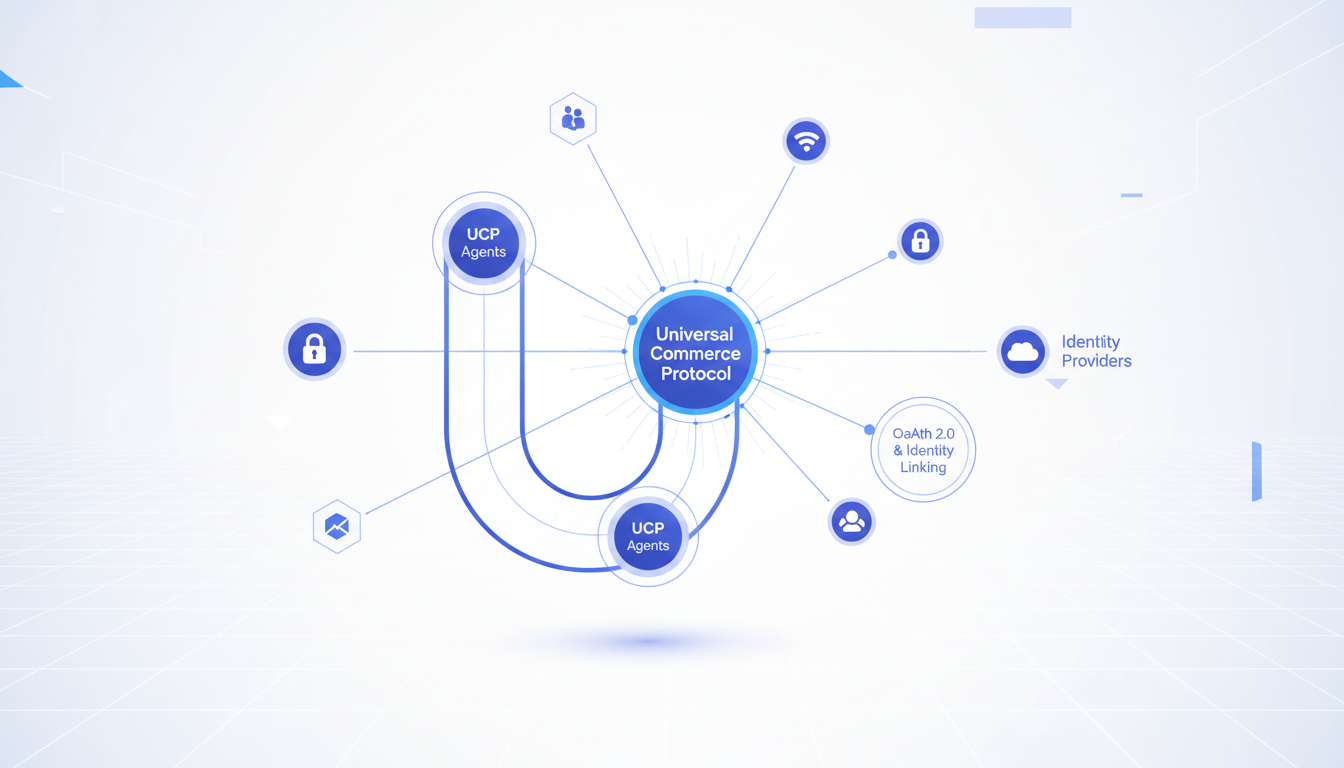
Implementing OAuth 2.0 & Identity Linking for UCP Agents
Technical deep dive into securing AI agent transactions using OAuth 2.0 and identity linking within the UCP framework.
-

UCP Gains Traction in AI Shopping
Google’s UCP powers AI checkout on its platforms.
-

Claude Marketplace & MCP: Anthropic’s Agentic Commerce
How Anthropic’s Claude Marketplace and Model Context Protocol (MCP) fit into agentic commerce in 2026. Includes platform comparison, MCP vs UCP architecture, GDPR data residency, and how Claude and UCP work together for the complete merchant stack.
-

UCP vs Claude Marketplace: Commerce Agent Architecture
The Universal Commerce Protocol (UCP) is an open-source integration standard that normalizes REST and GraphQL APIs across Shopify, WooCommerce, and BigCommerce platforms through vendor-agnostic JSON Schema definitions, while Claude Marketplace is Anthropic’s proprietary agent framework built on Claude 3 model variants (Opus, Sonnet, Haiku) accessible via the Anthropic API Console and constitutional AI training. UCP…
-

UCP Merchant Economics: ROI Calculator & Analysis
Unified Commerce Platform (UCP) merchants quantify ROI by benchmarking implementation costs—infrastructure investment, staff training, and software licensing—against omnichannel revenue growth, inventory carrying cost reduction, and customer lifetime value (CLV) increases. Break-even analysis using unit economics models (customer acquisition cost, average order value, gross margin per transaction, and channel-specific churn rates across POS, e-commerce, and mobile)…
-

UCP vs MCP Architecture: Implementation Guide for Leaders
Unified Commerce Platform (UCP) architecture employs distributed microservices for commerce orchestration across omnichannel retail, optimizing horizontal scalability and system throughput. Modular Commerce Platform (MCP) architecture centralizes AI-native processing through integrated machine learning pipelines, transformer-based large language models (LLMs), and neural networks for real-time personalization, recommendation engines, and predictive analytics. UCP vs. MCP selection criteria include…