Tag: AI agents
-

How Gemini Nano Can Supercharge Your AEO Strategy (Right Inside Your Browser)
While everyone optimises for search rankings, the smarter 2026 play is AEO — getting your content cited as the answer by AI engines like Perplexity, Google AI Overviews, and voice assistants. This post shows how Chrome’s built-in Gemini Nano model can extract questions from your drafts, generate FAQ schema markup, and score your snippet-readiness —…
-
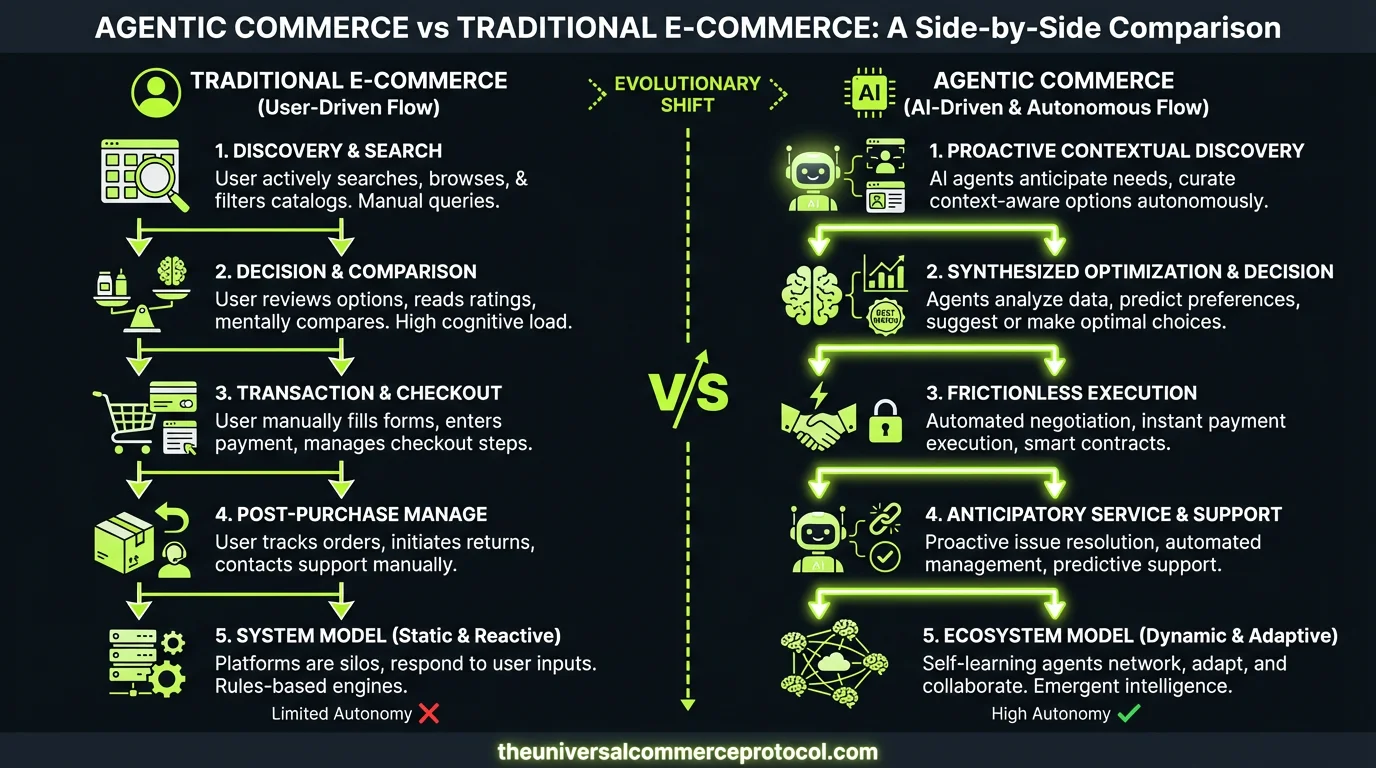
Agentic Commerce vs Traditional E-commerce: A Side-by-Side Comparison
Side-by-side comparison of traditional e-commerce and agentic commerce in 2026: who initiates the purchase, how checkout works, and what UCP changes for merchants.
-
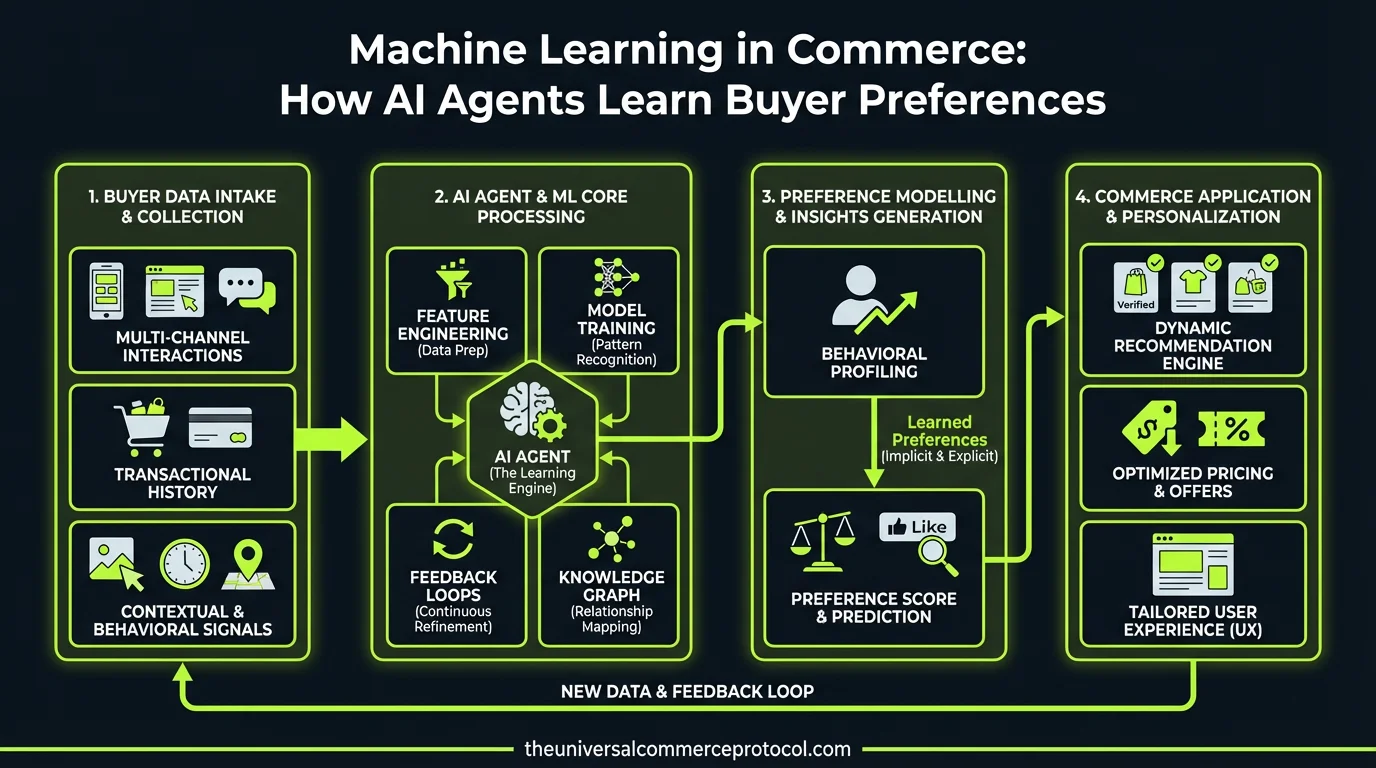
Machine Learning in Commerce: AI Agents Learn Preferences
AI shopping agents utilize supervised and reinforcement learning algorithms to analyze behavioral signals—including browsing history, purchase patterns, and explicit feedback—enabling real-time preference prediction in e-commerce environments. As of 2026, transformer-based preference models and collaborative filtering systems have become standard infrastructure for autonomous purchasing platforms, with companies like Amazon, Shopify, and enterprise retailers deploying these systems…
-

UCP and Decentralized Commerce: Web3 Shopping
Universal Commerce Protocol (UCP) enables decentralized commerce infrastructure by providing standardized APIs and smart contract interfaces for Web3 shopping agents to execute autonomous transactions across blockchain networks including Ethereum, Solana, and Polygon. Web3 shopping agents leverage UCP’s decentralized order routing and settlement mechanisms to facilitate peer-to-peer commerce without intermediaries, reducing transaction costs and enabling direct…
-

UCP vs Claude Marketplace: Training Commerce Agents
Unified Commerce Platform (UCP) architectures implement role-based access control (RBAC) with sandboxed transaction boundaries for PCI-DSS compliance in payment processing and PII handling, while Anthropic’s Claude Marketplace agents use RESTful API integration with tool-use capabilities to orchestrate actions across distributed third-party systems like Stripe, Shopify, and ERP microservices. UCP-trained commerce agents operate within monolithic service…
-

Training Commerce Agents: UCP vs Claude Marketplace
Anthropic’s Unified Commerce Platform (UCP) implements deterministic API-based catalog integration for agent state representation, while Claude Marketplace employs vector embedding retrieval (similar to RAG architectures) for semantic product matching. These architectural approaches produce distinct reward functions and action spaces: UCP supports direct inventory state access for deterministic pricing and fulfillment decisions, whereas Claude Marketplace’s probabilistic…
-
UCP vs MCP: Best Protocol for Mid-Market Merchants
Mid-market merchants with $10M–$500M annual transaction volumes should evaluate UCP 600 (Uniform Commercial Code Article 5, International Chamber of Commerce standard, published 2007) against Mastercard Commerce Protocol (MCP) based on PCI DSS v3.2.1 compliance, settlement velocity (T+1 vs. T+2), and per-transaction costs. UCP 600 delivers standardized letter-of-credit governance recognized across 190+ jurisdictions under ICC administration,…
-

Commerce Agent Performance Evaluation Frameworks
Commerce agents powered by large language models (LLMs) including OpenAI’s GPT-4, Anthropic’s Claude, and Meta’s Llama 2 require specialized evaluation frameworks measuring task success rates, latency in milliseconds, cost-per-transaction metrics, and human preference ratings across model architectures. Production-grade assessment of agentic commerce systems employs A/B testing, shadow testing deployments, hallucination rate monitoring, and task completion…
-

Anthropic Launches Claude Marketplace for AI Tools
Anthropic, headquartered in San Francisco, California, launched Claude Marketplace, a digital distribution platform enabling developers to build, list, and monetize applications powered by Claude 3 (including Opus, Sonnet, and Haiku model variants). The marketplace operates as a third-party application ecosystem comparable to Apple App Store and Google Play Store, providing monetization infrastructure and discovery mechanisms…
-

Cross-Border Payment Settlement in Agentic Commerce
Agentic commerce platforms settle cross-border payments via Stripe Connect, PayPal Cross-Border API, and Mastercard Send, with real-time FX conversion across 180+ currency corridors using OANDA and XE APIs, while maintaining PCI DSS Level 1, OFAC sanctions screening, and FinCEN AML/KYC compliance. Settlement infrastructure routes transactions through SWIFT, ACH, correspondent banking, and blockchain rails—including USDC on…