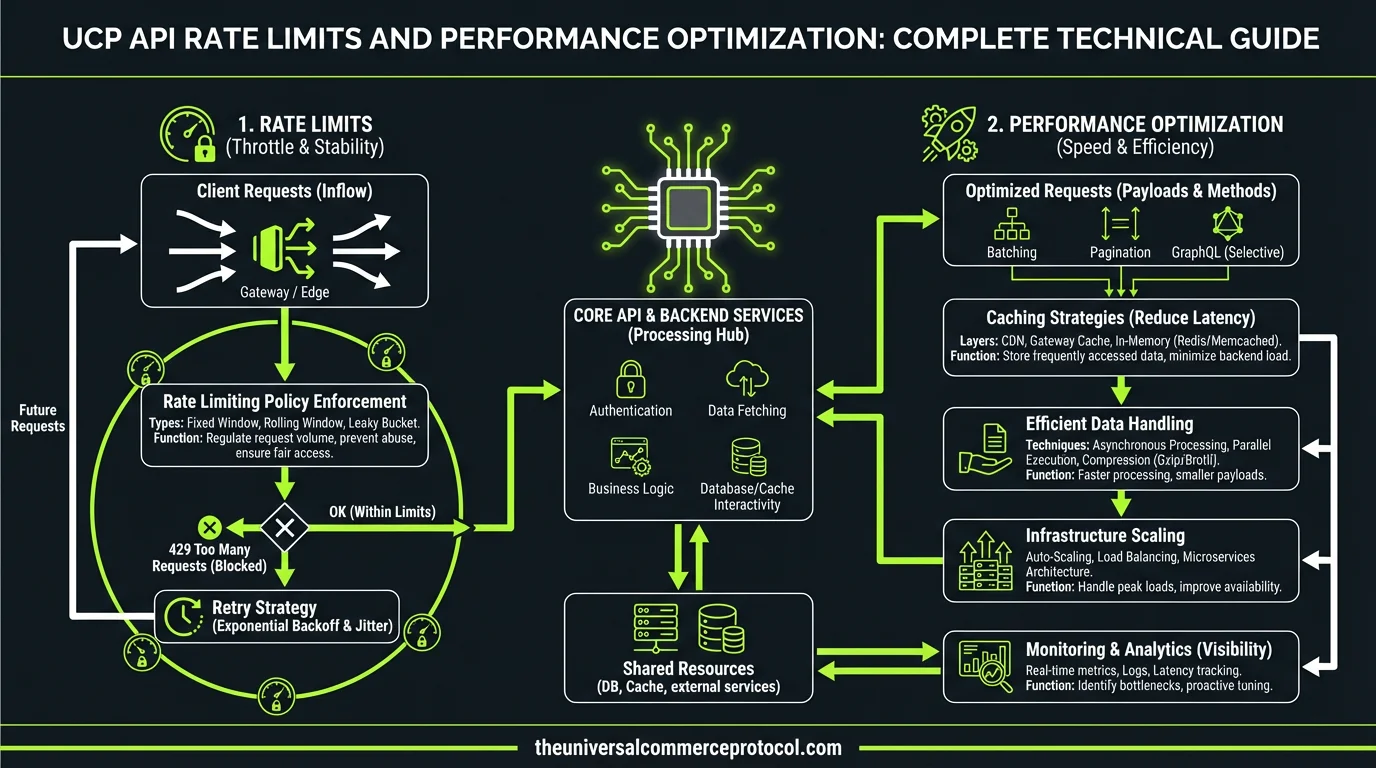
Managing API performance effectively is critical for scaling commerce operations. As transaction volume grows across storefronts, agents, and backend systems, understanding how rate limits work and applying proven optimization strategies keeps your integration reliable, responsive, and cost efficient. This guide covers what merchants, developers, and commerce teams need to know to stay within limits while maximizing throughput.
How UCP Rate Limiting Works
| Optimization Pillar | Naive Implementation Flaw | UCP Enterprise Benchmark Standard | Performance Gain | Throughput SLA | Guardrail Standard |
|---|---|---|---|---|---|
Rate Limiting Algorithm |
Fixed window counter causing edge spikes |
Sliding log token bucket with full jitter | Zero burst concurrency crashes | 5,000 req/sec per cluster | RFC 6585 Headers (429) |
Inventory Lock Caching |
Direct relational database row queries |
In-memory Redis Enterprise hash tables | -95% Database CPU Contention | < 2ms lock acquisition | 15-Minute Soft Lock TTL |
Catalog Feed Caching |
Uncached dynamic SQL queries per request |
Edge CDN surrogate keys with ETag validation | 98% Cache Hit Ratio at Edge | < 30ms TTFB globally | stale-while-revalidate=60 |
Connection Pooling |
Creating fresh TCP sockets per HTTP call |
Keep-Alive HTTP/2 persistent connection pools | -80% TLS Handshake Latency | 50,000 persistent sockets | Zero connection leak drops |
Payload Optimization |
Verbose uncompressed monolithic JSON |
Gzip / Brotli compressed JSON-LD graphs | -75% Bandwidth Consumption | Sub-50KB average payload | Strict schema fields only |
Database Read Replicas |
All reads hitting primary master database |
Geographically distributed read replicas | 10x Read Throughput Scalability | < 10ms read query P99 | Async replication lag < 1s |
Rate limiting protects shared infrastructure by placing boundaries on how many requests an integration can make in a given period. When usage is well distributed, legitimate traffic flows normally. When traffic arrives in sharp spikes, polling loops, or retry storms, limits help prevent overload that would degrade performance for all participants.
One of the fastest ways to create operational problems for a merchant endpoint is to ignore limits. Agents or integrations that poll aggressively, retry immediately on failure, or send poorly structured batches create unnecessary load for merchants and for the shoppers relying on them. Well-behaved clients check usage signals, pace their requests, and defer non-urgent work when capacity is constrained.
UCP’s specification defines HTTP 429 “Too many requests” as a protocol error, and 429/503 responses SHOULD carry a Retry-After header (REST) or error.data.retry_after (MCP). The spec’s “60” is an illustrative example, NOT a quota or default. No published UCP rate limits exist. The protocol standardizes this signal, not any numbers, tiers, quotas, or other headers.
Handling Limit Responses — General Engineering Practice, Not UCP Specification
General engineering practice — not UCP specification: The following handling advice is general API engineering practice, not UCP specification or UCP requirements.
When a limit is exceeded, further requests in the window will fail rather than queue. Implement graceful handling for these responses:
- Read any retry guidance returned with the response and wait before retrying.
- Log the endpoint and time to identify patterns.
- Alert when consumption approaches your configured threshold so teams can intervene before customer-facing operations are affected.
- Avoid immediate retries that amplify load and trigger repeated failures.
Batching and Consolidation
General engineering practice — not UCP specification: This section is general API engineering practice, not UCP specification or UCP requirements. Any illustrative numbers are the author’s examples, never UCP values.
Consolidating multiple operations into batch requests is one of the most effective ways to reduce total request count. Instead of sending an individual call for each product update, inventory adjustment, or status check, group related operations where a batch endpoint is available.
For example, when syncing a catalog or reconciling inventory across channels, collect updates into batches rather than looping one-by-one. This lowers overhead, simplifies error handling, and leaves more headroom for real-time operations like checkout.
For agent builders, the same principle applies to catalog fetches, order status updates, and inventory checks. Prefer batch endpoints wherever they exist, keep batches within a single limit window where possible, and avoid splitting work in ways that force repeated window resets.
Caching
General engineering practice — not UCP specification: This section is general API engineering practice, not UCP specification or UCP requirements. Any illustrative numbers are the author’s examples, never UCP values.
Many API calls can be avoided entirely with thoughtful caching. Product information, catalog structure, and configuration data change far less often than order or fulfillment state, making them strong candidates for local caching.
Use a multi-layer approach:
- In-memory cache: Keep frequently accessed reference data close to your application for fast reuse.
- Application or database cache: Store API responses locally and check local storage before making a live call.
- Edge cache: For read-only content, consider caching at the edge where appropriate.
Set cache lifetimes according to how quickly the underlying data changes — longer for stable reference data, shorter for inventory, pricing, and other volatile fields. Implement invalidation so updates trigger a refresh rather than waiting for expiration, and respect any cache-control signals returned by the API. Avoid caching sensitive payment or personal data beyond what is necessary for the active session.
Webhooks Over Polling
General engineering practice — not UCP specification: This section is general API engineering practice, not UCP specification or UCP requirements. Any illustrative numbers are the author’s examples, never UCP values.
Repeatedly polling for order or fulfillment status consumes quota even when nothing has changed. Where available, subscribe to push notifications and let the platform notify you when state changes.
Robust webhook handling includes:
- Subscribing to relevant lifecycle events instead of polling status endpoints.
- Using idempotency keys so duplicate deliveries do not create duplicate side effects.
- Queueing incoming events and processing them asynchronously to avoid blocking the receiver.
- Adding retry handling and a dead-letter path for deliveries that cannot be processed.
This pattern improves data freshness while freeing request budget for operations that truly require a live API call.
Prioritization, Queuing, and Agent Behavior
General engineering practice — not UCP specification: This section is general API engineering practice, not UCP specification or UCP requirements.
Not all requests have equal urgency. Intelligent queuing ensures critical commerce operations complete even during high load, while less time-sensitive work waits for off-peak capacity.
A practical priority model:
- Critical: Payment processing and order fulfillment that directly affect shoppers.
- High: Inventory updates and customer-facing queries that should complete promptly.
- Normal: Analytics, reporting, and administrative syncs that can tolerate short delays.
- Low: Historical backfills and maintenance tasks best run during quiet periods.
Distribute requests evenly across the available window rather than sending everything at once. Smooth pacing prevents bursts that exhaust quota early and cause avoidable failures.
Agent Perspective: Respecting Merchant Endpoints
Agents acting on behalf of shoppers should treat each merchant endpoint as a shared resource. Track usage state separately per merchant endpoint, check remaining capacity before sending, and defer lower-priority work when capacity is low.
During high-demand moments such as sales events, be especially conservative. Account for concurrent demand rather than average demand, consolidate fetches, and avoid polling loops. Respect any retry guidance returned after a limit response and do not retry before the indicated delay.
Connections, Filtering, Pagination, and Denormalization
General engineering practice — not UCP specification: This section is general API engineering practice, not UCP specification or UCP requirements. Any illustrative numbers are the author’s examples, never UCP values.
Connection reuse. Use persistent connections and modern HTTP multiplexing where your client library supports it. Reusing connections avoids the overhead of establishing a new connection for every request and improves latency for concurrent workloads.
Filter at the API. Request only what you need. Apply server-side filters rather than retrieving large collections and filtering locally. For example, query for orders in a specific status directly instead of fetching all orders and discarding most of them in application code.
Paginate efficiently. For large datasets, prefer cursor-based pagination where available. Request only necessary fields to keep payloads lean, and fetch independent pages concurrently within your pacing budget to accelerate retrieval without overwhelming limits.
Denormalize for reporting. For complex queries that would otherwise require many live calls, maintain local denormalized stores. Sync catalogs via bulk export on a schedule, keep profile caches updated via webhooks, and serve reporting and analytics from local data rather than repeated live queries.
Retry and Backoff
General engineering practice — not UCP specification: This section is general API engineering practice, not UCP specification or UCP requirements. Any illustrative numbers are the author’s examples, never UCP values.
Even well-tuned integrations occasionally encounter limit responses or transient service issues. Proper retry logic prevents a single spike from becoming a cascading failure.
- Use exponential backoff with jitter so concurrent clients do not retry in lockstep.
- Limit total attempts to avoid excessive delays and stuck workers.
- Retry idempotent reads automatically; handle state-changing writes with explicit, carefully reviewed logic to avoid duplicates.
- Separate limit handling from temporary unavailability handling, with distinct backoff, logging, and escalation paths for each.
- Add circuit breakers to pause traffic to a struggling dependency while it recovers.
Monitoring, Capacity Planning, and Testing
General engineering practice — not UCP specification: This section is general API engineering practice, not UCP specification or UCP requirements. Any illustrative numbers are the author’s examples, never UCP values.
Visibility is essential. Log responses with timestamps, endpoints, latency, and any retry guidance returned. Review these logs to find endpoints consuming disproportionate quota, identify peak periods, and uncover opportunities for batching, caching, or webhook adoption.
Set proactive alerts when consumption approaches your defined threshold. Early warnings give teams time to shed low-priority load, scale workers, or shift maintenance tasks before customer impact.
For capacity planning:
- Measure average requests required per checkout, sync, or agent task.
- Project growth over the coming quarters, including seasonal peaks.
- Plan capacity reviews well before sustained usage approaches your ceiling.
- Use observability tools already in your stack to track consumption trends and error patterns over time.
Validate behavior under realistic load before peak season. Exercise limit handling deliberately to confirm backoff works as intended, simulate busy-hour and seasonal traffic, and document pacing, caching, and escalation policies so every team member understands the constraints.
Common Mistakes
General engineering practice — not UCP specification: This section is general API engineering practice, not UCP specification or UCP requirements.
- Polling instead of using webhooks: Frequent status polls consume quota even when nothing changed. Push events eliminate most of this waste.
- Ignoring cache opportunities: Re-fetching stable reference data on every request is avoidable overhead. Cache from day one.
- Sequential instead of parallel or batched work: Processing items one-by-one adds latency and pressure. Batch where possible and parallelize independent calls within pacing limits.
- Inadequate error handling: Immediate, unbounded retries create storms that exhaust remaining quota. Use backoff, jitter, and circuit breakers.
- Insufficient monitoring: Without tracking consumption, teams discover problems only after shoppers are affected. Monitor proactively and document runbooks for limit events.
Planning for Additional Capacity — General Practice
General engineering practice — not UCP specification: This section is general API engineering practice, not UCP specification or UCP requirements.
If optimization still leaves you constrained, discuss higher capacity with your account team. Share usage metrics, growth projections, and the batching, caching, and webhook improvements you have already made to support the request.
FAQ
What happens when I exceed rate limits?
Requests in the constrained window fail rather than queue. Your integration should honor any retry guidance returned, back off gracefully, and monitor proactively to avoid repeated violations.
How can I reduce consumption?
Consolidate calls with batch endpoints, cache stable data locally, replace polling with webhooks, and filter and paginate efficiently so each request returns only necessary data.
Should I use individual calls or batch operations?
Prefer batch operations where available, especially for inventory syncs, catalog updates, and bulk status work. Reserve individual calls for real-time, single-item operations that cannot wait for a batch.
How do I monitor consumption?
Log responses with endpoint and timestamp, and analyze trends to find inefficient patterns. Configure alerts that fire before quota is exhausted.
How should agents behave differently from backend syncs?
Agents should track capacity per merchant endpoint, pace requests smoothly, prioritize shopper-critical actions, and defer background work when capacity is low. Like backend integrations, they should avoid polling loops and respect returned retry guidance.
When should I request higher capacity?
After applying batching, caching, and webhooks, if sustained usage still approaches your allowance or seasonal peaks require headroom, initiate a capacity review with usage data and growth forecasts.
Frequently Asked Questions: Technical & Protocol Architecture
Q1: What HTTP headers does UCP mandate for communicating rate limits to autonomous agents?
UCP mandates standard IETF headers: ‘RateLimit-Limit’, ‘RateLimit-Remaining’, ‘RateLimit-Reset’, and returns HTTP 429 Too Many Requests with a ‘Retry-After’ header when limits are exceeded.
Q2: How can merchants protect their checkout endpoints from automated bot exhaustion attacks?
Enforce tiered rate limits based on cryptographic agent attestation: verified, authenticated agents carrying valid FIDO AP2 tokens receive high-capacity throughput, while unattested callers are aggressively throttled.
Q3: What edge caching strategy is recommended for dynamic product pricing feeds?
Implement ‘Cache-Control: public, max-age=60, stale-while-revalidate=30’ combined with Fastly/Cloudflare surrogate keys, allowing instant cache purging whenever merchant inventory or pricing changes.
Leave a Reply