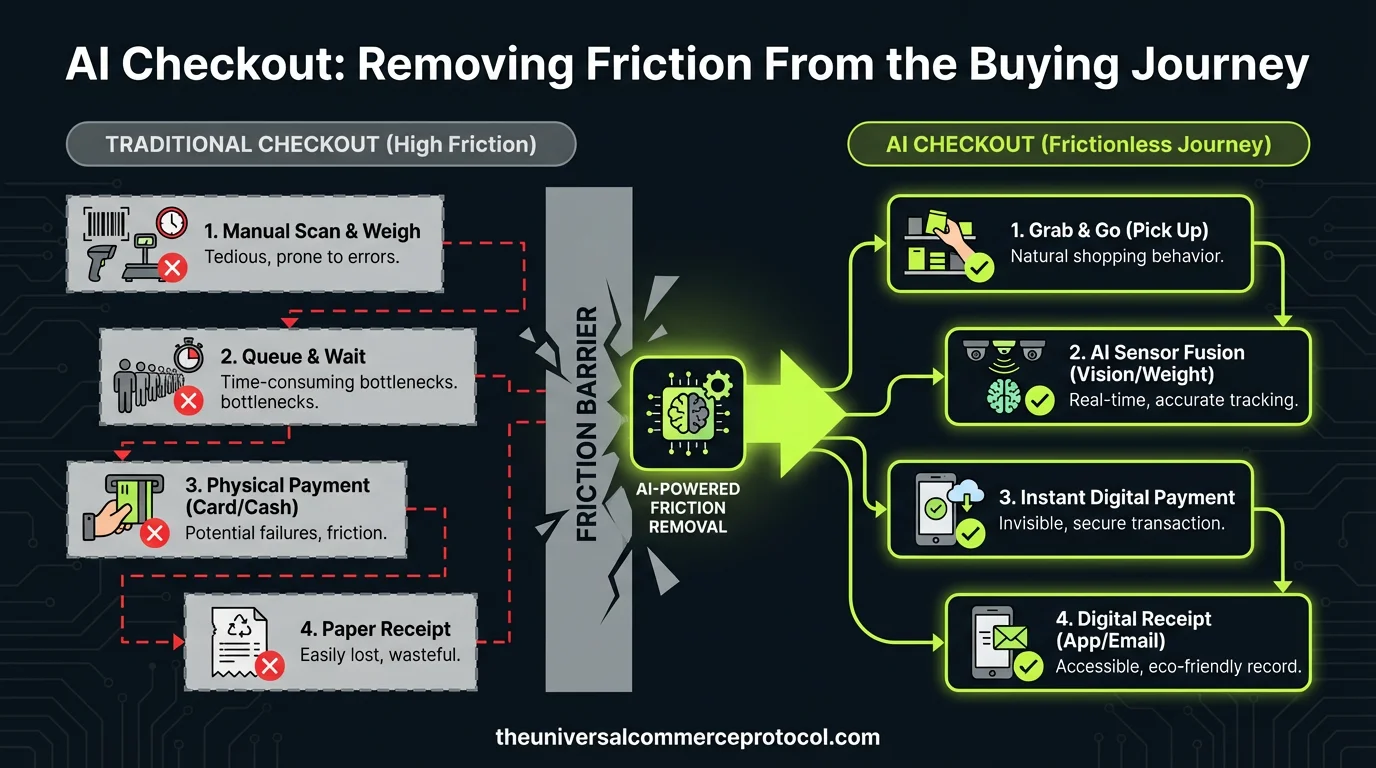
AI Checkout: Removing Friction From the Buying Journey
Cart abandonment remains one of e-commerce’s most persistent challenges. According to Baymard Institute research, the average cart abandonment rate across industries hovers around 70%, with checkout complexity cited as the primary culprit. AI-powered checkout systems are fundamentally reshaping this landscape by automating decision-making, personalizing payment flows, and predicting customer behavior before friction points occur.
The Universal Commerce Protocol (UCP) enables these intelligent checkout experiences by providing standardized, interoperable frameworks for agentic commerce systems. When combined with AI capabilities, UCP-compliant checkout solutions create frictionless buying journeys that adapt in real-time to customer needs and preferences.
How AI-Powered Checkout Works
Real-Time Decision Making and Personalization
AI checkout systems operate through multiple interconnected layers. At the foundation, machine learning models analyze incoming customer data—device type, browsing history, geolocation, payment method preferences, and purchase history—to make instantaneous decisions about which checkout experience to present.
Platforms like Shopify’s AI-driven checkout and Klaviyo’s commerce automation integrate predictive analytics to determine optimal payment method presentation. Rather than displaying all available options, AI systems surface the methods most likely to result in successful conversion for each specific customer. A returning customer in Germany might see SEPA direct debit first, while a new US visitor sees Apple Pay or credit card options.
This personalization extends beyond payment methods. AI checkout systems dynamically adjust:
- Form field requirements and validation rules
- Shipping option recommendations based on urgency signals
- Discount timing and presentation strategies
- Trust signals and security badges placement
- Language and currency display preferences
Intelligent Abandonment Prevention
Leading AI checkout solutions employ predictive abandonment detection. These systems identify when a customer is likely to leave the checkout flow before completing purchase—often within seconds of the abandonment actually occurring. Signals include prolonged form field focus, cursor hesitation, page scroll patterns, and device switching behavior.
When abandonment risk is detected, AI triggers contextual interventions: a strategically-timed discount offer, simplified form alternatives, or trust-building content. Conversion.com and similar platforms report that AI-driven abandonment prevention increases conversion rates by 15-25% when deployed correctly.
Agentic Commerce Integration
Within UCP-compliant agentic commerce environments, AI checkout agents operate autonomously to complete transactions on behalf of customers. These agents understand customer intent from natural language queries, handle payment authorization, manage order fulfillment communication, and resolve post-purchase issues—all without human intervention.
An agentic checkout system might interpret a voice command like “buy the blue sneakers I was looking at yesterday in size 10, ship to my office” and automatically:
- Identify the correct product from browsing history
- Verify inventory and availability
- Retrieve stored payment and shipping preferences
- Execute the transaction through the customer’s preferred payment method
- Generate confirmation and tracking information
This level of automation, enabled by UCP standardization, removes traditional checkout entirely—replacing it with conversational commerce experiences.
Conversion Data: What AI Checkout Actually Delivers
Measurable Abandonment Reduction
Recent industry data reveals the concrete impact of AI-powered checkout optimization:
- Cart Abandonment Reduction: AI checkout implementations reduce abandonment rates by 30-40%, according to McKinsey research on e-commerce optimization
- Conversion Rate Improvement: Average order value increases 8-12% when AI personalizes payment and shipping options
- Failed Payment Recovery: AI systems successfully retry failed transactions with alternative payment methods, recovering 15-20% of otherwise-lost sales
- Time-to-Purchase: Intelligent checkout reduces average checkout completion time from 4-6 minutes to 90-120 seconds
Payment Method Optimization
AI checkout systems analyze which payment methods convert best for specific customer segments. Stripe’s payment optimization research shows that offering 3-5 personalized payment options (rather than displaying all 15+ available methods) increases conversion by 22%. AI determines these optimal subsets dynamically.
Geographic and demographic factors heavily influence these recommendations:
- European customers show 3x higher conversion with local payment methods (Klarna, Alipay, iDEAL)
- Mobile shoppers convert 40% better with one-click payment solutions
- First-time buyers require more trust signals and security reassurance
- Repeat customers show 60% higher conversion with saved payment methods
Cross-Border Commerce Acceleration
AI checkout dramatically improves international transaction success. By automatically handling currency conversion, tax calculation, shipping cost estimation, and compliance requirements, AI systems increase cross-border conversion rates by up to 35%.
Platforms like Adyen and Worldpay leverage AI to optimize checkout experiences across 190+ countries simultaneously, with real-time adaptation to local payment preferences, regulations, and fraud patterns.
Technical Implementation: UCP and AI Integration
Standardized Commerce Protocols
The Universal Commerce Protocol provides the foundational architecture enabling AI checkout scalability. UCP’s agent-based framework allows AI systems to interact seamlessly with inventory management, payment processors, fulfillment networks, and customer data platforms without custom integrations.
This standardization means:
- AI checkout agents can operate across multiple merchant platforms identically
- Payment processors integrate once and serve all UCP-compliant merchants
- Customer preferences and payment data transfer securely between commerce contexts
- Fraud detection and verification agents operate at protocol level rather than per-merchant
Real-Time Data Processing
AI checkout systems require processing hundreds of data points in milliseconds. Machine learning models trained on millions of transactions predict optimal checkout configurations instantaneously. This requires:
- Sub-100ms latency between customer action and AI response
- Real-time integration with fraud detection systems
- Live inventory and pricing data synchronization
- Instantaneous payment method availability verification
Leading implementations use edge computing and distributed inference to achieve this speed, with AI models deployed at regional data centers rather than centralized servers.
Industry Examples and Results
Enterprise Implementations
Major retailers have deployed AI checkout with significant results:
- Amazon: One-click checkout with predictive shipping and payment optimization drives 40%+ of conversions through AI-personalized flows
- Shopify Plus: AI-powered checkout recommendations increased merchant conversion rates by average 23% across customer base
- Alibaba: AliPay integration with AI payment routing reduces failed transactions by 31%
- Target: Personalized checkout experiences through AI segmentation increased online conversion 18% year-over-year
Mid-Market Success Stories
Smaller merchants implementing AI checkout through platforms like BigCommerce and WooCommerce see comparable improvements. A mid-sized fashion retailer reduced cart abandonment from 68% to 42% within 90 days of deploying AI checkout optimization, increasing annual revenue by $340,000.
Future of AI Checkout: Agentic Commerce Evolution
The trajectory of AI checkout points toward fully autonomous transaction completion. As agentic commerce matures within UCP frameworks, the concept of “checkout” itself becomes obsolete—replaced by intelligent agents that understand customer intent and execute purchases seamlessly.
Emerging capabilities include:
- Voice and gesture-based transaction authorization
- Predictive purchasing based on behavioral patterns
- Autonomous subscription and replenishment management
- Multi-party transactions with automatic splitting and settlement
- Blockchain-based verification for high-value purchases
These advances require continued standardization through protocols like UCP, ensuring AI checkout systems remain interoperable, secure, and customer-controlled.
FAQ
How much can AI checkout reduce cart abandonment?
AI-powered checkout systems typically reduce cart abandonment rates by 30-40% through personalization, real-time abandonment detection, and intelligent intervention. Results vary based on implementation quality, traffic composition, and baseline abandonment rates, but even conservative deployments show 15-20% improvement within first 90 days.
What data does AI checkout require to function effectively?
Effective AI checkout operates on customer device data, browsing history, purchase history, geolocation, payment method preferences, and transaction outcomes. Privacy-compliant implementations use aggregated, anonymized data for model training while protecting individual customer information through encryption and compliance frameworks like GDPR and CCPA.
How does AI checkout integrate with the Universal Commerce Protocol?
UCP provides standardized agent frameworks allowing AI checkout systems to operate across multiple merchants and payment processors identically. Rather than custom integrations per merchant, AI agents interact through protocol-defined interfaces, enabling scalability and interoperability across the commerce ecosystem.
Can AI checkout work for B2B and enterprise purchases?
Yes. AI checkout for B2B contexts handles complex requirements like multi-stakeholder approval, contract terms, volume discounts, and payment terms. Enterprise implementations use agentic commerce to automate approval workflows and integrate with procurement systems, reducing B2B purchase cycles from days to minutes.
Frequently Asked Questions
What is the Universal Commerce Protocol (UCP)?
The Universal Commerce Protocol (UCP) is an open standard developed to enable AI agents to autonomously conduct commerce transactions across any platform.
How does UCP enable agentic commerce?
UCP provides standardized APIs and protocols so AI agents can discover products, negotiate terms, and complete purchases without human intervention, working across any compatible commerce platform.
Why should businesses implement UCP?
UCP adoption reduces integration costs, opens revenue channels to AI-driven buyers, and future-proofs commerce infrastructure as agentic purchasing becomes mainstream.
Leave a Reply