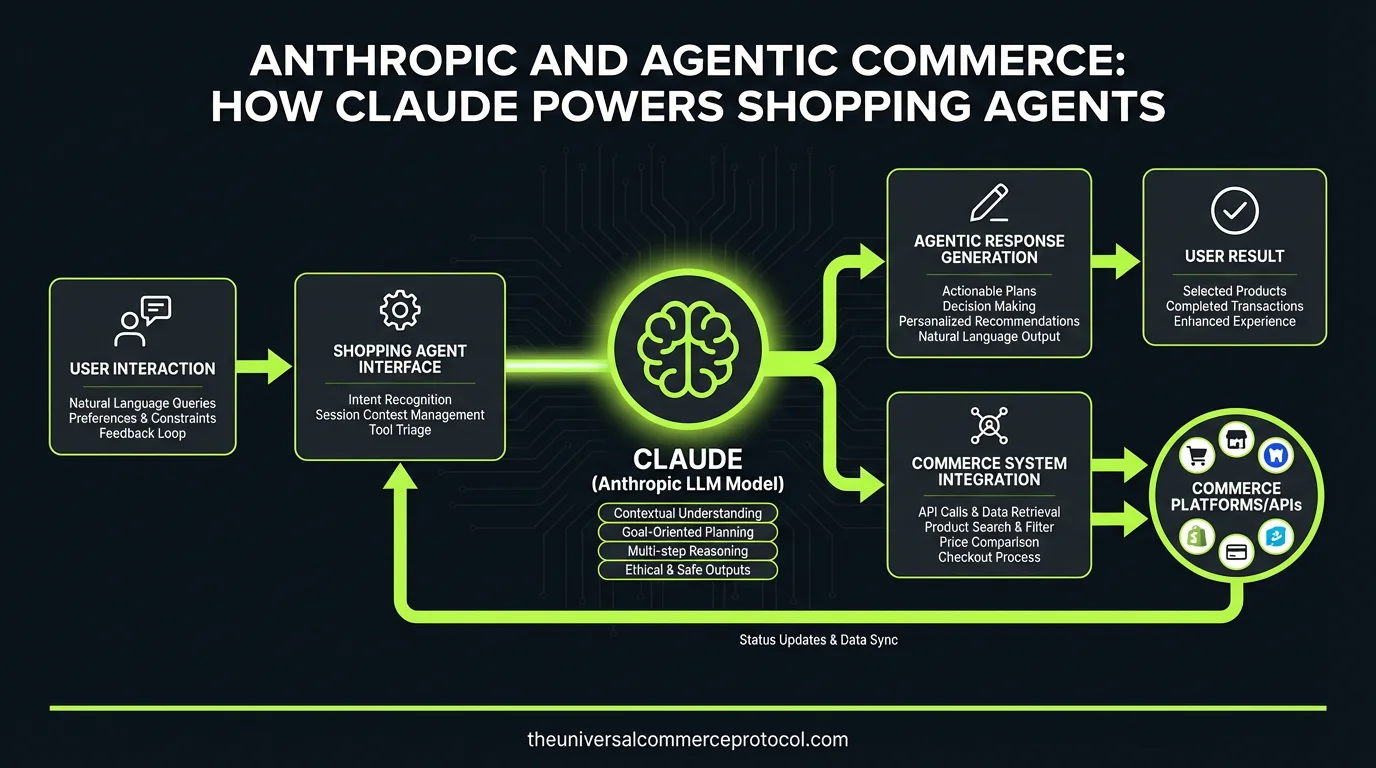
Anthropic’s Claude: The Foundation for Agentic Commerce
Anthropic has emerged as a critical player in enabling agentic commerce through Claude, its flagship large language model. Claude’s architecture and training methodology make it uniquely suited for commerce applications where autonomous agents must make decisions, execute transactions, and interact with complex payment systems. Unlike general-purpose AI assistants, Claude is specifically designed to handle the nuanced decision-making required in commerce scenarios where accuracy and safety are paramount.
The agentic commerce landscape demands AI systems that can understand user intent, navigate multiple product catalogs, compare pricing across vendors, and ultimately facilitate transactions. Claude accomplishes this through a combination of advanced language understanding, tool-use capabilities, and safety guardrails built into its training process through Constitutional AI (CAI).
Tool Use: Claude’s Commerce Superpowers
Claude’s tool-use functionality represents a fundamental shift in how AI agents can interact with commerce infrastructure. Through the Anthropic API, Claude can be equipped with access to specific tools—APIs, databases, and transaction systems—that enable it to perform real commerce operations without hallucinating or making up responses.
How Claude Integrates with Commerce APIs
When deployed as a shopping agent, Claude can be configured with tools that connect to:
- Product catalog APIs from retailers like Amazon, Shopify, and WooCommerce
- Inventory management systems that provide real-time stock information
- Pricing engines that aggregate costs across multiple vendors
- Payment processors including Stripe, Square, and PayPal
- Logistics platforms for shipping rate calculations and tracking
- User authentication systems for secure session management
Claude’s tool-use implementation differs from simple prompt injection. Rather than generating text that might approximate an API call, Claude receives structured tool definitions and can reliably invoke them with correct parameters. This is critical for commerce, where a misplaced decimal point or incorrect product ID could result in customer dissatisfaction or financial loss.
Real-World Implementation: Shopping Agent Workflows
A Claude-powered shopping agent might follow this workflow: A customer asks, “Find me the best deal on wireless headphones under $150 with two-day shipping.” Claude receives this request and systematically:
- Invokes a product search tool across multiple retailer APIs
- Filters results by price, rating, and availability
- Calls a shipping calculator tool to verify delivery timeframes
- Compares total cost including taxes and shipping
- Presents options with clear reasoning for each recommendation
- Awaits user confirmation before proceeding to payment
This structured approach ensures Claude doesn’t make up prices or product availability—it queries live systems and reports actual data back to the user.
Safety and Constitutional AI in Payment Contexts
Anthropic’s Constitutional AI framework is particularly relevant for agentic commerce because it addresses the high-stakes nature of financial transactions. Unlike standard RLHF (Reinforcement Learning from Human Feedback), Constitutional AI trains models to follow a set of principles that guide behavior even in novel situations.
Payment Security Principles
Claude is trained to adhere to principles that directly apply to commerce safety:
- Never store or repeat sensitive data: Claude will not echo back credit card numbers, SSNs, or authentication tokens, even if a user provides them
- Verify user intent: Before executing high-value transactions, Claude confirms the action multiple times to prevent accidental purchases
- Refuse suspicious requests: If a user attempts to use an agent for fraudulent purposes, Claude’s training causes it to decline and explain why
- Maintain audit trails: Claude can be configured to log all commerce decisions in a way that allows human review
- Respect user preferences: Claude follows explicit user instructions about spending limits, preferred vendors, and privacy settings
Constitutional AI vs. Traditional Safety Approaches
Traditional commerce systems rely on rules-based blocking: “Don’t process transactions over $X” or “Block cards from high-risk countries.” Claude’s approach is more sophisticated. Through Constitutional AI, Claude develops a deeper understanding of commerce ethics and can apply principles to novel situations. For example, Claude can recognize social engineering attempts or unusual patterns that might indicate account compromise, even if no explicit rule covers that specific scenario.
This is crucial because agentic commerce systems must operate in real-time without always deferring to human approval. Anthropic’s approach ensures that autonomous decision-making is grounded in principles rather than just rules.
Integration with Universal Commerce Protocol Standards
The Universal Commerce Protocol (UCP) provides a standardized framework for agentic commerce interactions. Claude integrates naturally with UCP specifications because both emphasize structured, machine-readable commerce data. When Claude receives a shopping request formatted according to UCP standards, it can parse intent, access standardized product schemas, and execute transactions using UCP-compliant endpoints.
This standardization means that a Claude agent trained once can work across multiple retailers and platforms that support UCP, rather than requiring custom integration for each vendor.
Real-World Applications and Use Cases
B2B Procurement Agents
Enterprise procurement teams use Claude-powered agents to automate routine purchasing. An agent can monitor inventory levels, compare supplier pricing, check contract terms, and execute purchase orders automatically—with human oversight at critical decision points. Claude’s ability to reason about complex business rules (volume discounts, payment terms, preferred vendors) makes it superior to simpler automation approaches.
Personal Shopping Assistants
Consumer-facing applications deploy Claude as a shopping assistant that understands personal preferences, budget constraints, and style preferences. Unlike traditional recommendation engines, Claude can have natural conversations about tradeoffs: “This option is $20 more but has better reviews and ships faster—would you prefer that?”
Marketplace Aggregation
Companies like PriceGrabber and Kayak use AI agents to search across multiple vendors. Claude’s tool-use capabilities enable faster, more accurate aggregation than previous-generation systems, with better handling of edge cases like dynamic pricing or regional availability.
Technical Architecture: How Claude Fits Into Commerce Stacks
A typical architecture deploys Claude through Anthropic’s API as the reasoning layer in a larger system:
- Frontend: User interface (web, mobile, voice) collects shopping intent
- Claude Agent: Receives user request, orchestrates tool calls, generates responses
- Tool Layer: APIs and connectors to product catalogs, payment processors, and fulfillment systems
- Data Layer: Databases storing user preferences, order history, and payment methods
- Compliance Layer: Systems ensuring PCI-DSS compliance, fraud detection, and regulatory adherence
Claude operates at the “intelligence” layer, but it’s important to note that sensitive payment data never passes through Claude. Instead, Claude orchestrates transactions by instructing other systems to handle sensitive operations. For example, Claude might say “Process payment using the customer’s stored payment method on file” rather than handling the payment directly.
Limitations and Considerations
While Claude is powerful for agentic commerce, implementers should understand its limitations:
- Latency: API calls to Claude introduce latency compared to rule-based systems. For sub-second commerce decisions, hybrid approaches may be necessary
- Cost: Claude’s pricing scales with token usage. High-volume commerce operations may require optimization or caching strategies
- Hallucination risks: While tool-use mitigates this, Claude can still generate plausible-sounding but incorrect information if tools aren’t properly configured
- Regulatory compliance: Different jurisdictions have specific requirements for automated commerce. Implementers must ensure Claude-powered agents comply with local regulations
The Future of Claude in Agentic Commerce
Anthropic continues to enhance Claude’s capabilities for commerce applications. Recent updates include improved tool-use reliability, better handling of complex multi-step transactions, and enhanced safety features specifically designed for financial contexts. As agentic commerce matures, we can expect Claude to become even more specialized for commerce workflows.
The convergence of Claude’s capabilities, standardized protocols like UCP, and improving commerce infrastructure suggests that AI-driven shopping agents will become mainstream within the next 2-3 years. Organizations that build competency with Claude today will have significant advantages in deploying these systems at scale.
FAQ
Can Claude directly process credit card payments?
No, and this is by design. Claude never handles sensitive payment data directly. Instead, Claude orchestrates payment processing by instructing payment processor APIs (like Stripe) to charge stored payment methods or process tokenized payments. This architecture maintains PCI-DSS compliance and protects customer data.
How does Claude handle transactions across different currencies and regions?
Claude can be equipped with tools that handle currency conversion, regional pricing, tax calculation, and compliance rules. When a user requests a purchase in a different country, Claude invokes appropriate tools to calculate final pricing, apply regional taxes, and ensure compliance with local commerce regulations.
What happens if Claude makes a mistake during a transaction?
Claude’s tool-use architecture includes confirmation steps before finalizing transactions. If Claude proposes an incorrect action (wrong product, wrong quantity), the system prompts for confirmation before executing. Additionally, all Claude-driven transactions are logged for audit purposes, and most commerce systems allow transaction reversal within specified timeframes.
How does Anthropic’s Constitutional AI prevent fraud in commerce contexts?
Constitutional AI trains Claude to recognize and refuse suspicious patterns—unusual spending, requests that violate user-set limits, or attempts to circumvent security measures. While Claude isn’t a fraud detection system per se, its principled approach to decision-making makes it resistant to social engineering and enables it to flag suspicious activities for human review.
Frequently Asked Questions
What is the Universal Commerce Protocol (UCP)?
The Universal Commerce Protocol (UCP) is an open standard developed to enable AI agents to autonomously conduct commerce transactions across any platform.
How does UCP enable agentic commerce?
UCP provides standardized APIs and protocols so AI agents can discover products, negotiate terms, and complete purchases without human intervention, working across any compatible commerce platform.
Why should businesses implement UCP?
UCP adoption reduces integration costs, opens revenue channels to AI-driven buyers, and future-proofs commerce infrastructure as agentic purchasing becomes mainstream.
Leave a Reply