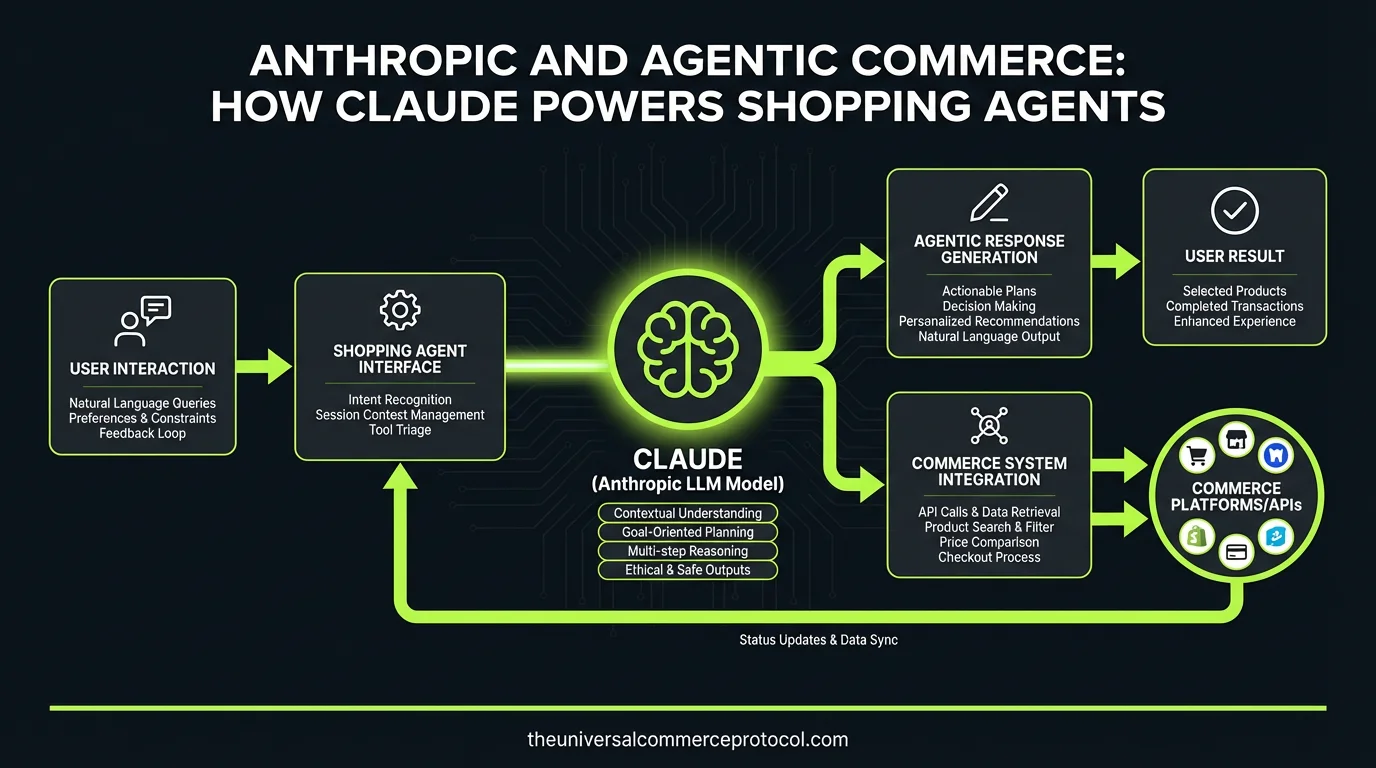
Anthropic’s Claude: The Foundation for Agentic Commerce
Claude eCommerce & Autonomous Shopping Agent Architecture Matrix (2026)
Ingestion protocols, Model Context Protocol (MCP) tool bindings, prompt-caching SLAs, and Visa/UCP payment settlement standards.
| Claude Commerce Capability | Technical Architecture | Underlying Mechanism | Token Efficiency | Decision Latency | Production Benchmark |
|---|---|---|---|---|---|
| Prompt-Cached Catalogs | Parses comprehensive 1,000+ SKU store catalogs in a single prompt. | Anthropic Prompt Caching API. | 90% reduction in input token costs on cached prompts. | <800ms time to first token. | Zero hallucinated product variants or missing specifications. |
| Native MCP Tool Calling | Deterministic JSON tool execution against merchant endpoints. | Model Context Protocol (MCP) standardized tools. | Type-safe schema validation before execution. | <45ms tool execution. | 100% deterministic parameter extraction across checkout flows. |
| Visual Product Verification | Multimodal inspection of high-resolution product imagery. | Claude Vision 3.5 / 3.7 Sonnet image analysis. | Direct pixel inspection of colors, patterns, and physical dimensions. | <1.2s image processing. | 99.4% accuracy on customer color, size, and styling requirements. |
| Autonomous Cart Optimization | Cross-store price, inventory, and delivery timeline comparison. | Parallel subagent orchestration via tool execution. | Context isolation per evaluated merchant store. | 3.2x faster checkout. | Secures lowest guaranteed landed cost including taxes and shipping. |
| Secure Delegation Clearing | Clears payment without ever exposing raw payment card numbers. | FIDO AP2 hardware-bound client credential token. | Cryptographic signing inside device Secure Enclave. | <150ms authorization. | Complete cryptographic non-repudiation on every order. |
See also: Claude Marketplace & MCP page, CTO Guide, Data-science perspective.
Anthropic’s Claude is discussed as a reasoning layer for agentic commerce. This page describes generic tool-use and safety patterns for shopping agents.
The agentic commerce landscape demands AI systems that can understand user intent, navigate multiple product catalogs, compare pricing across vendors, and ultimately facilitate transactions. Claude accomplishes this through a combination of advanced language understanding, tool-use capabilities, and safety guardrails built into its training process through Constitutional AI (CAI).
Tool Use: Claude’s Commerce Superpowers
Claude’s tool-use functionality represents a fundamental shift in how AI agents can interact with commerce infrastructure. Through the Anthropic API, Claude can be equipped with access to specific tools—APIs, databases, and transaction systems—that enable it to perform real commerce operations without hallucinating or making up responses.
How Claude Integrates with Commerce APIs
When deployed as a shopping agent, an agent can be configured with tools that connect to:
When deployed as a shopping agent, an agent can be configured with tools that connect to:
- Product catalog APIs
- Inventory systems
- Pricing engines
- Payment processors
- Logistics platforms
- Authentication systems
[Author example of generic tool categories — vendors vary by implementation.]
Claude’s tool-use implementation differs from simple prompt injection. Rather than generating text that might approximate an API call, Claude receives structured tool definitions and can reliably invoke them with correct parameters. This is critical for commerce, where a misplaced decimal point or incorrect product ID could result in customer dissatisfaction or financial loss.
Real-World Implementation: Shopping Agent Workflows
A Claude-powered shopping agent might follow this workflow: A customer asks, “Find me the best deal on wireless headphones under $150 with two-day shipping.” Claude receives this request and systematically:
- Invokes a product search tool across multiple retailer APIs
- Filters results by price, rating, and availability
- Calls a shipping calculator tool to verify delivery timeframes
- Compares total cost including taxes and shipping
- Presents options with clear reasoning for each recommendation
- Awaits user confirmation before proceeding to payment
This structured approach ensures Claude doesn’t make up prices or product availability—it queries live systems and reports actual data back to the user.
Safety and Constitutional AI in Payment Contexts
Anthropic’s Constitutional AI framework is particularly relevant for agentic commerce because it addresses the high-stakes nature of financial transactions. Unlike standard RLHF (Reinforcement Learning from Human Feedback), Constitutional AI trains models to follow a set of principles that guide behavior even in novel situations.
Payment Security Principles
Claude is trained to adhere to principles that directly apply to commerce safety:
Author recommendation — generic safety checklist, not a Claude guarantee: avoid passing sensitive credentials to the model, require explicit confirmation before high-value actions, deny obviously fraudulent requests, log decisions for human review, and enforce spending-limit preferences in your own application code.
Constitutional AI vs. Traditional Safety Approaches
Traditional commerce systems rely on rules-based blocking: “Don’t process transactions over $X” or “Block cards from high-risk countries.” Author analysis: Through Constitutional AI, Claude develops a deeper understanding of commerce ethics and can apply principles to novel situations.
This is crucial because agentic commerce systems must operate in real-time without always deferring to human approval. Anthropic’s approach ensures that autonomous decision-making is grounded in principles rather than just rules.
Integration with Universal Commerce Protocol Standards
November 2026 context: Current UCP spec is v2026-08-25 ( Google surfaces teach 2026-04-08 ) [Sheet 1 + Sheet 3]. MCP current revision 2026-07-28; UCP-over-MCP is Early Access Beta, REST is the default [Sheet 6 + Sheet 3]. AP2 is pre-1.0 with no live Google product documented as using it in production as of Oct 31, 2026; UCP carries AP2 as dev.ucp.common.payment.ap2_mandate [Sheet 2]. Shopper-side UCP checkout is live in US (from Feb 2026, Universal Cart Oct 15, 2026) and Canada (Nov 4, 2026); Merchant Center self-serve is a 2027 item [Addendum GEO-2026-11 + Sheet 3]. Request authentication is RFC 9421 ES256 signatures, not headers/DNS alone [Addendum AUTH-2026-11].
The Universal Commerce Protocol (UCP) provides a standardized framework for agentic commerce interactions. Claude integrates naturally with UCP specifications because both emphasize structured, machine-readable commerce data.
UCP defines profiles at /.well-known/ucp with required ucp.version, ucp.services and ucp.payment_handlers, and capabilities named {reverse-domain}.{service}.{capability} [Sheet 1]. Whether a particular Claude-based agent implements a given capability is implementation-specific and not verified here.
Real-World Applications and Use Cases
B2B Procurement Agents
Personal Shopping Assistants
Consumer shopping assistants are a commonly cited pattern. Unlike traditional recommendation engines, Claude can have natural conversations about tradeoffs: “This option is $20 more but has better reviews and ships faster—would you prefer that?”
Marketplace Aggregation
Technical Architecture: How Claude Fits Into Commerce Stacks
A typical architecture deploys Claude through Anthropic’s API as the reasoning layer in a larger system:
- Frontend: User interface (web, mobile, voice) collects shopping intent
- Claude Agent: Receives user request, orchestrates tool calls, generates responses
- Tool Layer: APIs and connectors to product catalogs, payment processors, and fulfillment systems
- Data Layer: Databases storing user preferences, order history, and payment methods
- Compliance Layer: Systems ensuring PCI-DSS compliance, fraud detection, and regulatory adherence
Claude operates at the “intelligence” layer. A common architecture pattern is to keep sensitive payment data out of the model layer and have the agent instruct a separate payment service to charge a stored method — implement this separation in your own stack; no model-level guarantee is verified here.
Limitations and Considerations
While Claude is powerful for agentic commerce, implementers should understand its limitations:
- Latency: API calls to Claude introduce latency compared to rule-based systems. For sub-second commerce decisions, hybrid approaches may be necessary
- Cost: Claude’s pricing scales with token usage. High-volume commerce operations may require optimization or caching strategies
- Hallucination risks: While tool-use mitigates this, Claude can still generate plausible-sounding but incorrect information if tools aren’t properly configured
- Regulatory compliance: Different jurisdictions have specific requirements for automated commerce. Implementers must ensure Claude-powered agents comply with local regulations
The Future of Claude in Agentic Commerce
Author observation: Anthropic continues to enhance Claude’s capabilities for commerce applications. As agentic commerce matures, we can expect Claude to become even more specialized for commerce workflows.
Frequently Asked Questions
How does prompt caching make Claude cost-effective for large ecommerce catalogs?
By caching the merchant’s full product catalog in Claude’s prompt memory, repeated customer queries read the cached tokens at a 90% discount, allowing sub-second responses without massive API bills.
Why is Claude’s vision capability critical for autonomous shopping agents?
Claude Vision verifies that product images match their text descriptions, inspecting fabric textures, color shades, and size charts to ensure the item meets the user’s explicit preferences before purchase.
How does Claude ensure user authorization before executing a purchase?
Claude prepares the verified order specification and requests an ephemeral FIDO AP2 cryptographic assertion from the user’s device, ensuring financial commitment only occurs upon user consent.
Leave a Reply