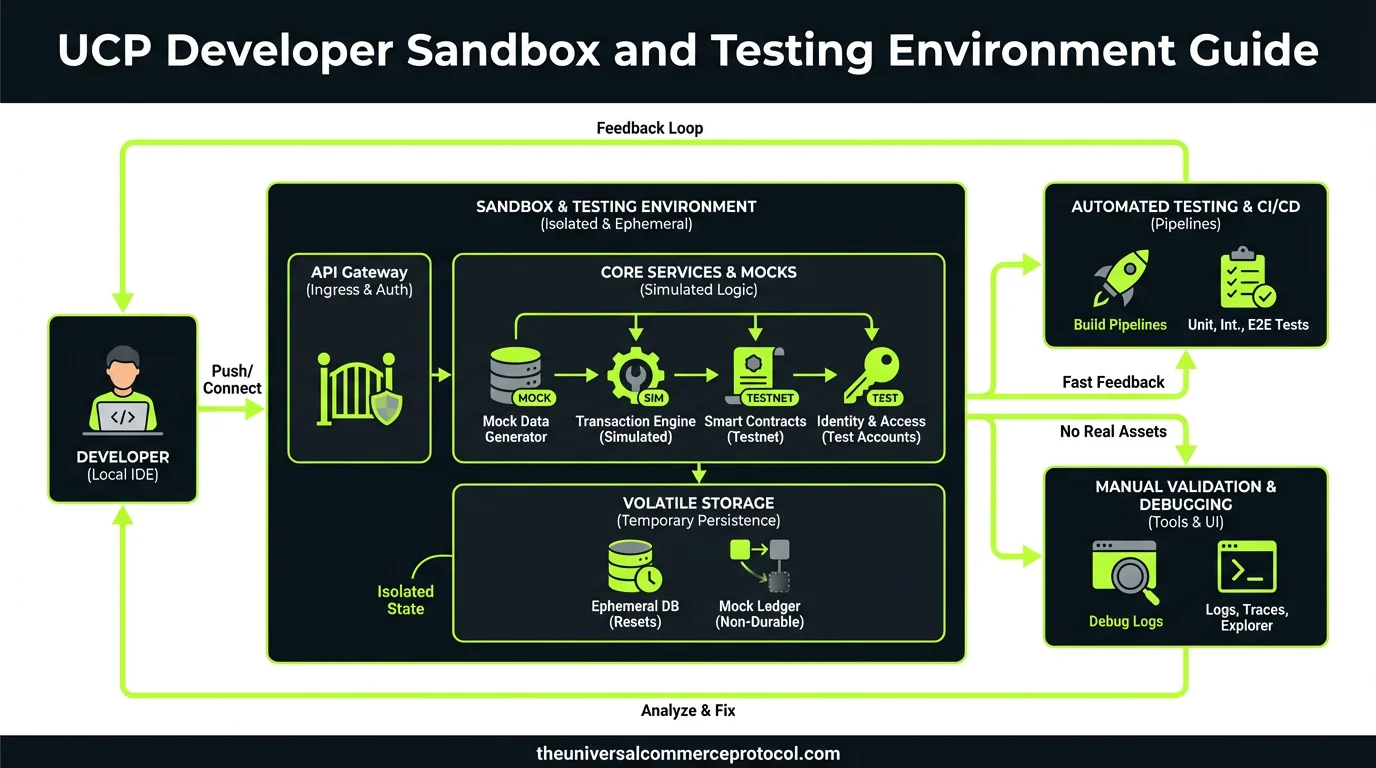
UCP Developer Sandbox and Testing Environment Guide
November 2026 update: Spec v2026-08-25 stands with no version bump. UCP still publishes no developer sandbox, test PANs, quota tables, or X-RateLimit-* / X-UCP-RateLimit-* headers — the only settled rate signal is HTTP 429 with Retry-After. Sandbox specifics in this guide remain operator-specific and unverified against the UCP spec and Google UCP FAQ as of 2026-11-08.
The Universal Commerce Protocol (UCP) developer sandbox is the critical foundation for building, testing, and validating commerce integrations before deploying to production environments. This comprehensive guide walks merchants, developers, and commerce professionals through every aspect of the UCP sandbox ecosystem, from initial setup through advanced testing scenarios.
Scope note as of 2026-11-08: UCP as published in Spec v2026-08-25 and the Google UCP FAQ publishes no developer sandbox, sandbox architecture, test credentials, test card numbers, order or fulfillment simulation, webhook testing infrastructure, or sandbox persistence, isolation, or load-testing policy. Where this guide discusses testing approaches below, those discussions are general engineering practice — not UCP specification — and any sandbox you use is that operator’s own product with its own dated documentation. Do not read operator-specific detail here as UCP fact.
Understanding the UCP Developer Sandbox Architecture
UCP publishes no sandbox architecture, no isolated replica, and no statement of feature parity with live systems. No sheet publishes a UCP sandbox. If an implementer or platform operator offers you a test environment labeled as a sandbox, treat all of its components, behavior, and parity claims as that operator’s own claims to be verified in that operator’s own dated documentation, not as UCP specification.
Related articles: UCP Shipping Carrier Selection & Rate Optimization • UCP Security Best Practices for AI-Driven Commerce
Core Sandbox Components
UCP publishes no Core Sandbox Components. The following are not UCP facts and are not presented as UCP components. [General engineering practice — not UCP specification]: commerce teams that operate their own isolated test environments commonly assemble their own tooling for their own platforms, which may include their own approaches to simulated payments, test accounts, fulfillment simulation, event capture and replay, throttling tests, and failure injection. Whether any given operator provides any of these, how they behave, and how they integrate is set solely by that operator.
[General engineering practice — not UCP specification]: when evaluating any operator-provided test environment, document what that operator actually provides, what is stubbed versus fully simulated, how test data is isolated, and where behavior is known to diverge from that operator’s production. Do not assume independent operation or seamless end-to-end integration as a UCP property, because UCP publishes no such architecture.
Setting Up Your UCP Sandbox Environment
Prerequisites and Account Configuration
UCP publishes no sandbox prerequisites, no developer account model, no sandbox API keys, no webhook URL requirement, no SDK requirement, and no test merchant provisioning process. [General engineering practice — not UCP specification]: teams typically prepare for integration testing by clarifying with the specific operator what credentials are needed, which endpoints to target, which SDK version to pin, and how test merchants or test organizations are created in that operator’s system, consulting only that operator’s dated documentation.
[General engineering practice — not UCP specification]: Never use production credentials in development environments, and never commit sandbox keys to version control systems. Keep test and production configuration strictly separated, use environment-specific configuration, and validate at startup that development builds cannot address production hosts with production secrets.
Sandbox Credentials and API Key Management
UCP publishes no credential model for testing, no publishable versus secret key distinction, and no key regeneration policy. Sheet 1 keys[] is a JWK set, not a publishable/secret model. Any publishable/secret terminology, auto-provisioning claim, or unlimited regeneration claim you encounter describes a specific operator’s implementation, not UCP, and is unverified against the UCP spec as of 2026-11-08.
[General engineering practice — not UCP specification]: as a general hygiene matter, treat all test secrets as sensitive, scope them narrowly, rotate them if exposed, and maintain key rotation policies in development workflows even for non-production environments. Confirm the actual key types, lifetimes, and rotation procedures with the operator whose environment you are using.
Testing Payment Processing in the Sandbox
Test Payment Methods and Card Numbers
UCP publishes no test PANs, no test card outcomes, and no expiry, CVC, or currency rules for testing. No sheet publishes test card numbers. This guide therefore lists no card numbers as UCP fact. Any card numbers presented elsewhere as UCP test cards are unverified operator detail and must not be treated as UCP specification.
[General engineering practice — not UCP specification]: when an operator supplies its own test payment instruments, teams commonly document for their own use which instruments that operator maps to success, decline, authentication challenge, insufficient funds, expired, or CVC-failure outcomes, and which expiry, CVC, and currency values that operator accepts. Verify all such mappings only in that operator’s own dated documentation and re-verify after any operator maintenance or reset, because UCP defines none of them.
Testing Payment Scenarios and Edge Cases
UCP publishes no currency-conversion rates or fees, no partial-capture behavior, no refund or reversal simulation, no recurring-payment lifecycle, and no 3D Secure simulation screen for sandbox testing. All such behaviors are operator-specific where they exist at all.
Currency Conversion: [General engineering practice — not UCP specification]: teams testing multi-currency logic generally verify with the operator how that operator computes converted amounts, what rates and fees that operator applies in test, and how rounding and display are handled, rather than assuming realistic production parity from UCP.
Partial Captures: [General engineering practice — not UCP specification]: where an operator supports authorization and capture concepts, teams typically test full and partial capture amounts, remaining authorizable balances, and idempotency on retries, per that operator’s docs.
Refunds and Reversals: [General engineering practice — not UCP specification]: teams typically validate full and partial refunds, reconciliation of refunded totals, and customer communications in their own systems, confirming status transitions with the operator under test.
Recurring Payments: [General engineering practice — not UCP specification]: teams that manage subscriptions commonly test setup, renewal, upgrade, downgrade, pause, and cancellation flows and the corresponding lifecycle events emitted by the operator they integrate with.
3D Secure Authentication: [General engineering practice — not UCP specification]: where authentication challenges exist, teams typically validate frontend handling of challenge presentation, success, abandonment, and failure paths against the operator’s test harness.
Order and Fulfillment Testing
Creating Test Orders with Varied Scenarios
UCP publishes no order-creation parity statement for testing and no order-ID naming convention for sandbox orders. Whether a test order API accepts the same parameters as a given production API, and what identifiers it returns, is set by that operator.
[General engineering practice — not UCP specification]: teams commonly build varied test baskets for their own coverage — single and multiple line items, digital and physical products, domestic and international addresses, varied customer segments and loyalty states, and promotional and discount combinations — and process those test orders through their own order management logic identically regardless of environment, with environment-specific endpoints and credentials.
Simulating Fulfillment Workflows
UCP publishes no fulfillment state machine and no manual or automated progression API for testing. Pending, Picking, Packing, Shipped, In Transit, Delivered, or any similar sequence describes at most a particular operator’s simulation or a team’s own model, not UCP.
[General engineering practice — not UCP specification]: teams that need to validate notification, inventory, and post-fulfillment logic without waiting for real delivery commonly agree with the operator or test harness how to advance test orders, whether progression is manual, timed, or event-driven, and what delays are configurable. Document the harness’s actual states and transitions from operator docs and validate customer-facing messages at each transition your system cares about.
Testing Shipping and Carrier Integration
UCP publishes no mock carrier rates, label generation, or tracking-number behavior for testing. Any realistic rates, labels, or tracking numbers encountered in testing are that operator’s simulation, not UCP values.
[General engineering practice — not UCP specification]: teams typically validate rate shopping, label creation, tracking ingestion, and delivery-notification workflows against the carrier or operator test endpoints they actually integrate with, confirming which tracking identifiers are scannable or purely opaque test strings in that harness.
Webhook Testing and Event Validation
Webhook Endpoint Configuration
UCP publishes no webhook payload parity, delivery or retry parity, or signature-verification method with a sandbox secret for a UCP sandbox. Any identical-payload, retry, or signing claim is operator-specific and unverified against the UCP spec as of 2026-11-08.
[General engineering practice — not UCP specification]: teams commonly configure a dedicated test endpoint for event ingestion, verify signatures exactly as the operator under test specifies for test secrets, and log raw payloads, headers, delivery attempts, and verification results for diagnosis. Confirm which secret signs which environment’s events with that operator; do not assume a production secret verifies test events or vice versa.
Testing Event Scenarios and Replay
UCP publishes no webhook dashboard, replay function, or failure-simulation feature. Where such tooling exists, it is the operator’s tooling.
[General engineering practice — not UCP specification]: teams commonly exercise payment, order, fulfillment, refund, and account-change events, plus delivery-failure and retry paths, by replaying captured events where the harness allows it and by inducing endpoint timeouts, HTTP errors, and malformed responses to confirm handler idempotency and recovery. Validate expected handler behavior against the operator’s documented delivery and retry policy, not against an assumed UCP retry logic.
Advanced Testing Strategies
Load and Performance Testing
Load-testing policy for any sandbox is set by that sandbox operator — UCP publishes no sandbox load-testing allowance. Check that operator’s own dated documentation before load testing.
UCP publishes no rate-limit tiers, quotas, or RPM/RPS numbers. The protocol standardizes only the overload signal — HTTP 429 Too many requests with a Retry-After header (REST) or error.data.retry_after (MCP) — which you should honor. Any limits you encounter in testing are that implementer’s own policy, not UCP values. General backoff handling below is general engineering practice, not UCP specification.
[General engineering practice — not UCP specification]: teams that need performance confidence typically define their own load objectives, ramp gradually, watch latency, error rate, and saturation signals, and back off when they receive 429 or 503 with retry guidance. Obtain explicit permission for any high-volume test from the operator whose systems would carry it.
Error Handling and Resilience Testing
UCP publishes no error-injection sandbox feature for timeouts, malformed responses, authentication failures, 404s, or 5xx faults. [General engineering practice — not UCP specification]: teams often deliberately exercise their own clients against timeouts, malformed payloads, authentication failures, missing resources, and server errors to confirm retry, backoff, and degradation behavior.
[General engineering practice — not UCP specification]: Verify that your application implements appropriate retry logic, exponential backoff, and graceful degradation when services return errors. Honor Retry-After / retry_after where provided on 429 or 503, add jitter to avoid thundering herds, bound total retry budgets, and degrade gracefully with clear user messaging and safe retryable states.
Data Consistency and Reconciliation Testing
UCP publishes no sandbox reporting APIs for reconciliation testing. [General engineering practice — not UCP specification]: teams commonly generate test transaction reports from the operator or harness under test and validate that their own reconciliation logic matches external records to internal records, including deliberate discrepancy scenarios to confirm that mismatches are flagged, queued, and resolved with audit trails.
Best Practices for Sandbox Development
Environment Separation and Configuration Management
[General engineering practice — not UCP specification]: Maintain clear separation between test and production environments. Use environment-specific configuration files that specify API endpoints, credentials, and feature flags. Implement configuration validation to prevent accidentally using production credentials in development. Document all harness-specific behaviors and known divergences from production to ensure developers understand testing limitations and requirements.
Test Data Management
[General engineering practice — not UCP specification]: Create comprehensive test data sets covering all customer segments, product types, and transaction scenarios your system supports. Document test data creation procedures to ensure consistency across development team members. Periodically reset test data where the operator permits it to maintain clean testing environments and prevent accumulation of stale test records, and keep canonical test cases in version control rather than relying on persistence of any hosted test store.
Documentation and Logging
[General engineering practice — not UCP specification]: Enable verbose logging in your test integration to capture detailed API interactions, webhook events, and system state changes. Review logs systematically to identify integration issues and validate expected behavior. Document all test scenarios, expected outcomes, and actual results. Maintain test case documentation to support regression testing and onboarding of new team members.
Transitioning from Sandbox to Production
Pre-Production Validation Checklist
[General engineering practice — not UCP specification]: Before deploying to production, teams commonly validate:
- All payment scenarios tested and working correctly
- Webhook delivery and event processing functioning properly
- Error handling and recovery mechanisms validated
- Performance and load testing completed successfully
- Data reconciliation processes verified
- Security and credential management implemented correctly
- Monitoring and alerting systems configured
[General engineering practice — not UCP specification]: treat this list as a starting template to tailor to the operator you are launching with, with explicit sign-off on credentials, endpoints, event handling, error budgets, reconciliation, and observability.
Production Credentials and Configuration
UCP publishes no account-manager provisioning process for production credentials and no identical-authentication-pattern claim across environments. How production access is issued, what authentication it uses, and what it routes to is set by the operator you deploy with.
[General engineering practice — not UCP specification]: update application configuration to use production credentials, update webhook endpoints to production URLs, and implement enhanced monitoring for production traffic. Rotate any secrets that were exposed during testing, verify TLS, scopes, and allowlists, and perform a low-volume production smoke test before ramping.
FAQ: UCP Developer Sandbox and Testing
Can I use sandbox data in production?
UCP publishes no sandbox-to-production isolation model or data portability rule. Whether test transactions are visible in production, whether credentials cross environments, and whether data must be recreated is set by the operator. [General engineering practice — not UCP specification]: assume test and production stores are separate unless the operator’s dated docs state otherwise, and plan to recreate needed production data via production paths with production credentials.
How long does sandbox data persist?
UCP publishes no persistence promise and no reset policy for any sandbox — neither indefinite persistence nor periodic maintenance resets are UCP facts. Check the operator’s own dated documentation for retention, deletion, and reset windows. [General engineering practice — not UCP specification]: keep critical test data and creation scripts documented in your own test-case documentation rather than relying on persistent hosted records.
Are there limits on sandbox API requests?
UCP publishes no sandbox or production rate limits or quotas to compare. The only published rate-limit signal is HTTP 429 with Retry-After / retry_after, which you should honor with retry logic. Do not present any sandbox or production throttle numbers as UCP values.
Can I test webhook failures in the sandbox?
UCP publishes no webhook retry logic for sandbox versus production. Whether failed deliveries are retried, on what schedule, and what tooling exists to simulate failures is operator-specific. [General engineering practice — not UCP specification]: teams commonly point a test endpoint at controllable failure modes — HTTP errors, timeouts, malformed responses — and confirm handler idempotency and recovery, per the operator’s documented retry behavior.
What happens if I accidentally use production credentials in sandbox code?
UCP publishes no cross-environment credential incompatibility rule and no authentication-error behavior for mismatched credentials. Behavior on credential misuse is set by the operator. [General engineering practice — not UCP specification]: always verify you are using the correct environment’s credentials in each build, implement configuration validation to prevent credential misuse, and treat any unexpected authentication result as a configuration defect to investigate in that operator’s docs and logs.
Updated November 8, 2026: Updated November 2026 to correct sandbox rate-limit claims to the only published UCP signal — HTTP 429 with Retry-After — and to flag all sandbox, test-card, and quota specifics as unverified operator detail, with original March 9, 2026 publish date preserved. First published March 9, 2026.
| Sandbox Component | Type | Requirement | Verification Scope | Functional Description | Illustrative Pattern |
|---|---|---|---|---|---|
sandbox.mock_catalog_endpoint |
string |
Mandatory | Deterministic fixture responses | Simulates multi-variant SKUs, stock depletion, and regional pricing rules | "/sandbox/v1/catalog" |
auth.test_credential_issuer |
enum |
Mandatory | Isolated non-production keypair | Issues short-lived test tokens and AP2 mandates that cannot execute live charges | "SANDBOX_JWT_ISSUER" |
payment.fault_injection_card |
string |
Required | Simulated gateway decline & timeout | Triggers deterministic 3DS challenges, insufficient-fund declines, and gateway timeouts | "TEST_TOKEN_DECLINE_SIM" |
webhook.loopback_inspector |
string |
Standard | Signed callback delivery audit | Verifies HMAC signature validation and retry handling on order state webhooks | "/sandbox/v1/webhooks/inspect" |
concurrency.race_simulator |
boolean |
Critical | Parallel agent lock contention | Tests idempotency keys and inventory reservation locks under concurrent agent bursts | true |
schema.contract_linter |
enum |
Recommended | CI/CD JSON Schema & JSON-LD check | Validates payload conformance against UCP structural rules before staging promotion | "UCP_SCHEMA_LINTER_CI" |
Developer & Architecture FAQ (Reference Standard 2026-11-10)
Q1: Why does agentic commerce require specialized sandbox testing compared to traditional web checkout?
Autonomous shopping agents execute multi-step API sequences—querying availability, locking quotes, negotiating shipping, and submitting tokenized payments—at machine speed. A dedicated UCP sandbox allows developers to test race conditions, expired quotes, and retry idempotency deterministically before exposing endpoints to live agent traffic.
Q2: How should developers simulate payment failures and webhook retries in a UCP test environment?
Developers use deterministic sandbox payment tokens mapped to specific failure modes (such as soft declines, expired mandates, or network timeouts) alongside a webhook loopback harness that deliberately drops initial delivery attempts to verify exponential backoff and signature verification.
Q3: What contract tests should run in CI/CD before deploying UCP endpoint updates?
Automated pipelines should validate that `/.well-known/ucp.json` resolves cleanly, all catalog and quote responses conform to strict JSON-LD and UCP schemas, and duplicate checkout requests sharing an idempotency key return identical state without side effects.
Leave a Reply