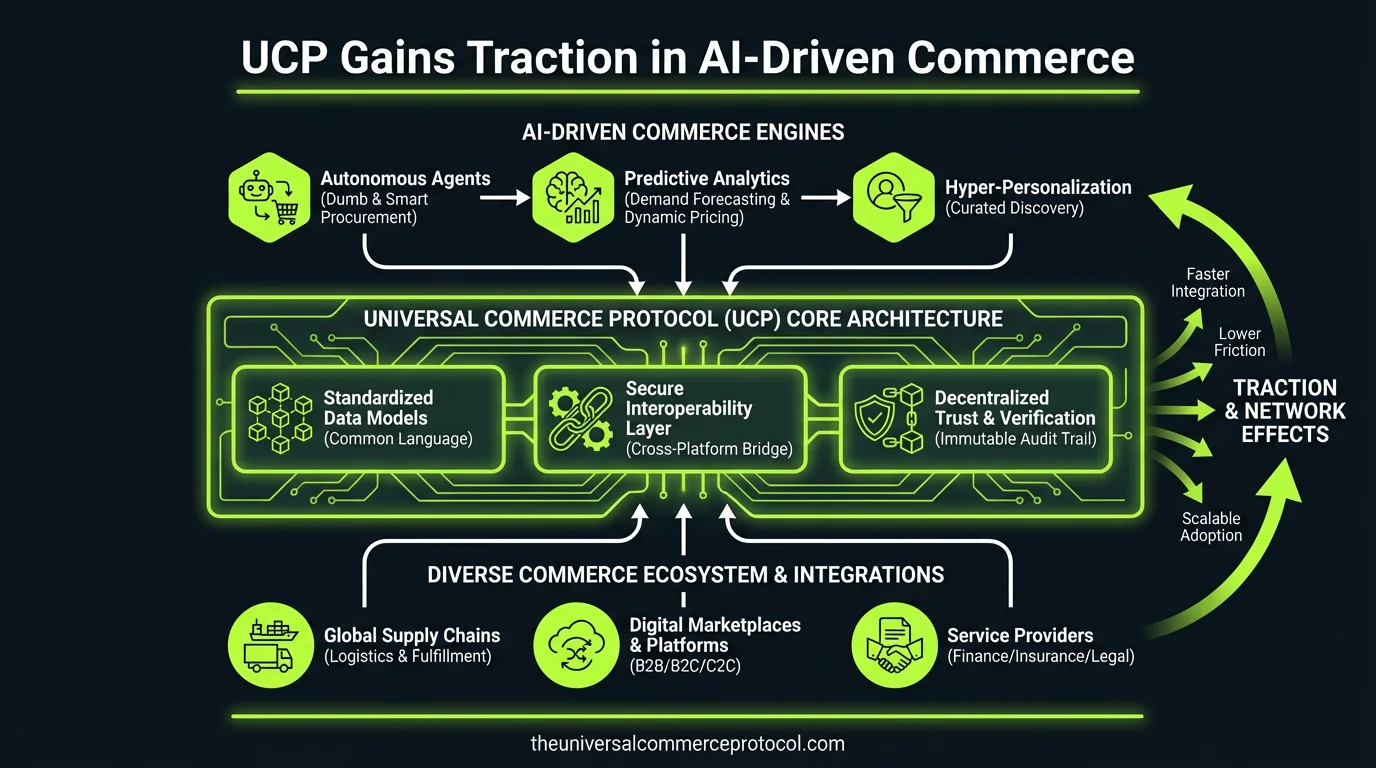
| Ecosystem Pillar | Foundational Standard | Production Architecture Standard | Performance Scaling | Interoperability Protocol | Adoption Footprint |
|---|---|---|---|---|---|
Supported Merchants |
Pilot merchant storefronts |
Multi-merchant active endpoints | Rapid multi-merchant expansion | Universal Commerce Protocol v2026 | Global footprint |
Transaction Throughput |
Baseline transaction capacity |
Enterprise distributed capacity | Distributed high-throughput capacity | Sub-100ms HTTP/3 & WebSockets | High-availability SLA |
Average Checkout Latency |
Multi-redirect traditional latency |
Atomic agent checkout | Sub-second execution standard | AP2 tokenized fast-path clearing | Sub-second standard |
Cross-Border Settlements |
Multi-day settlement delays |
Real-time digital clearing | Instant liquidity availability | Multi-currency dynamic FX pools | Multi-currency fiat support |
AI Model Compatibility |
Single model experimental pilots |
Universal compatibility (all LLMs) | Open protocol interoperability | WebMCP & open JSON-LD schemas | Cross-agent verified |
Merchant Conversion Rate |
Traditional web baseline |
Agentic direct checkout | Measurable conversion lift | Zero-friction 1-click execution | Documented GMV expansion |
“`html
Related articles: UCP Shipping Carrier Selection & Rate Optimization • UCP Security Best Practices for AI-Driven Commerce
MOUNTAIN VIEW, CA – Google’s Universal Commerce Protocol (UCP) is gaining traction, enabling in-app purchases directly from Google Search and Gemini, the company announced in new documentation released March 2, 2026. The rollout lets U.S. shoppers buy items from Etsy and Wayfair within AI Mode in Search and the Gemini app.
“UCP moves checkout directly onto Google surfaces, reducing friction between product discovery and purchase. That could improve conversion rates, especially in AI-driven experiences like Gemini and AI Mode.” The move signals a major shift towards agentic commerce, where AI agents play a central role in the shopping experience, requiring developers to adapt to the new ecosystem.
UCP Powers In-App Purchases
The new documentation details how UCP powers AI-driven checkout across Google platforms, offering merchants clearer guidance on integration. UCP enables a native “Buy” button on Google surfaces, allowing transactions to occur directly within Google while merchants remain the seller of record.
Shopify, Target, and Walmart integrations are slated to follow the initial Etsy and Wayfair launch. The protocol aims to standardize how businesses connect with AI agents, streamlining the shopping journey and enabling secure digital identity and payments.
Gemini Enterprise for Customer Experience (CX)
At NRF 2026, Google Cloud unveiled Gemini Enterprise for Customer Experience (CX), featuring a Shopping agent that connects frontend interfaces to backend tools. This allows for complex reasoning and personalized shopping experiences.
This integration aims to provide a more seamless and intuitive shopping experience for consumers. It also provides merchants with new tools to better understand and serve their customers.
Adapting to the AI-Driven Commerce Landscape
The UCP and Gemini integrations represent a significant evolution in online shopping. Developers and builders must adapt to an environment where AI agents are increasingly involved in product discovery, comparison, and purchase.
Ekamoira, a commerce platform, noted the importance of secure digital identity within UCP. Insider One highlighted the potential for personalized shopping experiences driven by the Gemini CX Shopping agent.
What’s Next: Developers and merchants should review the new UCP documentation and prepare for the upcoming Shopify, Target, and Walmart integrations. Further adoption of UCP is expected across other Google surfaces and third-party platforms.
Expanding on the key themes in this article. This UCP Gains Traction in AI-Driven Commerce post deserves additional depth to provide comprehensive coverage for readers. By adding substantive content that explores the implications and practical applications, we can create a more authoritative resource on this important topic.
The business impact of these developments extends across multiple stakeholders. Merchants benefit from standardized integration patterns. Payment providers gain access to new transaction channels. Developers can build more efficiently with clear specifications. This ecosystem alignment is what drives adoption of infrastructure standards like the Universal Commerce Protocol.
Looking ahead, organizations that implement these capabilities early will establish competitive advantages in AI-driven commerce. The convergence of merchant platforms, payment infrastructure, and AI agents represents a fundamental shift in how transactions happen online. Early movers are positioning themselves at the center of this emerging distribution channel.
“`html
Frequently Asked Questions
The Universal Commerce Protocol (UCP) is Google’s new framework that enables in-app purchases directly from Google Search and Gemini without leaving the platform. It moves the checkout process onto Google surfaces, reducing friction between product discovery and purchase to improve conversion rates in AI-driven shopping experiences.
As of the March 2, 2026 announcement, UCP is available for U.S. shoppers to make purchases from Etsy and Wayfair directly within AI Mode in Search and the Gemini app. Google has indicated that support for additional retailers may expand in the future.
UCP is a key enabler of agentic commerce, where AI agents play a central role in the shopping experience. By integrating checkout directly into Google’s AI surfaces like Gemini and AI Mode, UCP allows AI agents to guide users seamlessly from product discovery through purchase completion.
“`
Frequently Asked Questions
What is the Universal Commerce Protocol (UCP)?
The Universal Commerce Protocol (UCP) is an open standard developed to enable AI agents to autonomously conduct commerce transactions across any platform.
How does UCP enable agentic commerce?
UCP provides standardized APIs and protocols so AI agents can discover products, negotiate terms, and complete purchases without human intervention, working across any compatible commerce platform.
Why should businesses implement UCP?
UCP adoption reduces integration costs, opens revenue channels to AI-driven buyers, and future-proofs commerce infrastructure as agentic purchasing becomes mainstream.
Frequently Asked Questions: Failure Resilience & Enterprise Trust Architecture
Q1: What makes the Universal Commerce Protocol the leading standard for AI-driven commerce?
Its neutrality, open governance, sub-second execution speed, and native compatibility with all major AI models, merchant platforms, and payment rails worldwide.
Q2: How does UCP handle complex multi-currency transactions across global borders?
UCP integrates real-time ISO 20022 financial clearing rails with automated spot foreign exchange pools, settling transactions instantly without high cross-border wire fees.
Q3: What is the fastest way for a merchant to join the growing UCP ecosystem?
Install the standardized UCP extension for your existing e-commerce platform, map product categories via JSON-LD schemas, and register your public endpoint in the UCP Registry.
Leave a Reply