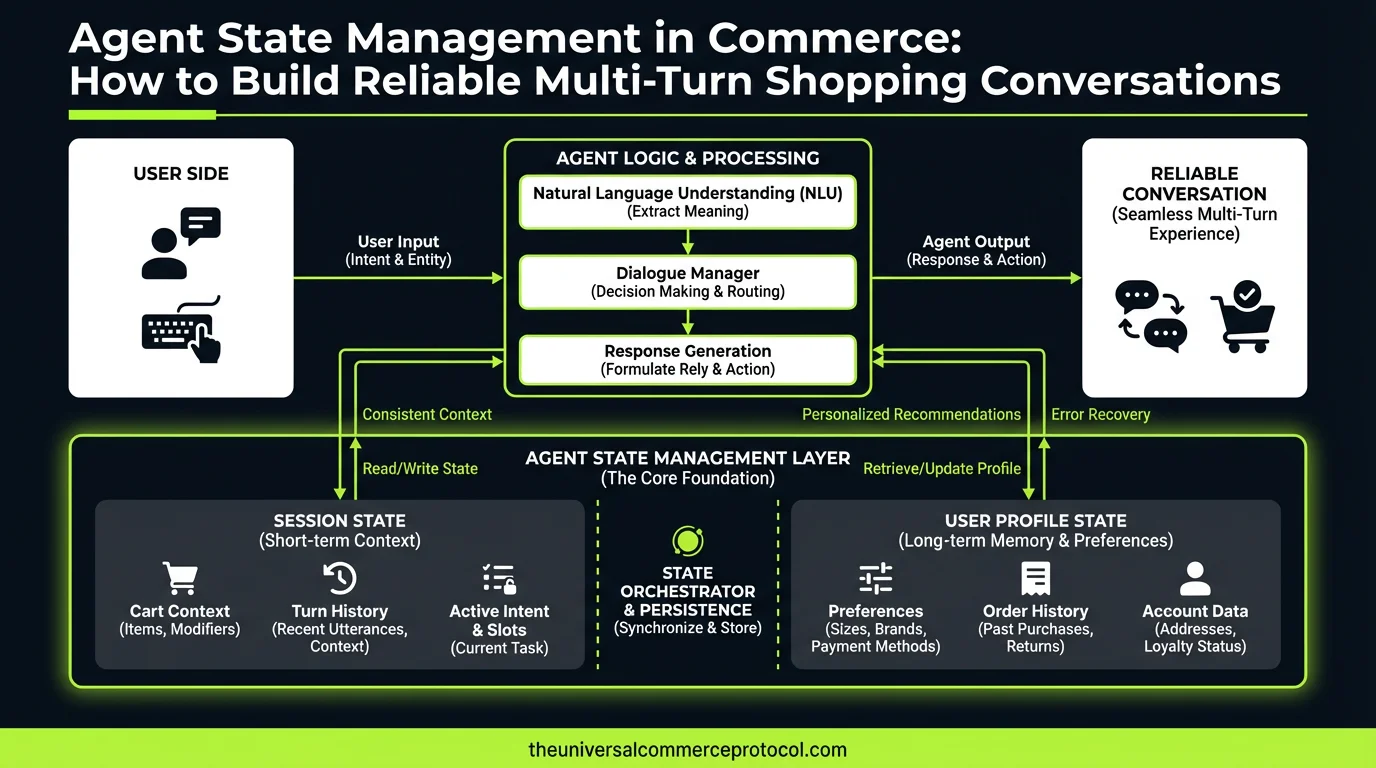
Why State Management Matters in Agentic Commerce
While session management covers the infrastructure layer — keeping the connection alive — state management addresses a deeper problem: what the agent actually remembers and how it constructs decisions across turns. Observability then monitors that behavior. This gap sits between connection persistence and monitoring. It is about memory, constraints, and decision continuity.
A customer walks into a live chat with an agent. They ask about a product. The agent retrieves it. Then they ask a follow-up question — “do you have it in blue?” A stateless system treats this as a new request, losing context. A properly architected agent remembers the previous product, the customer’s preferences, and their cart state across the entire conversation.
A customer asks an agent to find running shoes under $100. The agent finds three options. The customer asks “what’s the return policy on the blue one?” Three minutes later, they ask “can I get it in size 12?” If the agent’s state isn’t properly maintained, it may forget which shoe is “the blue one,” lose the customer’s price constraint, or give an answer that no longer matches current merchant data.
State management is not a new problem in software engineering, but agentic commerce introduces unique constraints: agents must maintain state across multiple LLM calls, preserve it through payment processing, handle concurrent user sessions, and remain auditable for compliance. Yet most agentic commerce architectures gloss over this critical layer.
What Must Be Tracked: The State Layers
Unlike traditional stateless APIs, commerce agents operate in a fundamentally stateful domain. Every product query, cart addition, shipping address change, and payment attempt modifies the customer’s transaction state.
An agent must track four layers:
- Conversation State: What products have been discussed? What questions remain unanswered? This includes explicit message history and referenced entities — products, prices, policies mentioned in this conversation — and commerce-specific selections such as which variant the customer chose.
- User State: Preferences, purchase history, loyalty status, shipping address. This persists across sessions and should inform every decision. A premium member asking “which one’s fastest to ship?” should see expedited options first.
- Transaction State: Cart contents, selected variants, applied discounts, shipping method, plus real-time realities: what’s in stock, current prices, active promotions, and merchant policies. Agents must know whether they are operating on stale data.
- Agent Decision State: Which fallbacks were attempted? Why was a particular recommendation made? What constraints were applied? If the customer asks “why not that cheaper option?”, the agent should be able to retrieve its reasoning, not invent an explanation after the fact.
The challenge deepens when agents operate asynchronously. A customer might pause mid-conversation, return hours later, and expect the agent to resume seamlessly. Or multiple agents might handle the same customer in parallel — one for chat, one for email — requiring state synchronization across instances.
Where State Management Fails Today
Without explicit state tracking, multi-turn commerce breaks in predictable ways:
- Context window overflow: Including full message history, user profile, inventory snapshot, and decision rationale in every prompt quickly exceeds token limits. Naive systems truncate history, losing earlier constraints.
- Stale-data injection: User state and transaction state retrieved at turn 1 are outdated by turn 5. A product that was in stock is now sold out. A price has changed. An agent making decisions on stale data will recommend items that no longer match the conversation’s constraints, then defend the recommendation with outdated facts.
- State hallucination: Agents invent state to fill gaps. Without explicit tracking, agents confabulate to maintain coherence — referencing preferences never stated or promotions no longer active.
- Cross-turn contradiction: The agent states one return window in turn 2, then a different window in turn 4, because the statements came from different API calls. Without state canonicalization, agents contradict themselves, eroding trust.
- User state leakage: An agent inadvertently references another customer’s saved address or discloses sensitive history. State isolation between customers and sessions is non-negotiable.
Architectural Patterns for Agent State
Pattern 1: In-Memory State with Persistent Checkpoints
The simplest approach stores conversation state in memory during a session, checkpointing to a database at key moments: after each LLM turn, before payment initiation, after checkout completion.
Pros: Fast state access, minimal latency for multi-turn conversations, straightforward debugging.
Cons: Agent failure loses in-flight state; scaling requires careful session affinity; difficult to migrate sessions across servers.
Best for: Single-session checkout flows where conversation duration is short.
Pattern 2: Event-Sourced State
Instead of storing state snapshots, log every state-mutating event — product viewed, cart item added, discount applied, payment authorized. The current state is derived by replaying events.
Pros: Complete audit trail; state is always recoverable; agents can be restarted without context loss; natural fit for distributed systems.
Cons: Higher latency to reconstruct current state; requires careful event schema management; debugging is harder — replaying many events versus inspecting one snapshot.
Best for: High-compliance environments, multi-agent systems, long-running conversations.
Example: A customer’s journey logged as: [SessionStarted] → [ProductViewed(SKU-123)] → [CartItemAdded(SKU-123, qty=2)] → [DiscountApplied(CODE-MARCH10)] → [ShippingAddressSet] → [PaymentInitiated]. On reconnection, replay all events to rebuild state.
Pattern 3: Hybrid State with Read Cache
Combine event sourcing for writes with a cached materialized state for reads. Events are immutable; a separate state cache is updated on each event and invalidated intelligently.
Pros: Audit trail plus fast reads; resilience to cache failures; good for high-concurrency systems.
Cons: Cache invalidation complexity; potential state divergence if cache update fails.
Best for: High-traffic retail platforms where state access frequency justifies caching overhead.
Pattern 4: Structured State Object
Rather than embedding all state in the prompt, maintain a structured state object that the agent can read and write. Between turns, only changed fields are updated, reducing token usage and preventing drift.
For example, a single object captures conversation and user identifiers, current intent such as find_running_shoes, constraints such as max price and brand or width preferences, candidate products with the reason each was chosen, loyalty and history signals, and the timestamp of the last inventory check:
{“conversation_id”: “abc123”, “user_id”: “user_456”, “current_intent”: “find_running_shoes”, “constraints”: {“max_price”: 100}, “candidates”: [{“sku”: “4821”, “name”: “Nike Pegasus”, “price”: 87.99, “in_stock”: true, “decision_reason”: “matches_price_and_brand_constraint”}], “last_inventory_check”: “2026-03-13T14:22:00Z”}
The agent references this object rather than reconstructing state from memory. Pair it with just-in-time refresh: don’t load all inventory and user data upfront. Instead, refresh specific data points when the decision hinges on them. If the agent is about to recommend a SKU, check inventory and price in real time. If it is about to explain a return policy, fetch the current policy from the merchant API. This trades a small amount of latency for accuracy.
Handling Concurrent State Mutations
Two agents — or the same agent handling retries — may attempt to modify state simultaneously. Consider a customer adding an item to their cart while an inventory sync agent is checking stock.
- Optimistic locking: Assume no conflict; tag each state mutation with a version number. If version mismatch occurs on write, reject and retry. Fast but requires retry logic.
- Pessimistic locking: Lock state before mutation. Safe but can create bottlenecks if agents hold locks during slow operations such as API calls or LLM inference.
- Event-based resolution: Accept concurrent mutations, order them by timestamp, and apply a deterministic conflict resolution rule. Simpler for distributed systems but requires careful design — for example, most recent product view wins, or sum quantities on duplicate cart items.
State Preservation Across Agent Transitions
A customer might interact with a browser-based agent, then continue via email. Or a primary agent might hand off to a specialist agent for a specific question. State must transfer cleanly.
Create a state serialization contract: a schema that captures the minimal state needed to resume. Include:
- Current cart state — items, quantities, variants
- Conversation transcript — or a summary for large conversations
- Customer context — shipping address, preferences
- Agent metadata — which fallbacks were tried, confidence scores
- Timestamp and originating agent ID
Validate on transfer: the receiving agent parses the state and verifies it’s consistent with current inventory, customer record, and business rules. Reject invalid states with a graceful error message to the customer.
Add versioning and rollback to that contract. If a user says “actually, forget that — I want to go back to the blue shoe option,” the agent should be able to revert to a previous snapshot. Take state snapshots at each significant decision point — product selected, constraint added, question asked. This enables “undo” and provides audit trails for dispute resolution.
Multi-Merchant State Complexity
A single agent shopping across five merchants faces state explosion. The same product costs different amounts on different merchants. Return policy differs. Shipping time differs. Stock levels are independent.
Maintain separate transaction state per merchant, but unified user state and conversation intent. The agent should know the customer wants the lowest price across all merchants, but also track when each merchant’s inventory was last checked. Stale data from one merchant shouldn’t contaminate recommendations from another.
Debugging Agent State Issues
State bugs are particularly insidious in agentic commerce: they appear as mysterious customer confusion, incorrect prices, or cart discrepancies.
Implement state observability:
- Log every state transition with a unique ID.
- Store state snapshots at conversation checkpoints, queryable by session ID.
- Emit metrics: state size, mutation frequency, event replay latency.
- Track state divergence: if materialized state doesn’t match replayed state, alert.
Create a state viewer tool: allow support teams to inspect any session’s state history — what was in the cart 5 minutes ago, which discount was active, what the agent’s last decision was.
Extend that observability with explicit reasoning logging as part of agent decision state. When an agent makes a choice, log the filtering it applied — for example, from broad consideration set to price matches to brand matches to final recommendation. If the customer challenges the recommendation, you can replay that logic instead of generating a new justification.
State and Compliance
When asked why an agent recommended a product, retrieve the state object from that conversation. To show whether the customer was informed of the return policy, check the decision reasoning log. To confirm whether the agent had accurate inventory data, review the timestamp on the last transaction refresh.
State management is compliance infrastructure. It is auditable, reproducible, and defensible in dispute resolution.
Common Pitfalls
Pitfall 1: Forgetting to invalidate state on external changes. Inventory drops, a discount expires, a customer’s address is updated in a CRM. If the agent’s state cache isn’t invalidated, it makes decisions on stale data. Solution: subscribe to change events from upstream systems; invalidate relevant state slices.
Pitfall 2: Storing too much state. Caching the entire product catalog or customer history inflates memory and slows retrieval. Store only what the agent needs for the current conversation. Reference the rest by ID.
Pitfall 3: No state versioning. Your business logic evolves; old conversations have state in a deprecated format. Solution: version your state schema; include a version field; handle migration or explicit rejection.
Pitfall 4: Treating state recovery as optional. If an agent crashes mid-conversation, can you resume? If not, the customer’s work is lost and trust erodes. Solution: checkpoint state before slow operations such as LLM calls and payments.
| Parameter / Field | Type | Requirement | Constraint | Description | Example |
|---|---|---|---|---|---|
state_architecture.memory_model |
enum |
Mandatory | EPISODIC_STATE_GRAPH | KEY_VALUE_CONTEXT | MONOTONIC_EVENT_LOG | Structural model capturing multi-turn negotiation history, constraints, and intermediate bids | "EPISODIC_STATE_GRAPH" |
hydration.session_restore_latency_ms |
integer |
Critical | <= 20 ms | Latency budget to rehydrate full conversational memory and cart context from distributed cache | 12 |
compaction.context_pruning_policy |
enum |
Standard | SEMANTIC_SUMMARIZATION | SLIDING_WINDOW_TOKENS | Algorithm condensing multi-turn dialogue while preserving immutable price quotes and binding terms | "SEMANTIC_SUMMARIZATION" |
checkpoint.state_persistence_engine |
enum |
Required | REDIS_RAFT | SCYLLADB_GLOBAL | FOUNDATIONDB_ACID | Strictly serializable distributed storage engine persisting intermediate negotiation checkpoints | "REDIS_RAFT" |
concurrency.distributed_state_lock_ttl_sec |
integer |
Mandatory | 5 <= ttl <= 30 seconds | Lease window preventing multiple sub-agents from mutating the same cart state simultaneously | 15 |
durability.crash_recovery_sla_ms |
integer |
Optimal | <= 100 ms | System recovery time to restore active negotiations following pod eviction or node crash | 45 |
Frequently Asked Questions: AI Agents & Autonomous Commerce
Q1: How do multi-turn commerce agents avoid context window exhaustion during lengthy negotiations?
Systems implement semantic state graph compaction: conversational chit-chat is compressed, while binding contractual terms, SKU IDs, price quotes, and cryptographic nonces are retained in immutable memory nodes.
Q2: What storage engines provide the consistency needed for multi-agent cart states?
Raft-backed Redis or FoundationDB provide strict serializability and ACID transactions, ensuring that simultaneous actions by buyer and merchant agents never corrupt shared inventory or price states.
Q3: How does crash recovery function if an agent pod is evicted mid-negotiation?
Durable execution runtimes rehydrate the exact state machine state from the last committed snapshot in under 45ms, re-issuing unconfirmed RPC messages with existing idempotency keys.
Leave a Reply