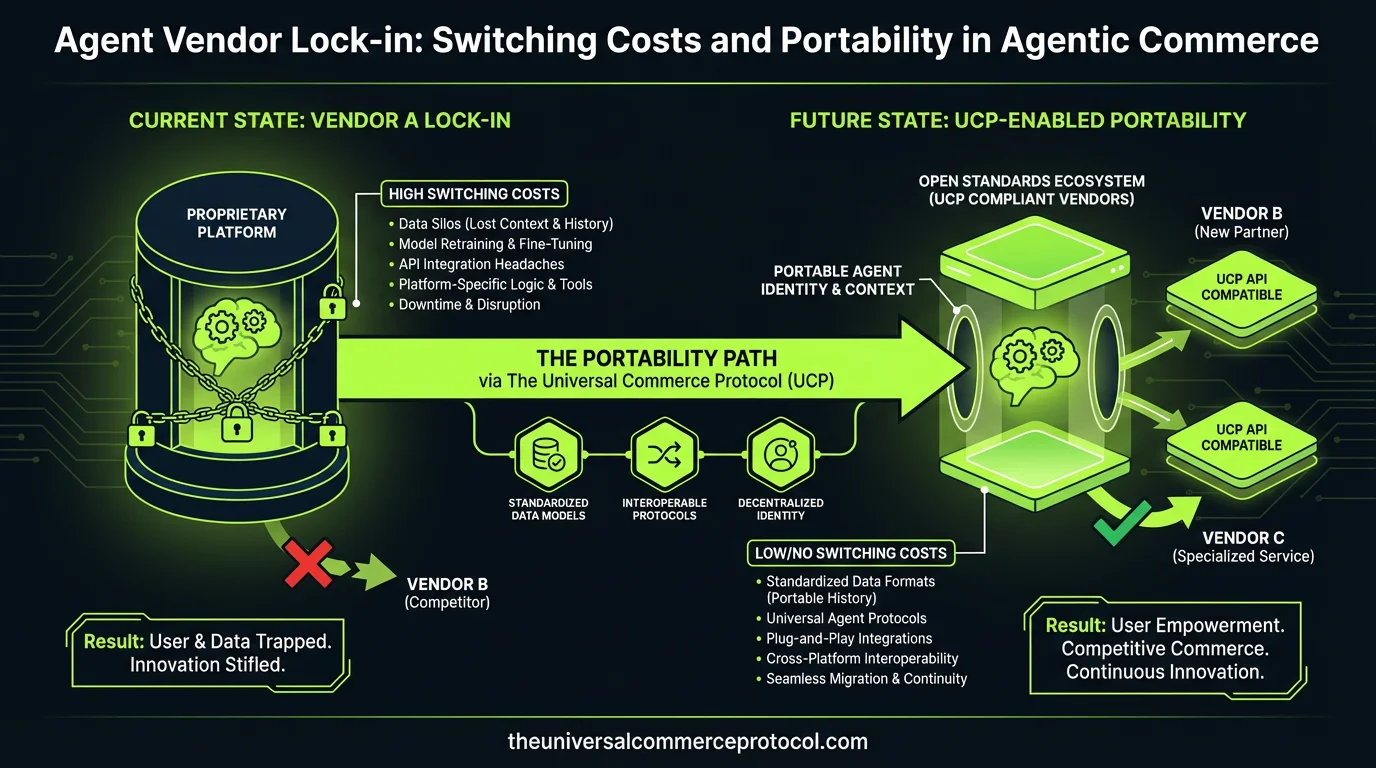
Agentic commerce is accelerating adoption, but merchants face a critical risk that has gone largely unexamined: vendor lock-in at the agent infrastructure layer.
Unlike traditional e-commerce platforms where merchants can migrate databases and storefronts, agentic systems embed agents into LLM ecosystems (Claude + MCP, GPT + OpenAI tools, Gemini + Google Shopping), creating compounding switching costs. A merchant running agents on Shopify + ChatGPT integration cannot easily port those agents to Amazon’s emerging agent layer without rebuilding approval workflows, state machines, and fallback logic.
The Portability Problem
Today’s agentic commerce integrations are fundamentally tethered to specific LLM vendors and their tool ecosystems. Shopify’s ChatGPT storefronts, for example, rely on OpenAI’s function-calling API and session management. If a merchant wants to switch to Claude-based agents (which use the Model Context Protocol), they must:
- Redesign agent state management (different session/context window semantics)
- Rebuild inventory sync logic (MCP uses a different discovery and tool definition model than OpenAI tools)
- Re-engineer approval workflows (OpenAI and Claude handle multi-turn validation differently)
- Migrate historical agent decision logs and training data
This is not a matter of API translation. It’s architectural. The cost to switch grows with agent sophistication—every custom fallback rule, every trained approval heuristic, every agent-to-agent negotiation protocol becomes platform-specific debt.
Data Lock-in: Agent Behavior and Decision History
The stickiest lock-in lever is data. Once an agent has executed thousands of commerce transactions, merchants accumulate:
- Agent decision logs (which products the agent recommended, why, outcomes)
- Behavioral training data (which agent responses reduced cart abandonment)
- Compliance audit trails (proof of agent adherence to return policies, tax rules)
- Cost attribution models trained on that specific agent’s behavior
Moving these logs to a competitor’s agent platform requires not just export, but retraining. A merchant cannot take Claude agent logs and directly use them to fine-tune a GPT agent—the decision trees, confidence scores, and action spaces differ fundamentally.
The CFO implications are severe. The $2.3M annual blind spot cost cited in recent observability research assumes merchants stay with their chosen agent platform. If switching costs exceed $500K–$1M (realistic for mid-market merchants), lock-in calcifies.
The Universal Commerce Protocol as Lock-in Mitigation
This is where UCP design becomes critical. The Universal Commerce Protocol’s core value—normalizing agent-to-merchant communication across LLM vendors—directly addresses portability.
A true UCP implementation should define:
- Agent State Schemas: Standardized representations of multi-turn agent context (session ID, inventory snapshot, approval stage) that are vendor-agnostic
- Tool Discovery Format: Unified definition of available merchant actions (add-to-cart, apply-discount, trigger-approval) that work across Claude MCP, OpenAI tools, and Gemini agents
- Decision Log Portability: A canonical format for exporting and re-importing agent decision history so merchants aren’t trapped by their logs
- Fallback Protocol: Standardized handoff mechanics so an agent-to-human escalation on ChatGPT can be replayed on Amazon’s agent layer
Google’s recent UCP expansion with Walmart suggests this thinking is active in the protocol design. However, most current implementations focus on the happy path (agent executes a purchase cleanly) rather than portability and switching mechanics.
Competitive Leverage and Market Consolidation Risk
If vendor lock-in is not mitigated, expect:
- Winner-take-most dynamics: The first LLM vendor to reach scale in agentic commerce (likely OpenAI via ChatGPT storefronts or Google via UCP + Walmart) will extract switching costs from competitors indefinitely
- Merchant negotiating weakness: Once a merchant has tuned agents for 6+ months, they cannot credibly threaten to leave, eliminating pricing pressure
- Fragmented agent ecosystems: Merchants may maintain separate agents per platform (one on ChatGPT, one on Claude) to avoid single-vendor risk, multiplying infrastructure costs
JPMorgan and Mirakl’s partnership (announced March 2026) is notable here—by integrating AI agents into a marketplace middleware layer, they’re attempting to sit above LLM vendor lock-in. If they succeed in making agents portable across OpenAI, Claude, and Gemini, they’ve neutralized the lock-in moat.
Practical Steps for Merchants to Avoid Lock-in
1. Demand UCP Compliance Guarantees
Before deploying an agentic storefront, verify that the provider commits to exporting agent state, decision logs, and tool definitions in a UCP-standard format. Avoid proprietary schemas.
2. Version Agent Logic Separately from LLM Integration
Architect approval workflows, pricing rules, and fallback policies as merchant-owned code, not platform-embedded configuration. This way, switching LLM vendors doesn’t require business logic rewrites.
3. Establish a Baseline Cost of Switching
Calculate the true cost to migrate your agent to a competitor: data export, state translation, workflow re-engineering, testing, and retraining. If it exceeds your annual agent ROI, you’re locked in.
4. Use Multi-Agent Hedging
Deploy pilot agents on multiple platforms (even at modest scale) to keep switching costs low. A merchant running 5% of traffic on Claude agents and 95% on ChatGPT is more leverage-ful when negotiating contract terms.
Frequently Asked Questions
Q: Is vendor lock-in in agentic commerce worse than SaaS platform lock-in?
A: Yes. Traditional SaaS platforms (Shopify, WooCommerce) lock you in via data volume and integration complexity. Agentic systems add a layer: you’re also locked in by agent behavior patterns and LLM training. Switching costs compound.
Q: Can merchants use API wrappers to abstract away LLM vendor differences?
A: Partially. Tools like LangChain provide a veneer of compatibility, but they don’t solve the state management or approval workflow problem. You still have to rebuild the agent’s decision logic.
Q: Will the Universal Commerce Protocol prevent vendor lock-in?
A: Only if merchants demand and enforce UCP portability clauses in contracts. UCP is a standard—it only has teeth if merchants use it as a lock-in prevention tool.
Q: What’s the time horizon before lock-in becomes irreversible?
A: 6–12 months. After a merchant has trained agents, tuned approval workflows, and built historical decision logs on a specific platform, switching cost ROI becomes negative. By month 12, most merchants are locked in.
Q: Should merchants avoid early agentic adoption to dodge lock-in risk?
A: No. Early movers gain behavioral data advantages. But they should negotiate lock-in terms (exit clauses, data export rights, state portability) from day one.
Frequently Asked Questions
Q: What is vendor lock-in in agentic commerce?
A: Vendor lock-in in agentic commerce occurs when merchants become dependent on a specific LLM vendor’s ecosystem (such as OpenAI, Claude, or Gemini) for their agent infrastructure. Once agents are embedded into these systems, switching to a different vendor requires rebuilding agent state management, inventory sync logic, approval workflows, and other critical components, creating significant switching costs.
Q: How is agentic commerce different from traditional e-commerce platforms in terms of portability?
A: Traditional e-commerce platforms allow merchants to migrate databases and storefronts with relative ease. However, agentic systems embed agents directly into LLM ecosystems, creating compounding switching costs. Unlike traditional platforms, porting agents from one LLM vendor to another requires rebuilding core infrastructure components rather than simply moving data.
Q: What are the specific costs of switching from ChatGPT-based agents to Claude-based agents?
A: Switching from ChatGPT to Claude requires redesigning agent state management due to different session/context window semantics, rebuilding inventory sync logic since MCP uses different tool definition models than OpenAI tools, and re-engineering approval workflows that differ between OpenAI and Claude implementations.
Q: Why is agent infrastructure lock-in a critical risk for merchants?
A: Agent infrastructure lock-in is critical because it limits merchant flexibility and negotiating power with vendors. As merchants invest more deeply in agent-based commerce systems, the cost of switching vendors increases substantially, potentially trapping them in unfavorable contracts or with outdated technology.
Q: What role does the Model Context Protocol (MCP) play in vendor lock-in?
A: The Model Context Protocol (MCP), used by Claude, has different tool discovery and definition models compared to OpenAI’s function-calling API. This difference means that inventory sync logic, agent workflows, and tool integrations built for one protocol cannot easily transfer to another, increasing switching costs between vendors.
Frequently Asked Questions
What is the Universal Commerce Protocol (UCP)?
The Universal Commerce Protocol (UCP) is an open standard developed to enable AI agents to autonomously conduct commerce transactions across any platform.
How does UCP enable agentic commerce?
UCP provides standardized APIs and protocols so AI agents can discover products, negotiate terms, and complete purchases without human intervention, working across any compatible commerce platform.
Why should businesses implement UCP?
UCP adoption reduces integration costs, opens revenue channels to AI-driven buyers, and future-proofs commerce infrastructure as agentic purchasing becomes mainstream.
Leave a Reply