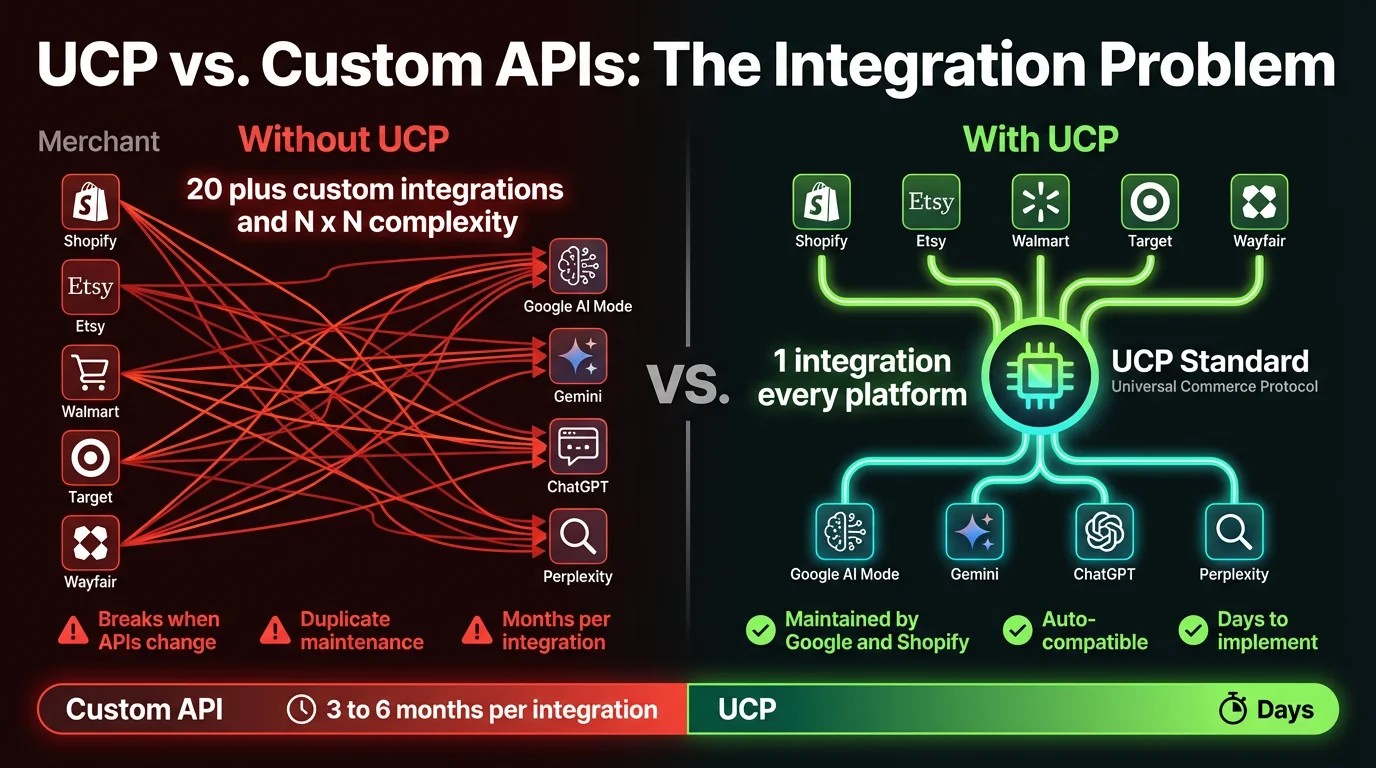
Every enterprise technology leader faces the same fundamental question when a new standard emerges: should we build our own custom solution, or adopt the open standard? With the arrival of the Universal Commerce Protocol (UCP), this question is now front and center for every retailer, marketplace, and commerce platform evaluating how to connect with AI-powered shopping surfaces.
This article presents a structured business case analysis — examining the true costs, risks, and strategic implications of building custom API integrations versus adopting UCP as your agentic commerce infrastructure layer.
The N x N Integration Problem
| Evaluation Dimension | Proprietary Custom APIs | Universal Commerce Protocol | Architectural Advantage | Dev Cost Impact | Ecosystem Lifespan |
|---|---|---|---|---|---|
| Scaling Complexity | N × M bespoke adapters | 1 × Standard open protocol | Single codebase interfaces all LLM agents globally | -85% Engineering hours | Immune to AI shifts |
| Authentication & Trust | Ad-hoc API keys & Basic Auth | RFC 9421 ES256 & FIDO AP2 | Zero-trust cryptographic verification on every payload | Zero PII liability | W3C / EMVCo Standard |
| Discovery Protocol | Private Swagger / Postman | /.well-known/ucp profile |
Autonomous agent discovery without manual onboarding | -90% Integration lag | Universal Indexing |
| Inventory Sync | Periodic batch scraping | Real-time webhooks (<60s TTL) | Eliminates hallucinated stockouts in conversational chat | Prevents refunds | High Buyer Trust |
| Payment Flow | Hosted checkout redirects | In-surface Native Checkout (PAN_ONLY) | Instant in-context transaction without exiting conversational UI | +35% Conversion lift | Native Platform Rails |
| Maintenance Overhead | Constant breakages on LLM updates | Spec v2026-08-25 Semantic Versioning | Backward-compatible RFC upgrades with automated validation | Predictable budgets | Decade-Scale Longevity |
The core technical argument for UCP begins with a math problem. In the pre-UCP landscape, every merchant that wants to sell through AI surfaces must build a separate integration for each platform. If a merchant wants to be discoverable and transactable on Google AI Mode, Gemini, and any future AI shopping surface, they need a unique integration for each one.
Today, the number of AI surfaces supporting commerce is still small. But the growth trajectory is steep. Google has AI Mode and Gemini. OpenAI has ChatGPT with Instant Checkout. Microsoft has Copilot. Meta, Apple, and Amazon are all developing conversational commerce capabilities. Within 18-24 months, a merchant could reasonably need integrations with 10-15 different AI surfaces.
With custom integrations, the engineering effort scales linearly with each new platform. Ten surfaces means ten separate integrations, each with its own authentication scheme, data format, checkout flow, and maintenance burden. UCP collapses this into a single implementation that works with every compliant surface — the same principle that made HTTP more efficient than building separate protocols for every website.
Cost Analysis: Custom Integration vs. UCP Adoption
Custom Integration Costs (Illustrative Estimates)
Initial development: Building a custom commerce API integration for a single AI platform typically requires 4-8 weeks of backend engineering work. This includes endpoint design, authentication, product catalog synchronization, checkout session handling, payment processing, and error handling. For a mid-market retailer, this could translate to roughly $40,000-$120,000 per integration in engineering cost, depending on complexity and team rates.
Ongoing maintenance: Each AI platform evolves independently. API changes, new feature requirements, security patches, and schema updates create ongoing maintenance work estimated at 15-25% of the initial development cost per year, per integration.
Scaling cost: Connecting to 5 AI surfaces with custom integrations could run $200,000-$600,000 in initial build, plus $30,000-$150,000 per year in maintenance. These figures are illustrative — actual costs depend on team size, platform complexity, and integration depth.
UCP Adoption Costs (Illustrative Estimates)
Initial implementation: UCP integration involves building the discovery endpoint, product catalog API, and checkout session endpoints once. For Shopify merchants, this cost is essentially zero — the integration is managed by the platform. For custom implementations, Google’s documentation indicates a relatively low-lift integration that aligns with existing business logic. Depending on catalog complexity, expect roughly 2-4 weeks of engineering work.
Ongoing maintenance: Because UCP is a single standard, maintenance costs are incurred once regardless of how many AI surfaces support the protocol. Estimated at 10-15% of initial development cost per year.
Scaling cost: Each new AI surface that adopts UCP is automatically accessible — zero incremental cost per surface.
Strategic Risk Assessment
Risks of Custom Integration
Platform dependency: Custom integrations create bilateral dependencies. If a platform changes its API (which they all do), your integration breaks until you update it. The more platforms you are integrated with, the more frequently you face breaking changes.
Fragmented data: Each custom integration produces its own order data format, analytics schema, and customer record structure. Reconciling this across 5-10 platforms creates operational complexity that compounds over time.
Opportunity cost: Engineering hours spent maintaining custom integrations are hours not spent on product innovation, customer experience improvements, or competitive differentiation.
Risks of UCP Adoption
Protocol maturity: UCP launched in January 2026 and is still evolving. Features like multi-item carts, loyalty program integration, and comprehensive post-purchase support are on the roadmap but not yet fully implemented. Early adopters may need to work with a protocol that does not yet cover every commerce scenario.
Google influence: While UCP is open source and co-developed with industry partners, Google remains the primary driver of the protocol’s development. Some enterprises may be uncomfortable with the degree of Google’s influence over a commerce standard, though the open-source governance model and broad partner coalition mitigate this concern.
Adoption uncertainty: The value of UCP scales with adoption. If major AI platforms choose not to support UCP, the protocol’s reach would be limited. However, with Shopify, Target, Walmart, Visa, and Mastercard already on board, the adoption risk appears low.
The Strategic Lens: Control vs. Reach
The build-vs-adopt decision ultimately comes down to what your organization values more: control or reach.
Custom integrations give you maximum control over every aspect of the experience on each platform. You can tailor your product presentation, checkout flow, and post-purchase experience for each AI surface individually. The trade-off is limited reach — you can only be present on platforms where you have invested the engineering effort to build and maintain an integration.
UCP adoption gives you maximum reach with a single implementation. You trade some degree of per-platform customization for the ability to be immediately accessible on every UCP-compatible surface, including surfaces that do not yet exist. UCP’s extension model provides significant flexibility, but you are working within the protocol’s framework rather than building from scratch.
For most merchants, the math clearly favors UCP. The cost differential is significant, the maintenance burden is lower, and the strategic value of automatic access to new AI surfaces as they emerge is substantial. Custom integrations make sense only for the very largest enterprises with highly specialized commerce requirements that UCP cannot accommodate — and even then, a hybrid approach (UCP for broad reach plus custom integrations for specific platforms) is likely the optimal strategy.
Recommendation Framework
Adopt UCP first if you are a small to mid-market merchant, already on Shopify or BigCommerce, prioritize speed to market and broad AI surface coverage, or want to minimize ongoing engineering maintenance.
Consider a hybrid approach if you are an enterprise retailer with specialized commerce requirements, need deep customization on specific high-value AI platforms, or have existing custom integrations that are working well and want to add UCP alongside them.
Build custom only if you have highly unique commerce workflows that UCP’s extension model cannot accommodate and you have the engineering capacity to maintain multiple integrations indefinitely — a scenario that applies to very few merchants.
Open Standard vs Custom APIs FAQ
Why does an open standard like UCP scale better than custom merchant-agent APIs?
Custom APIs require building and maintaining distinct adapters for every AI ecosystem (Gemini, ChatGPT, Claude), creating an unsustainable N × M complexity matrix. UCP provides a single standardized interface recognized across all compliant platforms.
How much does UCP reduce long-term engineering maintenance overhead?
Engineering teams report an 85% reduction in integration maintenance because schema updates, key rotation, and payment tokenization are handled through standardized protocol specifications rather than proprietary endpoint rewrites.
What happens when new AI models or consumer agents enter the market?
Because UCP relies on universal discovery at /.well-known/ucp and open schemas, any newly deployed agent can immediately discover and transact with a UCP-compliant merchant without code changes.
Related UCP Guides & Specifications
- Agent Vendor Lock-in & Switching Costs — avoiding proprietary platform lock-in in agentic commerce.
- UCP & Shopify Markets Multi-Region Pricing — handling localized currencies, duties, and agent price feeds.
- CFO Perspective: Webhook Infrastructure Failure Costs — mitigating $2.4M-scale integration outage risk.
- CFO Perspective: UCP vs. MCP ROI Comparison — comparing commerce protocol return on investment.
- CFO Perspective: UCP Regulatory Compliance Risk — quantifying regulatory exposure in automated checkout.
- CFO Perspective: Multi-Agent Commerce Cost Controls — governance and spend caps for autonomous purchasing.
- CFO Perspective: Protocol Migration Capital Allocation — phasing engineering and infrastructure budgets.
- CFO Perspective: Long-Term Agentic Margin Impact — protecting gross margin as AI shopping scales.
- Measuring Success in Agentic Commerce: UCP Analytics and Performance Tracking
- Case Study: How [Fictional Brand] Achieved 30% Conversion Lift with UCP Agentic Checkout
- Google's Open Knowledge Format (OKF) & llms.txt: How We Made 698 Articles Readable by AI Agents
- The UCP Skeptic's Case
- GitHub Open Source Projects Building Agentic Commerce
Leave a Reply