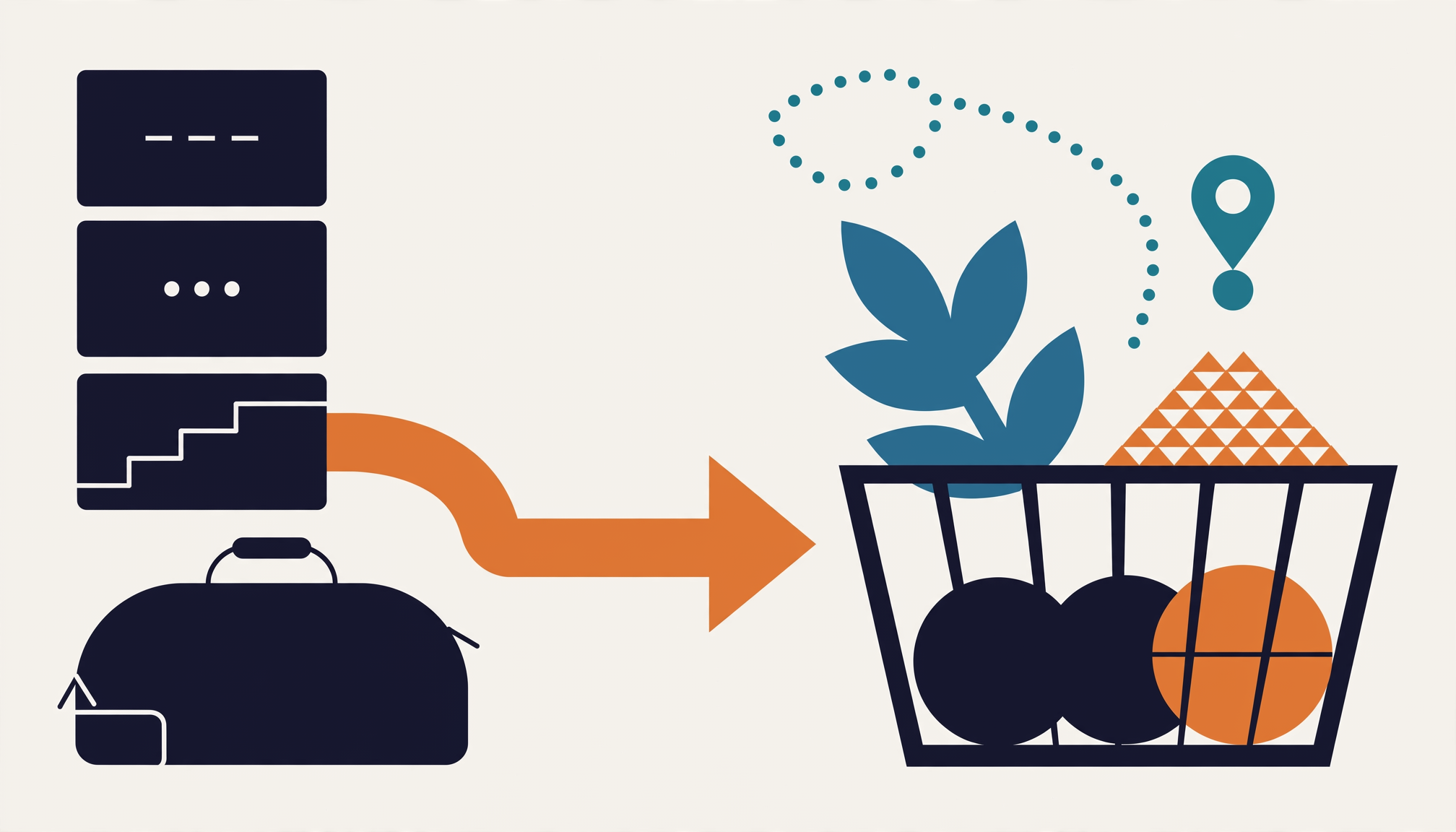
What the UCP v2026-08-25 update actually means for your kitchen, your gym bag, and your monthly ration list
First, what even is UCP?
Picture this: every online store speaks a slightly different “language” for how you search, add to cart, and checkout. That’s fine for humans clicking around — we adapt. But it’s a nightmare for AI agents (like Gemini) trying to shop for you across dozens of different stores.
UCP (Universal Commerce Protocol) fixes that. It’s an open standard — built jointly by Google, Shopify, and a growing council that now includes Amazon, Meta, Microsoft, Salesforce, and Stripe — that gives every store a common language. So when you tell an AI agent “order my usual groceries,” it can actually go do it, on any UCP-enabled store, without needing a custom integration for each one.
Think of it like TCP/IP, but for buying stuff.
So what changed on August 25?
UCP just had its biggest update since launch — version 2026-08-25. Until now, UCP was basically a “shopping protocol”: search, cart, checkout, done. This update starts turning it into something bigger — a protocol for any kind of AI-assisted transaction. That includes early groundwork for groceries, food ordering, and even hotels/lodging.
Two grocery-specific pieces stand out:
- Ordering by weight. Before this, agents could only order whole units — “2 bags of rice.” Now they can handle fractional quantities — “1.5 lbs of paneer” — which is how most fresh grocery actually gets sold.
- Store hours & location data, in a standard format. So an agent doesn’t just find the product — it knows if the store near you is even open right now.
It sounds small. It isn’t. It’s the difference between an AI agent that can browse a catalog and one that can actually do your shopping the way you’d do it yourself.
Okay, but why should I care?
Here’s where it gets genuinely interesting — because this isn’t really about groceries. It’s about AI agents finally having enough structure to understand you, not just products.
Imagine this scenario:
You’re prepping for a competition and your dietician has locked in your macros: 160g protein, 220g carbs, 60g fat, daily. You also train five days a week and eat differently on rest days.
Right now, translating that into an actual monthly grocery order is work. You do the math, check what’s in stock, compare prices, remember your intolerances, and hope the app doesn’t run out of your usual whey brand.
With UCP maturing toward this kind of structured, agent-friendly commerce, that whole flow could eventually collapse into one conversation:
- “I need 160g protein a day, no dairy, budget under ₹8000 this month — build my ration.”
- The agent pulls live inventory and pricing from real stores (that’s the Catalog capability).
- It calculates quantities down to fractional units — grams and litres, not just packs (that’s the fractional quantitypiece from this update).
- It checks which nearby store actually has stock right now and is open (that’s the Location capability).
- It builds one cart, across possibly multiple stores, and checks out (that’s Cart + Universal Cart).
- Next month, it remembers your preferences and loyalty discounts automatically (that’s Identity Linking).
That’s not a chatbot giving you diet advice. That’s an agent that can actually execute a dietician’s plan in the real world — buy the exact groceries, in the exact amounts, from the actual store down the street.
The bigger picture
This update is a small, almost boring-sounding technical release: fractional quantities, location schemas, payment restructuring. But that’s usually how the most useful infrastructure looks from the outside — unglamorous right up until millions of small annoyances quietly disappear.
We’re not there yet. As of this update, food and lodging support is still marked “coming soon” in the official docs — the full grocery experience isn’t live. But the pieces are visibly being laid down, one spec release at a time. Six months ago, AI agents could barely add one item to a cart. Now they can reason in grams and litres and check store hours before recommending a run.
If you’re the type who tracks macros, follows a dietician’s plan, or just wants your monthly ration sorted without doing math every Sunday — this is the kind of “boring” update that eventually makes your life a lot less annoying.
FAQ
What is UCP?
UCP (Universal Commerce Protocol) is an open standard, co-developed by Google and Shopify, that lets AI agents discover products, build carts, and complete checkout across any participating store — without needing a custom integration for each one.
What’s new in the v2026-08-25 update?
It’s UCP’s biggest release yet: groundwork for grocery, food, and lodging commerce, support for ordering by fractional quantities (like weight), standardized store location and hours data, restructured payments (including 3D Secure and installments), and a new loyalty extension.
Can I already order groceries through an AI agent using UCP?
Not fully yet. This update lays the technical groundwork — fractional quantities and location data — but detailed grocery and food specs are still marked “coming soon” as of this release.
How could this help with diet or fitness goals?
Once fully built out, an AI agent could take a dietician’s macro targets or a fitness plan and translate them directly into a real grocery order — calculating exact quantities, checking live stock and store hours, and checking out — instead of you doing the math yourself.
Who’s behind UCP?
It’s steered by a growing council including Google, Shopify, Stripe, Amazon, Meta, Microsoft, Salesforce, Etsy, Target, and Wayfair — not a single company.
Is UCP the same as OpenAI’s ACP?
No. UCP (Google/Shopify) and ACP (OpenAI/Stripe) are separate, competing open standards for agentic commerce, though they’re compatible at the merchant infrastructure layer.
Sources
- Universal Commerce Protocol — official site
- UCP v2026-08-25: The Release Where UCP Stops Being a Shopping Protocol — UCP Checker
- The State of Agentic Commerce — August 2026 — UCP Checker
- UCP v2026-08-25 Breaks Quietly: 4 Changes That Still Pass Validation — DEV Community
- UCP Releases Spec Update With Schema Changes — Search Engine Journal
- Shopify storefronts now support UCP 2026-08-25 — Shopify Developer Changelog
UCP is an open, evolving standard — this piece reflects the v2026-08-25 spec release and publicly available roadmap information as of September 2026.
| Parameter / Field | Type | Requirement | Constraint | Description | Example |
|---|---|---|---|---|---|
schema.dietary_profile_version | string | Mandatory | UCP-NUTRITION-v2.1 | Specialized schema extension encoding macro/micronutrient targets, allergens, and dietary restrictions | "UCP-NUTRITION-v2.1" |
validation.allergen_zero_tolerance_check | boolean | Critical | true (Hardcoded rejection on allergen trace) | Safety filter blocking cart additions if product contains ingredients flagged on user medical allergy profile | true |
substitution.ingredient_compatibility_score | float | Mandatory | Score 0.0 – 1.0 (Threshold >= 0.85) | Semantic algorithm selecting healthy, recipe-compatible ingredient substitutions when stockouts occur | 0.94 |
nutrition.macronutrient_tolerance_delta_pct | float | Standard | <= 5.0% variance from targets | Allowable variation in total daily protein, carbohydrate, and fat grams across generated weekly meal plans | 3.2 |
sync.pantry_inventory_iot_integration | enum | Optional | SMART_FRIDGE_RFID | MANUAL_BARCODE_SCAN | Integration with connected home appliances updating real-time home ingredient levels | "SMART_FRIDGE_RFID" |
latency.dietary_basket_optimization_ms | integer | Optimal | <= 350 ms | System time to balance a 40-item weekly grocery cart against multi-member household dietary restrictions | 180 |
Frequently Asked Questions: AI Agents & Autonomous Commerce
Q1: How does UCP encode dietary restrictions into machine-readable checkout constraints?
The UCP Nutrition Schema (v2.1) structures dietary profiles into strict typed enums (e.g., CELIAC_GLUTEN_FREE, KETO, LOW_SODIUM) and numerical nutrient ceilings that merchant catalogs validate at the API level.
Q2: What safeguards prevent an AI agent from purchasing items containing dangerous allergens?
The protocol enforces a Zero-Tolerance Allergen Filter; if a merchant product catalog lacks complete, cryptographically verified ingredient attestation or flags allergen traces, the agent automatically rejects the SKU.
Q3: How does the ingredient substitution engine handle out-of-stock items in recipe planning?
When an ingredient is unavailable, the agent computes a nutritional and culinary compatibility score, dynamically substituting an equivalent alternative (e.g., almond milk for dairy milk) that maintains recipe integrity.
Leave a Reply