The Paradigm Shift in Transactional Architecture
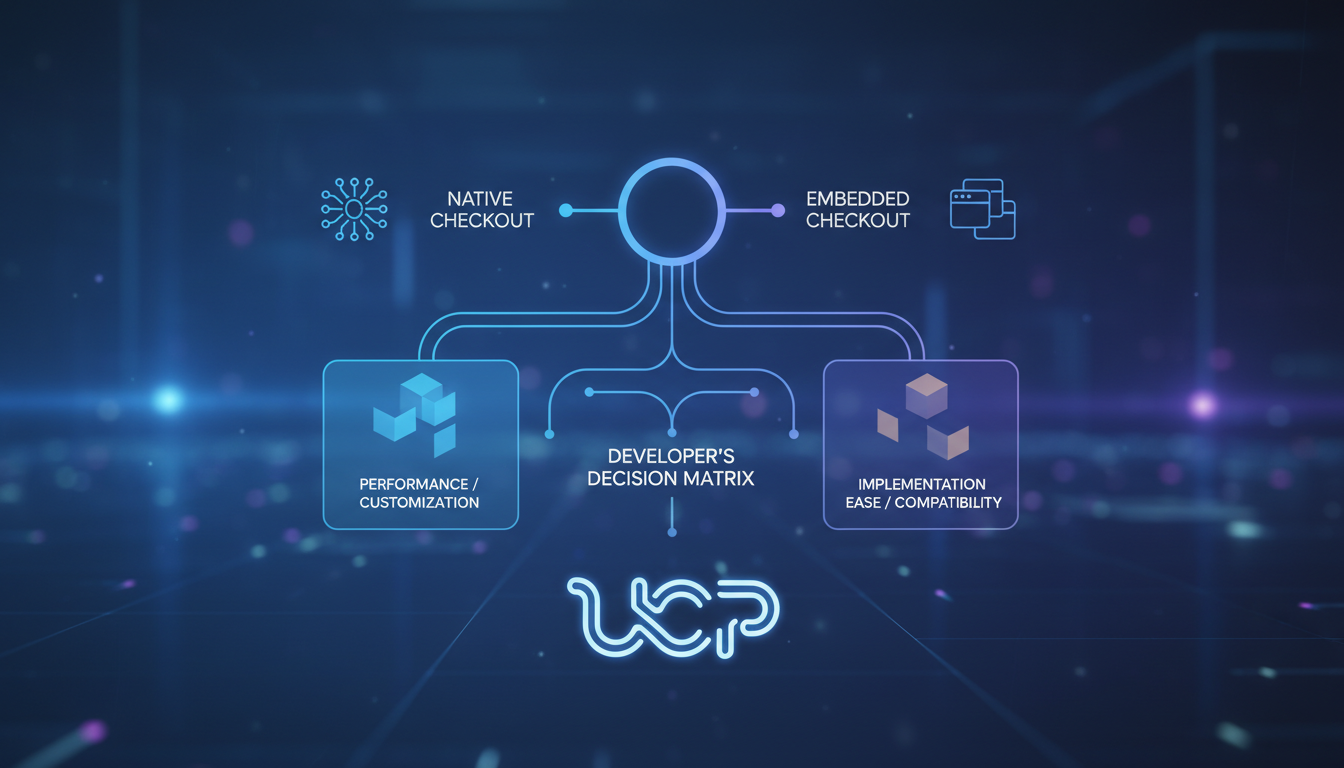
In the landscape of the Universal Commerce Protocol (UCP), developers face a fundamental architectural choice: how to bridge the gap between an autonomous agent’s intent and the finality of a transaction. As commerce moves away from traditional web surfaces into agentic environments powered by Gemini and the Model Context Protocol (MCP), the distinction between Native and Embedded checkout paths becomes the primary driver of conversion efficiency and technical complexity. This decision matrix explores these two methodologies, providing a technical roadmap for implementing secure, high-conversion transaction flows within the Google ecosystem.
Native Agent Workflows
Native checkout execution represents the pinnacle of friction-reduced commerce. In this model, the commerce agent—acting as the primary user interface—completes the entire transaction programmatically via direct API interactions. The agent does not redirect the user to a secondary website or frame; instead, it utilizes UCP-standardized endpoints to handle selection, shipping, and payment authorization.
The Role of Google Merchant Center and MCP
Native workflows rely heavily on high-fidelity product data. By integrating Google Merchant Center feeds with UCP, developers ensure that the agent has access to real-time inventory, pricing, and eligibility signals. Using the Model Context Protocol (MCP), a Gemini-powered agent can query these feeds to build a precise cart object. For example, when a user asks an agent to ‘Order the same running shoes I bought last year,’ the agent uses MCP to retrieve historical data, checks the current Merchant Center feed for availability, and initiates a Native checkout call.
Authentication and Payment Authorization
Secure native execution is powered by Identity Linking and Google Pay. The technical flow typically follows this sequence:
- Identity Verification: The agent confirms the user’s identity through OAuth 2.0 or OpenID Connect, linking the agent’s session to the user’s Google Account.
- Payment Tokenization: The agent requests a secure payment token via the Google Pay API. This token is passed through the UCP REST API to the Merchant of Record.
- Order Submission: A final JSON-RPC call is made to the merchant’s fulfillment endpoint, completing the order without the user ever leaving the agentic interface.
The primary advantage of the Native path is the elimination of ‘context switching.’ Every additional click or page load in an embedded environment introduces a drop-off point. Native paths achieve zero-click or one-tap finality, which is essential for voice-activated or ambient commerce scenarios.
Implementing Embedded Secure Frames
While Native checkout is the gold standard for simplicity, Embedded checkout paths remain a critical tool for complex transaction types. An Embedded path utilizes a secure iframe or a scoped web-view to present the merchant’s own checkout logic within the agent’s environment. This is often necessary when a product requires intricate configuration, such as insurance selection, custom engraving, or complex Prop 65 warnings that are not yet fully standardized in the agent’s native UI schema.
Architecting the Hand-off
The transition from a Native agent conversation to an Embedded frame must be seamless. This is achieved through a secure handshake protocol. The agent prepares a ‘Pre-filled Cart’ state and generates a short-lived, encrypted URL. When the user reaches a step requiring the Embedded frame, the agent renders the URL within a sandboxed environment.
Maintaining Protocol Flow
Even within an Embedded frame, the transaction should remain ‘protocol-aware.’ This means the frame should emit events (via postMessage or webhooks) back to the UCP agent. This ensures the agent knows when the payment is successful, allows the agent to update its internal state, and enables it to provide post-purchase support like tracking information.
Security and Trust
Embedded frames are often chosen to mitigate risk. By utilizing the merchant’s existing, PCI-compliant checkout infrastructure, developers can leverage established Risk Signals. For developers using Google AI Mode within their apps, the embedded path allows for the deployment of sophisticated anti-fraud measures that might be difficult to replicate in a purely headless, API-only native environment.
Choosing the Right Path for Your Catalog
The choice between Native and Embedded is not binary; most sophisticated implementations utilize a hybrid approach based on the specific SKU or transaction risk profile. Use the following decision matrix to determine the optimal path for your UCP integration.
| Feature/Requirement | Native Checkout Path | Embedded Checkout Path |
|---|---|---|
| User Friction | Ultra-Low (One-tap) | Moderate (Context shift) |
| Implementation Complexity | High (Requires full API integration) | Low (Uses existing web checkout) |
| Customization Level | Limited to UCP Schema | Unlimited (Merchant’s CSS/JS) |
| Payment Integration | Google Pay API / Tokenization | Existing Web Payment Gateway |
| Best For | Commoditized goods, re-orders | Customizable items, regulated goods |
| Latency | Low (Direct API calls) | Higher (Loading web assets) |
Optimizing with Google Cloud and AI
Regardless of the path chosen, developers should use Google Cloud’s infrastructure to manage the state between the agent and the transaction endpoint. Using Gemini to analyze user intent allows the system to intelligently decide which path to present. If the user expresses high certainty and the item is simple, the agent triggers the Native path. If the user expresses hesitation or needs to configure options, the agent proactively offers an Embedded window with more details.
Technical Implementation Checklist
To successfully deploy these paths within the UCP framework, developers must ensure the following components are operational:
- Webhook Listeners: To receive asynchronous updates from the Merchant of Record regarding order status.
- Supplemental Feeds: In Google Merchant Center, use supplemental feeds to provide the specific ‘checkout_link_template’ required for embedded transitions.
- Identity Linking: Ensure a robust mapping between the user’s AI profile and their billing identity to prevent authorization failures.
- Error Handling: Implement graceful fallbacks. If a Native transaction fails due to a complex validation error, the agent should automatically pivot to an Embedded frame to allow the user to resolve the issue manually.
Conclusion: The Future of Frictionless Transactions
As we move toward a world of autonomous commerce, the Native path will increasingly become the default. However, the robustness of the Universal Commerce Protocol lies in its flexibility. By mastering both Native and Embedded paths, developers can build commerce experiences that are both technically sound and user-centric. Integrating these paths with the Google ecosystem—leveraging Google Pay for security, Gemini for intelligence, and Google Merchant Center for data—positions merchants at the forefront of the agentic commerce revolution.
Frequently Asked Questions
What is the Universal Commerce Protocol (UCP)?
The Universal Commerce Protocol (UCP) is an open standard developed to enable AI agents to autonomously conduct commerce transactions across any platform.
How does UCP enable agentic commerce?
UCP provides standardized APIs and protocols so AI agents can discover products, negotiate terms, and complete purchases without human intervention, working across any compatible commerce platform.
Why should businesses implement UCP?
UCP adoption reduces integration costs, opens revenue channels to AI-driven buyers, and future-proofs commerce infrastructure as agentic purchasing becomes mainstream.
Leave a Reply