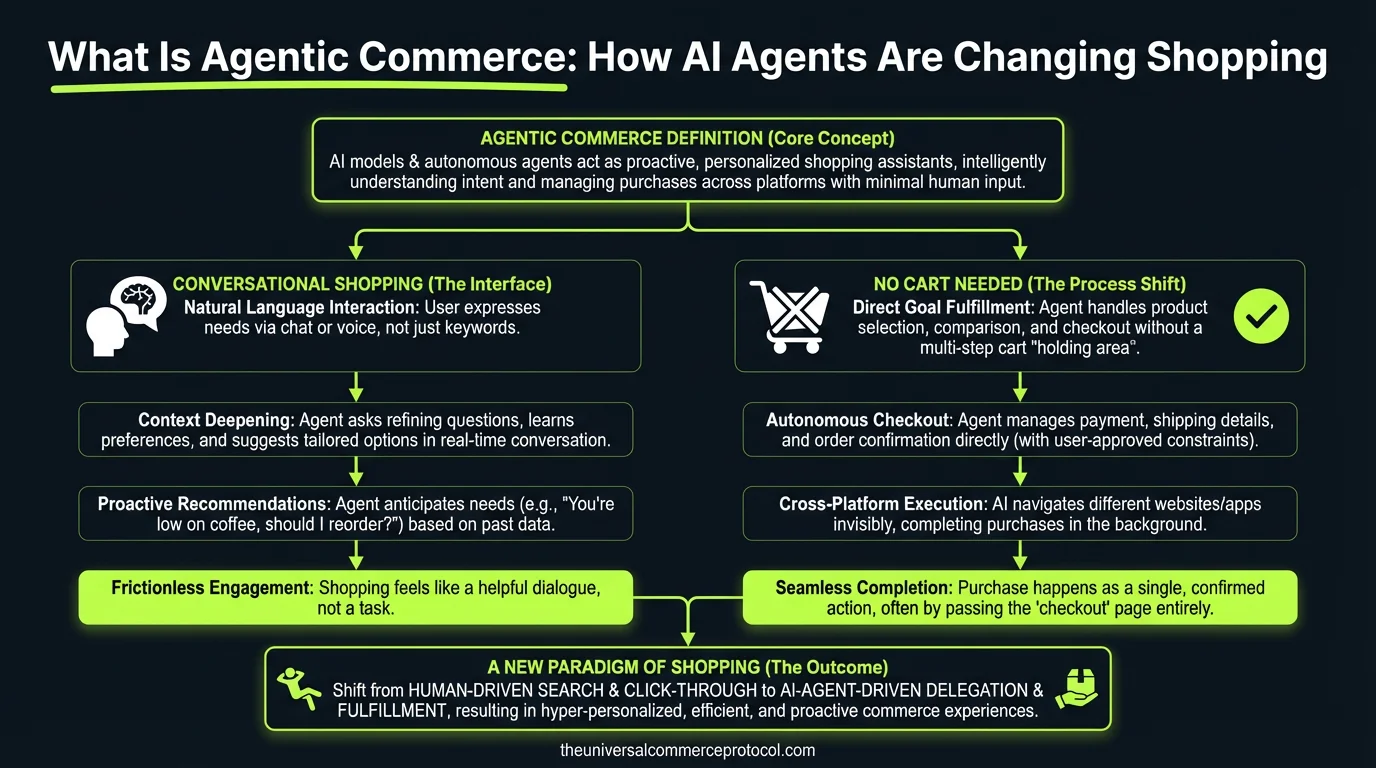
Agentic commerce is a model of digital shopping in which AI agents act on behalf of consumers to discover products, evaluate options, and complete purchases — without requiring the buyer to navigate a website, fill out forms, or manually initiate checkout. The transaction happens inside the AI interaction itself.
This is not a prediction about the future. As of January 2026, Google has launched live infrastructure for agentic commerce through the Universal Commerce Protocol (UCP), enabling eligible U.S. retailers to transact directly with shoppers inside Google AI Mode in Search and the Gemini app. This article explains what agentic commerce is, how it works today, and what it means for merchants and shoppers — based entirely on confirmed, publicly documented facts.
The Core Idea: From Discovery to Purchase Inside a Single Conversation
In traditional e-commerce, a shopper searches for a product, clicks through to a website, browses, selects a size or variant, adds to cart, enters shipping information, enters payment details, and confirms the order. Each step is a potential dropout point. Cart abandonment is the industry’s most persistent problem.
In agentic commerce, many of those steps collapse into the conversation itself. A shopper interacting with Google’s AI Mode in Search or the Gemini app can express their need in natural language. The AI surface discovers relevant products, presents options, and — for merchants who have integrated with UCP — can initiate and complete a checkout session without the shopper leaving the conversation.
Payment credentials stored in Google Wallet, shipping addresses already on file, and loyalty credentials linked via OAuth 2.0 can all be applied within the agent-mediated transaction. The shopper confirms; the order is placed. Source: Google Blog, January 11, 2026.
What Makes an AI Agent a Commerce Agent?
An AI agent, in the context of commerce, is software that can take actions — not just generate responses. A commerce agent specifically can:
- Discover a merchant’s available products and capabilities by fetching the merchant’s UCP profile
- Negotiate which checkout capabilities, payment handlers, and fulfillment options are mutually supported
- Create and manage a checkout session on behalf of the buyer
- Apply discounts, loyalty credentials, or subscription terms within the checkout flow
- Complete the transaction programmatically when all required information is present
- Hand off to the buyer when human input is required — and resume when the buyer has provided it
The key distinction is that an agent acts. It does not simply return a list of links. UCP is the protocol that defines how agents and merchants communicate so those actions are possible. Source: ucp.dev.
Where Agentic Commerce Is Live Today
As of January 2026, confirmed live or actively rolling out agentic commerce experiences include:
Google AI Mode in Search
Google is enabling a new checkout feature on eligible product listings in AI Mode in Search. Shoppers in the United States can check out from eligible retailers directly within the AI Mode experience, using payment methods and shipping information already saved in Google Wallet. Retailers remain the Merchant of Record. Source: Google Blog, January 11, 2026.
Gemini App
The same UCP-powered checkout capability is being rolled out in the Gemini web app, with the mobile app to follow. Source: Google UCP Developer Guide.
Microsoft Copilot
Shopify announced on January 11, 2026, that it is rolling out an update to its Microsoft Copilot integration with a new embedded checkout experience called Copilot Checkout. This allows shoppers to purchase directly inside Copilot. Merchants including Keen Footwear and Pura Vida are among those using this integration. Source: Shopify Newsroom, January 11, 2026.
ChatGPT
Shopify has an existing commerce integration with ChatGPT that is managed through Shopify’s Agentic Storefronts, the centralized admin hub for agentic commerce channel management. Source: Shopify Newsroom, January 11, 2026.
The Role of the Universal Commerce Protocol in Agentic Commerce
Agentic commerce requires a shared language. Without one, every AI platform would need a custom integration with every merchant, and vice versa — an impossible scaling problem. UCP is that shared language.
As Ashish Gupta, VP/GM of Merchant Shopping at Google, stated at launch: “The shift to agentic commerce will require a shared language across the ecosystem — and the Universal Commerce Protocol provides that framework. Through our collaboration with partners like Shopify we’re ensuring the protocol is interoperable and ready to meet the evolving demands of retailers and their customers.” Source: Shopify Newsroom, January 11, 2026.
UCP handles the discovery of what a merchant supports, the negotiation of which capabilities and payment handlers both the agent and merchant share, the structure of the checkout session, and the post-purchase order tracking — all through a single standardized protocol compatible with REST API, MCP, A2A, and AP2. Full technical documentation is available at ucp.dev.
What Happens When a Transaction Requires Human Input?
Not every transaction can be completed autonomously. A furniture retailer may require a buyer to select a specific delivery date and time window. A merchant may require confirmation of final sale terms. In these cases, UCP’s design does not fail — it routes gracefully.
When a checkout session reaches a requires_escalation status, the merchant response includes structured context and a continuation URL. The buyer follows that URL and picks up exactly where the agent left off — with all session state preserved. No transaction is abandoned due to a capability gap. Source: Shopify Engineering, January 11, 2026.
As Vanessa Lee, VP at Shopify, noted: “In the instances where a customer’s interaction is required — take a furniture retailer that requires a customer to select a specific delivery date and time — UCP gives a standard way for that furniture retailer to specify to agents what information is needed from customers in the checkout flow.” Source: Shopify Newsroom, January 11, 2026.
Who Owns the Customer Relationship in Agentic Commerce?
This is one of the most important questions merchants ask. In UCP-powered agentic commerce, the answer is clear and confirmed in official documentation: the merchant remains the Merchant of Record.
Google’s official developer documentation states explicitly: “You remain the Merchant of Record. Keep all of your customer data and relationships.” The merchant retains full ownership of the customer relationship, transaction data, and post-purchase experience. The AI surface facilitates the transaction; it does not own it. Source: Google UCP Developer Guide.
What Agentic Commerce Means for Merchants Practically
For merchants evaluating whether and how to engage with agentic commerce, the practical implications confirmed by official sources are:
- New reach without rebuilding checkout. Merchants can transact inside Google AI Mode, Gemini, and other AI surfaces without replacing their existing checkout infrastructure. UCP integrates with existing business logic.
- Reduced cart abandonment. By enabling checkout to happen within the discovery conversation, UCP eliminates multiple dropout points in the traditional purchase funnel. Source: Google UCP Developer Guide.
- Support for complex commerce. UCP handles discount codes, loyalty credentials, subscription billing cadences, and final-sale or pre-order confirmation within the agent-mediated checkout flow. Source: Shopify Newsroom, January 11, 2026.
- Payment flexibility. UCP works with any payment processor. Merchants advertise which payment handlers they accept; agents select a compatible one dynamically per transaction. Source: Shopify Engineering, January 11, 2026.
- Early access via waitlist. Integration with Google’s AI surfaces currently requires merchant approval. Merchants can join the waitlist at Google’s UCP interest form.
Merchant Voices on Agentic Commerce
Several merchants have spoken publicly about their participation in agentic commerce integrations. These are direct quotes from the official Shopify announcement:
Victor Tam, CEO and Co-Founder of Monos: “At Monos, we’re excited about agentic shopping because it enables us to meet customers where they already are. It’s a new way for our story and product details to show up at the exact moment someone is asking real questions with real intent, in a format that feels helpful, not intrusive.”
Sam Buckingham, Director of Global Digital Product at KEEN Footwear: “We’re excited to partner with Shopify as innovators in AI-driven commerce, which we believe represents the future of how people shop. As one of the first Shopify brands to use Copilot Checkout, we’re proud to help lead the industry in defining this new sales channel.”
Source for both quotes: Shopify Newsroom, January 11, 2026.
Primary Sources for This Article
- Universal Commerce Protocol official documentation (ucp.dev)
- Google UCP Developer Guide (developers.google.com)
- Google Blog: New tech and tools for retailers to succeed in an agentic shopping era (January 11, 2026)
- Shopify Newsroom: The agentic commerce platform (January 11, 2026)
- Shopify Engineering: Building the Universal Commerce Protocol (January 11, 2026)
🎙️ The UCP Brief — Audio Summary
Read transcript
Welcome to The UCP Brief. Today we’re diving into agentic commerce, which is poised to completely reshape how we shop online. Forget endless browsing and abandoned carts. Imagine AI agents handling the entire purchase process for you, from product discovery to checkout, all within a single conversation.
The key here is the shift from passive search results to active agents. These AI assistants aren’t just listing links; they’re actually negotiating with merchants, managing checkout sessions, and even applying discounts. It’s a whole new level of automation that streamlines the entire shopping experience.
This isn’t some far-off dream either. Google’s Universal Commerce Protocol, or UCP, is already live, powering agentic commerce within Google AI Mode in Search and the Gemini app. This means you can literally tell Google what you need, and it will handle the entire transaction, pulling payment info from your Google Wallet and shipping addresses already on file. That’s a game changer.
I’m Will Tygart. Stay curious.
Frequently Asked Questions
What is agentic commerce?
Agentic commerce is the model in which AI agents discover products, compare prices, and complete purchases autonomously on behalf of consumers — without requiring the user to navigate a website or click through a shopping cart. The AI acts as a purchasing agent within predefined spending limits and preferences.
How do AI agents complete purchases without human input?
AI agents use trust frameworks like the Universal Commerce Protocol (UCP) to authenticate with merchants, verify product availability and pricing in real time, and submit payment within spending limits set by the consumer. The transaction happens inside the AI conversation, not a traditional checkout flow.
What types of purchases can AI agents handle?
AI agents can handle routine, repeatable purchases such as grocery restocking, subscription renewals, travel bookings, and commodity orders. More complex or high-value purchases still typically require human confirmation, though this threshold is expanding as trust frameworks mature.
How does agentic commerce differ from traditional ecommerce?
Traditional ecommerce requires a human to browse, add to cart, and check out. Agentic commerce removes all three steps — the AI browses, selects, and transacts on the consumer’s behalf. Merchants must expose structured product data and accept agent-authenticated payment requests rather than browser-based sessions.
Leave a Reply