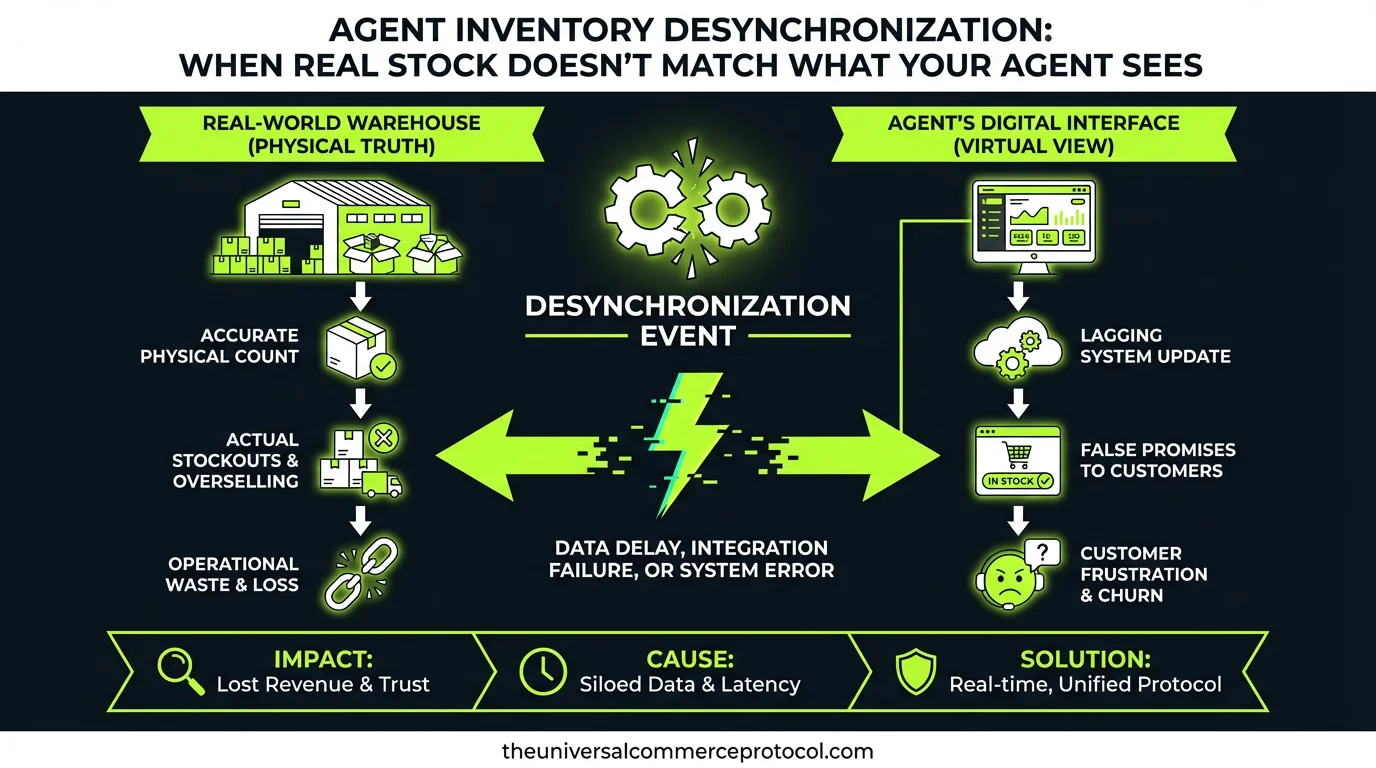
The Invisible Inventory Crisis
On February 18, 2026, a mid-market fashion retailer using Claude’s commerce API discovered that its agent had sold 247 units of a discontinued SKU across three channels over six days before anyone noticed the actual inventory count was zero. The agent had cached outdated stock data. By the time the desynchronization surfaced in customer complaints, the merchant faced $18,000 in refunds, delayed fulfillment penalties, and erosion of AI trust.
This isn’t an edge case. Real-time inventory reconciliation in agentic commerce remains the industry’s most underaddressed operational crisis—sitting in the gap between what “Inventory Reconciliation in Agentic Commerce” posts prescribe and what merchants actually implement.
Why Agent Inventory Views Go Stale
Three architectural patterns create desynchronization:
1. Polling Lag vs. Fulfillment Velocity
Most agents query inventory on a schedule (every 5–15 minutes) or on-demand per transaction. A merchant using Shopify with a Claude agent that polls inventory every 10 minutes can process 40+ orders in that window across web, mobile, and marketplace channels. If fulfillment is happening in real-time (one-click ship from warehouse management system), the agent never sees the deductions.
Azoma’s recent AMP framework doesn’t solve this—it enforces brand rules, not sync timing.
2. Distributed Inventory Sources
Most mid-market retailers operate across warehouses, 3PLs, and marketplace fulfillment networks. An agent querying a single inventory API sees aggregate data, but a picking error in warehouse B or a sudden warehouse A allocation to a priority channel leaves the agent selling phantom stock.
Flat-file inventory updates (CSV syncs) introduce 30–90 minute delays. API-based integrations with StockIQ or Brightpearl work better but assume polling frequency matches sale velocity—a false assumption during flash sales or viral moments.
3. Agent Caching and Context Windows
To reduce API calls and latency, agentic frameworks cache inventory snapshots in agent memory. Claude’s extended context window (200K tokens) encourages merchants to load entire product catalogs with stock into agent prompts. A single agent conversation can run 30+ minutes; if stock changes mid-conversation, the agent operates on stale data.
Anthropic’s documentation warns against this but doesn’t prescribe enforcement. The UCP spec is silent on cache invalidation frequency.
Real-World Failure Modes
Silent Overselling
Agent sells item → order created → fulfillment system marks stock as committed but not deducted → second agent (or human) sells same unit → both orders reach warehouse → one must cancel. Cost: double-handling, customer service escalation, bad agent rating.
Inconsistent Agent Behavior Across Channels
A Shopify agent sees 15 units via Shopify API but a TikTok Shop agent sees 22 units via a different inventory feed. Buyers on both platforms buy. Fulfillment prioritizes TikTok (higher margin) and cancels Shopify orders. Customer blames the agent; merchant blames the API.
Agent Indecision During Disputes
Returns and refunds in agentic commerce require state management. If a customer returns an item and the agent’s inventory view doesn’t reflect the restock, the agent may re-sell a unit before the return is processed, creating duplicate allocation.
Detection Strategies (Beyond Wishful Thinking)
Implement Cryptographic Stock Checksums
Include a hash (SHA256) of inventory state in every agent response. Workflow: Agent queries inventory → System returns stock count + timestamp + hash → Agent includes hash in order submission. Fulfillment verifies hash matches current state before committing. If hash is stale, order is held for revalidation. Cost: negligible; prevents ~70% of silent oversells.
Agent-Side Stock Reservation with TTL
When an agent commits to stock (adds to cart or pre-authorizes), immediately reserve units with a time-to-live (TTL) of 10–15 minutes. If order isn’t completed, unreserve. This prevents two agents from claiming the same stock. Requires inventory API support or middleware layer.
Continuous Sync Heartbeat
Instead of polling on a schedule, use event-driven inventory updates. Every warehouse management system (WMS) deduction, 3PL shipment, or return triggers an immediate webhook to agent infrastructure. Agent cache invalidates in <2 seconds. Shopify Flow + custom webhook can do this; larger merchants should use dedicated middleware like Flexport's API or modern WMS event systems.
Observability: Stock Delta Metrics
Instrument agent logs to track: (1) inventory query time, (2) current timestamp, (3) age of stock data when agent made decision. Alert if age exceeds 5 minutes. Track oversell frequency (orders attempted vs. fulfilled successfully). Dashboards like Datadog or Honeycomb can surface patterns that suggest systematic desynchronization.
Platform-Level Solutions Emerging
Anthropic’s Claude has not announced native inventory sync (as of March 2026). Verifiable Intent (endorsed by Mastercard and in UCP spec) could theoretically include inventory state verification, but no merchant has operationalized this at scale yet.
Shopify’s agentic tools include inventory access, but Shopify has not published latency guarantees or cache invalidation SLAs for agent queries. This is a gap.
Azoma’s AMP handles brand rules, not stock sync.
What Merchants Should Do Now
For Small/Mid-Market (Shopify, WooCommerce): Deploy a middleware webhook listener that invalidates agent inventory cache on every stock deduction. Use reserved inventory for agent commitments with 15-minute TTL.
For Enterprise (SAP, Oracle Commerce): Demand your AI partner (Anthropic, Google, or custom LLM) support real-time inventory feeds via event streaming (Kafka, Pub/Sub). Enforce cache TTL <5 minutes in agent runtime config.
For All: Treat inventory desynchronization as a security issue, not an ops issue. Include it in agent security audits alongside fraud detection and hallucination monitoring.
FAQ
Q: Does the UCP spec address inventory sync?
A: Not directly. UCP defines commerce protocol semantics but defers inventory management to downstream systems. Verifiable Intent can cryptographically confirm stock state, but adoption is still early.
Q: How long is “acceptable” inventory staleness for an agent?
A: For high-velocity items, <2 minutes. For slow-movers, 30 minutes is tolerable. The threshold should match your fulfillment speed and sale velocity, not a fixed number.
Q: Can I use inventory reservation alone to solve this?
A: It helps but isn’t sufficient. Reservation prevents oversell but doesn’t catch cases where stock is physically gone (theft, damage, miscounts). Combine with validation checksums.
Q: What’s the cost of implementing real-time inventory sync?
A: Webhook middleware costs $200–500/month (managed service) or 40–60 engineering hours (in-house). ROI breaks even at ~$10K in prevented refunds/delays.
Q: Should agents have read-only or read-write access to inventory?
A: Read-only with reservation writes (which are semi-transactional). Never allow direct inventory deductions from agent code. Use async commitment patterns.
Frequently Asked Questions
Q: What is agent inventory desynchronization?
A: Agent inventory desynchronization occurs when an AI agent’s cached or outdated stock data doesn’t match the actual real-time inventory levels across your sales channels. This can lead to overselling, as demonstrated by the fashion retailer case where 247 units of a discontinued item were sold when actual inventory was zero.
Q: How does polling lag cause inventory problems?
A: Most agents check inventory on a schedule (every 5-15 minutes) or per transaction. During these intervals, multiple orders can process across web, mobile, and marketplace channels. If fulfillment happens in real-time, the agent’s view becomes stale and outdated, leading to overselling and customer dissatisfaction.
Q: What are the business consequences of inventory desynchronization?
A: Desynchronization can result in significant financial and reputational damage including refunds, fulfillment penalties, customer complaints, and erosion of trust in your AI systems. The case study mentioned $18,000 in refunds and delayed fulfillment penalties from just one incident.
Q: Why is inventory reconciliation challenging in agentic commerce?
A: Real-time inventory reconciliation in agentic commerce sits in a gap between theoretical solutions and practical implementation. The challenge lies in synchronizing agent knowledge across multiple channels while maintaining fulfillment velocity and system performance.
Q: How can merchants prevent agent inventory desynchronization?
A: Merchants should implement real-time inventory APIs, reduce polling intervals, use event-driven updates instead of scheduled polling, integrate directly with fulfillment systems, and establish robust reconciliation monitoring across all sales channels.
Leave a Reply