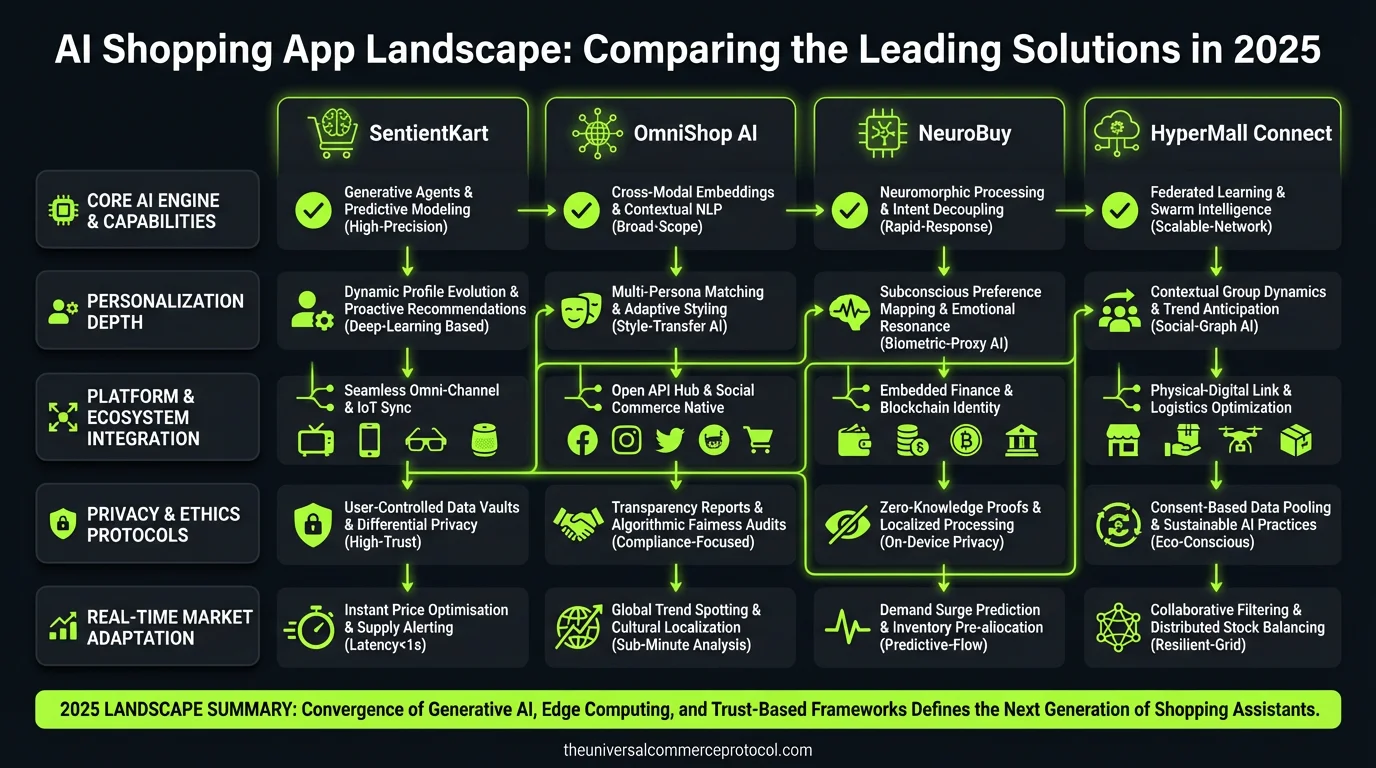
The AI Shopping App Market in 2025
The artificial intelligence shopping application landscape has undergone significant transformation in 2025, with major technology companies and startups deploying sophisticated AI agents to mediate consumer purchasing decisions. Unlike previous e-commerce eras dominated by closed platforms, today’s AI shopping apps increasingly operate across protocol standards that enable data portability, multi-vendor integration, and standardized commerce interactions.
The emergence of the Universal Commerce Protocol (UCP) has created a bifurcation in the market: legacy proprietary solutions maintaining closed ecosystems versus next-generation applications embracing open standards for commerce interoperability. This shift mirrors broader industry trends toward agentic commerce, where AI systems autonomously negotiate transactions, compare offerings, and execute purchases on behalf of consumers.
Leading AI Shopping Applications and Their Protocol Adoption
Amazon Rufus
Amazon’s Rufus represents the most mature AI shopping assistant deployed at scale, integrated directly into the Amazon mobile app and web experience. Rufus leverages Amazon’s proprietary commerce infrastructure and operates primarily on Amazon’s internal API standards rather than open protocols. The system provides product recommendations, answers customer questions about items in the Amazon catalog, and facilitates purchases within the Amazon ecosystem.
Protocol stance: Proprietary. Amazon has not publicly committed to UCP adoption, maintaining vertical integration of its shopping experience. However, Rufus demonstrates the baseline functionality that UCP-compliant applications aspire to achieve: natural language product discovery, comparative analysis, and transaction facilitation.
Google Shopping with Generative AI
Google has integrated generative AI capabilities into Google Shopping, enabling natural language product search and AI-generated buying guides. The integration connects to Google’s merchant center and shopping graph, allowing users to ask questions like “show me durable running shoes under $150” and receive curated results with AI-generated explanations.
Protocol stance: Hybrid. Google Shopping operates on Google’s Merchant Center API and proprietary shopping graph standards, but Google has indicated openness to structured commerce data standards. The company participates in schema.org development and supports structured product data markup, positioning it as potentially compatible with standardized commerce protocols.
Shopify AI Shopping Assistant
Shopify has deployed AI shopping assistants across its merchant partner network, enabling merchants to offer AI-powered product discovery to customers. The Shopify Storefront API provides the foundation for these implementations, with merchants able to customize AI behavior and integration depth.
Protocol stance: Proprietary with standards support. Shopify’s approach emphasizes merchant control and customization, using its own APIs as the primary integration layer. However, Shopify supports standard commerce data formats and has indicated willingness to support emerging open commerce protocols for cross-platform merchant participation.
Perplexity Shopping Features
Perplexity, the AI search engine, has added shopping features that leverage its large language model capabilities to compare products across multiple retailers. The platform integrates affiliate links and merchant data to provide comparative shopping insights with AI-generated analysis.
Protocol stance: Emerging standards approach. Perplexity operates on web scraping and affiliate network integration currently, but the company has expressed interest in standardized commerce data feeds that would enable more reliable product information and transaction processing. This positions Perplexity as a potential early adopter of UCP standards.
Anthropic Claude Commerce Integration
Anthropic has begun integrating Claude’s capabilities into commerce platforms, with early implementations at select retailers for customer service and product discovery. Claude’s multimodal capabilities enable image-based product search and detailed product analysis.
Protocol stance: Standards-agnostic currently. Anthropic has not committed to specific commerce protocols but has emphasized interoperability and integration flexibility. The company’s approach suggests openness to UCP adoption if standardization gains market traction.
Protocol Standards in AI Shopping Applications
Universal Commerce Protocol (UCP)
UCP represents the emerging standard designed specifically for agentic commerce, enabling AI systems to discover, negotiate, and execute transactions across multiple merchants and platforms. UCP implementations allow AI shopping agents to:
- Query product catalogs using standardized schemas
- Retrieve pricing, availability, and inventory in real-time
- Execute transactions with standardized payment and fulfillment workflows
- Access merchant policies and business rules in machine-readable format
Early adopters of UCP include mid-market retailers seeking to participate in AI shopping ecosystems and emerging AI-native commerce platforms building from the ground up with protocol compliance.
Commerce Markup Language (CommerceML) and Product Schema Standards
Existing product data standards like schema.org’s Product type, Google’s Merchant Center feed format, and Facebook’s product catalog standards provide foundational commerce data structures. These standards predate agentic commerce but form the basis for product information in AI shopping systems.
Most current AI shopping applications rely on these established standards for product data, supplemented by proprietary enhancements for specific functionality. The transition to UCP represents an evolution beyond product data standardization to standardize the entire agent-merchant interaction model.
Open Banking and Payment Standards (Open Banking APIs)
AI shopping applications increasingly leverage open banking standards like PSD2 (Europe) and Open Banking standards to facilitate payment processing. These enable AI agents to access customer payment methods and execute transactions with explicit customer authorization, reducing friction in the purchasing flow.
Proprietary Ecosystem Standards
Amazon’s Product Advertising API, eBay’s Commerce APIs, and Walmart’s Marketplace APIs represent proprietary standards controlling access to major retail platforms. AI shopping applications must integrate with these proprietary APIs to access inventory and pricing from these dominant retailers, creating a multi-standard landscape.
Market Segmentation by Protocol Strategy
Closed Ecosystem Players
Amazon, Walmart, and eBay maintain closed AI shopping experiences integrated into their platforms. These solutions benefit from first-party data advantages and seamless user experience but cannot participate in cross-platform shopping agent ecosystems. Market position remains dominant due to catalog scale and established customer bases.
Hybrid Approach Companies
Google, Shopify, and Microsoft represent companies operating hybrid strategies, maintaining proprietary infrastructure while supporting standards for specific use cases. These companies benefit from ecosystem participation while preserving competitive advantages through proprietary enhancements.
Standards-First Platforms
Emerging AI shopping applications built specifically for agentic commerce are adopting UCP and open standards as foundational architecture. These include specialized AI shopping assistants, price comparison engines with AI capabilities, and next-generation retail platforms designed for multi-merchant participation.
Key Market Trends and Implications
Fragmentation and Interoperability Challenges
The current market remains fragmented across proprietary systems, creating friction for developers building cross-platform AI shopping experiences. Each major platform requires separate integration, limiting the ability of AI agents to provide truly unified shopping experiences.
Protocol Standardization Momentum
Growing recognition of interoperability benefits is driving increased interest in open commerce protocols. Retailers increasingly recognize that participation in AI shopping ecosystems requires standardized integration points, creating demand for protocols like UCP that reduce integration complexity.
Merchant Empowerment Through Standards
Mid-market and small retailers lack the resources to integrate with dozens of proprietary AI shopping platforms. Standardized protocols enable these merchants to participate in AI-driven commerce ecosystems with single integrations, democratizing access to AI shopping channels.
Consumer Experience Convergence
As AI shopping applications proliferate, consumer expectations are converging around natural language interfaces, real-time availability, and integrated payment. Applications failing to meet these baseline expectations face competitive pressure, driving convergence toward standardized user experience patterns.
2025 Market Outlook
The AI shopping app landscape in 2025 remains dominated by proprietary solutions from established technology companies, but the foundation for standardization is solidifying. Early indicators suggest that by 2026-2027, meaningful UCP adoption will emerge among mid-market retailers and specialized AI shopping platforms.
The most likely scenario involves continued coexistence of closed ecosystems (Amazon, Walmart) with emerging standardized networks built on UCP and related open protocols. This mirrors the evolution of other digital infrastructure, where proprietary incumbents and open standards platforms coexist, each serving different market segments.
For enterprises and developers, the strategic imperative is clear: maintaining flexibility to integrate with both proprietary platforms and emerging standards-based systems will be essential for comprehensive market coverage through 2025 and beyond.
FAQ
What is the Universal Commerce Protocol and how does it differ from existing e-commerce standards?
The Universal Commerce Protocol (UCP) is specifically designed for agentic commerce, enabling AI systems to autonomously discover, negotiate, and execute transactions across multiple merchants. Unlike existing standards like schema.org or Merchant Center feeds that focus on product data representation, UCP standardizes the entire agent-merchant interaction model, including real-time inventory queries, dynamic pricing, transaction execution, and policy communication. This enables AI agents to treat different merchants as interchangeable service providers rather than requiring custom integrations for each platform.
Which major retailers have committed to supporting UCP or similar open commerce protocols?
As of 2025, major retailers have not made formal public commitments to UCP adoption, with most maintaining proprietary API strategies. However, mid-market retailers and specialized commerce platforms are increasingly exploring UCP and related standards. The adoption curve resembles other infrastructure standards, where smaller players and new entrants adopt first, followed by larger enterprises once network effects demonstrate clear business value. Expect major retailer participation to increase significantly in 2026-2027 as standardization gains momentum.
Can AI shopping apps operate effectively without protocol standardization?
Yes, current AI shopping applications function effectively within proprietary ecosystems or through custom integrations with multiple platforms. However, standardization dramatically reduces integration complexity and enables AI agents to provide truly cross-platform shopping experiences. Without standardization, each AI shopping application must maintain custom integrations with every merchant it wants to support, limiting scalability. Standardized protocols enable single integrations that work across any compliant merchant, dramatically improving economics for both AI platforms and retailers.
How should merchants prepare for protocol standardization in AI shopping?
Merchants should begin by ensuring their product data is clean, comprehensive, and available in multiple standard formats (schema.org, Merchant Center feeds, etc.). Next, evaluate current API capabilities and consider whether proprietary APIs could be supplemented with standardized endpoints. Finally, monitor protocol developments and consider pilot programs with standards-based platforms to gain early experience. Merchants who build protocol-agnostic commerce infrastructure now will be positioned to participate in emerging AI shopping ecosystems with minimal additional investment once standardization solidifies.
Leave a Reply