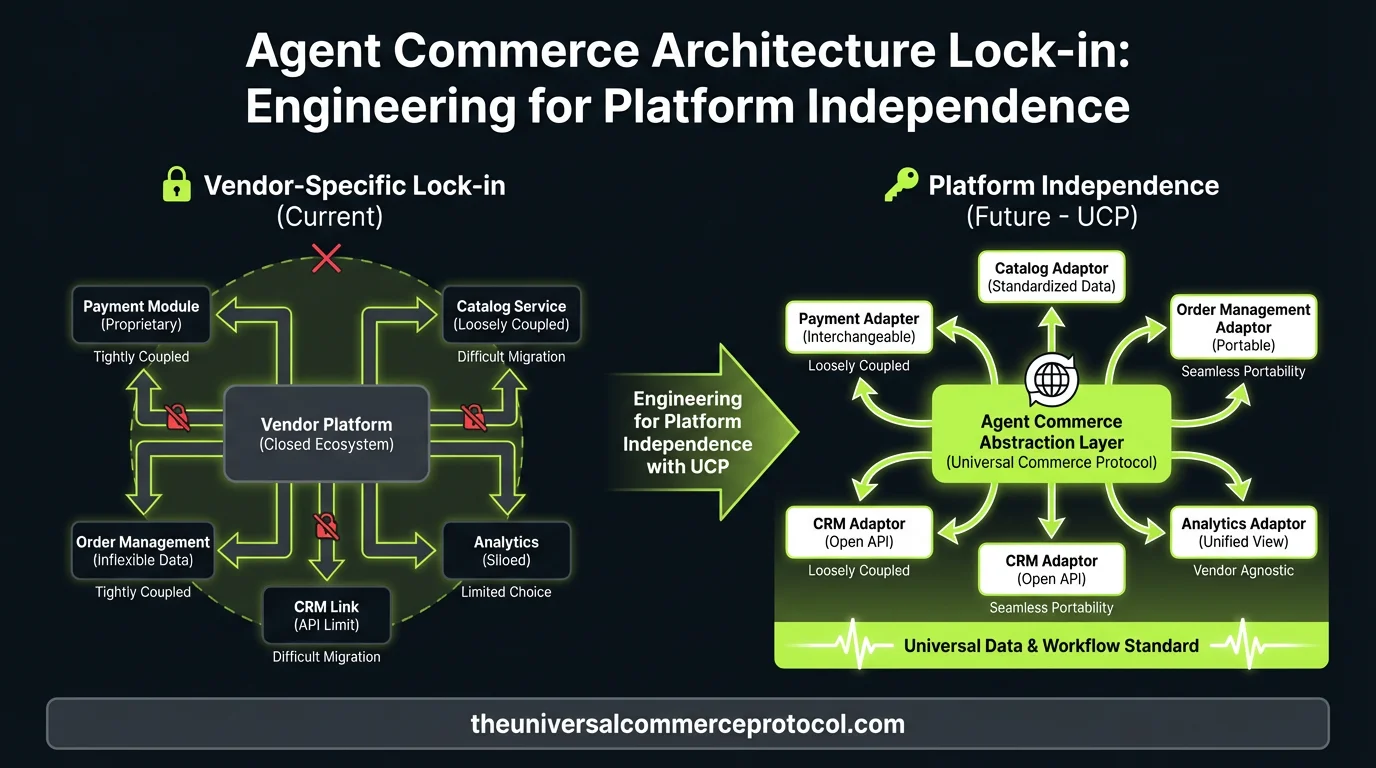
Your engineering team is being asked to integrate AI agents into commerce workflows, but the architectural decisions you make today will determine whether you’re locked into a single vendor ecosystem or maintain platform flexibility. Unlike traditional integration challenges where you can swap out services behind stable APIs, agentic commerce systems create deep coupling between your business logic and specific LLM vendor implementations—coupling that can cost $500K-$1M to unwind later.
The Technical Reality of Agent Platform Coupling
Current agentic commerce integrations bind your architecture to vendor-specific patterns at multiple layers. When you build on OpenAI’s function-calling API versus Claude’s Model Context Protocol (MCP), you’re not just choosing different SDKs—you’re committing to fundamentally different architectural patterns.
OpenAI’s approach centers on stateless function calls with JSON schema definitions. Your agent workflow becomes a series of synchronous API calls where session state lives in your application layer. Claude’s MCP, conversely, implements a resource-oriented model where the agent maintains longer-lived connections to your commerce resources, with bidirectional communication channels for real-time inventory updates.
This isn’t just a difference in API surface—it’s a difference in how you architect state management, error handling, and failure recovery. A system designed around OpenAI’s stateless model requires rebuilding your entire state machine architecture to work with MCP’s resource-oriented approach.
Session Management and Context Windows
The technical debt accumulates quickly in session handling. OpenAI agents expect you to manage conversation context explicitly, passing full context on each API call. Your engineering team builds around this with conversation state stored in Redis or your primary database, with careful attention to context window limits (typically 8K-32K tokens depending on the model).
Claude’s MCP reverses this pattern—the protocol expects your system to expose resources that the agent can query and modify over persistent connections. Converting between these patterns means rewriting your entire session architecture, not just changing API endpoints.
Data Migration Complexity: Beyond Export/Import
The stickiest technical challenge isn’t moving configuration—it’s migrating behavioral data that’s accumulated in production. Your agents generate decision logs, training data, and behavioral patterns that become integral to their performance. This data has vendor-specific schemas that don’t translate cleanly.
Consider the decision tree data structures. OpenAI agents output confidence scores and reasoning chains in their specific JSON format, optimized for their token prediction models. Claude agents structure their decision outputs differently, with reasoning chains that reflect their Constitutional AI training. You can’t simply export decision logs from one platform and import them into another—the underlying decision representation is incompatible.
Compliance and Audit Trail Portability
For regulated commerce environments, this creates a critical operational risk. Your compliance audit trails—proof that agents followed return policies, applied correct tax calculations, handled PCI requirements properly—are stored in vendor-specific formats. Switching platforms means losing this audit history or maintaining dual systems indefinitely.
From a technical debt perspective, maintaining multiple audit systems increases operational complexity and creates potential compliance gaps during transition periods.
Architectural Patterns for Platform Independence
The solution requires building abstraction layers that isolate your business logic from vendor-specific implementations. This isn’t a simple adapter pattern—it requires rethinking how you structure agent interactions with your commerce systems.
Agent Abstraction Layer Design
Design your agent integration with a vendor-neutral interface that handles the architectural differences between platforms. Your abstraction layer should normalize:
- Session Management: Unified session state handling regardless of whether the underlying platform is stateless (OpenAI) or stateful (MCP)
- Tool Discovery: Standardized interface for exposing commerce operations (inventory lookup, cart modification, payment processing) that works across different agent architectures
- Decision Logging: Vendor-neutral format for capturing agent decisions, reasoning chains, and outcomes
- Error Handling: Unified failure modes and recovery patterns that abstract platform-specific error conditions
Universal Commerce Protocol Implementation
Google’s Universal Commerce Protocol (UCP) attempts to address this at the industry level, but current implementations focus on the happy path rather than the architectural challenges of platform independence. A robust UCP implementation in your architecture should define:
State Schema Standardization: JSON schemas for agent state that work across platforms, including session context, inventory snapshots, and multi-turn conversation state.
Portable Decision Formats: Canonical representation of agent decisions that can be exported from one platform and meaningfully imported into another, preserving behavioral patterns and training value.
Fallback Protocol Specification: Standardized handoff mechanisms for agent-to-human escalation that aren’t tied to specific vendor implementations.
Implementation Strategy and Team Requirements
Building platform-independent agent architecture requires specific technical expertise and tooling investments. Your team needs engineers familiar with both LLM integration patterns and distributed systems design—the intersection of AI/ML engineering and traditional backend architecture.
Technical Stack Considerations
Plan for additional infrastructure complexity. Your abstraction layer needs to handle protocol translation, state normalization, and decision log formatting across multiple agent platforms. This typically requires:
- Message queue infrastructure for handling different async patterns between platforms
- State storage that can efficiently handle both stateless and stateful agent interaction patterns
- Decision log storage with schemas flexible enough to accommodate different reasoning chain formats
- Monitoring and observability that works across multiple agent platforms
Security and Compliance Architecture
Each agent platform has different security models for handling sensitive commerce data. OpenAI’s function calling passes data in API requests; MCP establishes persistent connections with your systems. Your security architecture needs to accommodate both patterns without compromising on data isolation or audit requirements.
Design your authentication and authorization to work across platforms—unified API keys, consistent permission models, and security logging that doesn’t depend on vendor-specific audit features.
Recommended Implementation Approach
Start with platform abstraction from day one, even if you’re initially deploying on a single agent platform. The cost of adding abstraction later—when you have production workloads, accumulated training data, and operational dependencies—far exceeds the initial development overhead.
Build your agent integration as a microservice with well-defined interfaces to your commerce systems. This service should expose unified APIs to your business logic while handling vendor-specific communication patterns internally. Design your data schemas to be platform-neutral from the start, even if this requires additional data transformation overhead.
Prioritize decision log portability in your initial architecture. Build decision storage that captures the semantic meaning of agent choices in vendor-neutral formats, not just raw API responses from specific platforms.
Next Technical Steps
Begin with a technical proof-of-concept that demonstrates the same commerce workflow running on two different agent platforms (OpenAI and Claude MCP are good candidates). This will reveal the specific architectural challenges in your domain and help size the engineering effort required for full platform independence.
Evaluate existing Universal Commerce Protocol implementations, but plan to extend them with the portability and migration features that current versions lack. Consider contributing to UCP standardization efforts if agent commerce becomes a significant part of your platform.
Budget for 20-30% additional development time initially to build proper abstraction layers. This investment pays back quickly as you gain the ability to negotiate with vendors, adopt new agent capabilities without platform migration costs, and avoid the $500K+ switching costs that compound over time.
FAQ
How much engineering effort should we budget for platform-independent agent architecture?
Plan for 20-30% additional development time initially to build abstraction layers, plus ongoing maintenance overhead of about 15%. The alternative—rebuilding for platform migration later—typically costs 3-5x more than building abstraction from the start.
Can we use existing Universal Commerce Protocol implementations to avoid vendor lock-in?
Current UCP implementations focus on basic commerce operations rather than the portability and state migration features needed for true platform independence. You’ll likely need to extend existing UCP libraries with additional abstraction layers for decision logging and session management.
What are the specific technical risks of building on Claude MCP versus OpenAI function calling?
MCP’s persistent connection model creates operational complexity around connection management, state synchronization, and failure recovery that doesn’t exist with OpenAI’s stateless approach. However, MCP provides better real-time capabilities and can reduce latency for multi-turn agent interactions.
How do we handle decision log migration between different agent platforms?
Build decision storage with platform-neutral schemas from day one, capturing the semantic meaning of agent choices rather than raw vendor API responses. This requires additional data transformation overhead but enables meaningful migration of behavioral patterns between platforms.
What security considerations are specific to multi-platform agent architectures?
Each platform has different security models—OpenAI passes data in API requests while MCP establishes persistent connections. Design unified authentication, authorization, and audit logging that works across platforms without compromising data isolation or compliance requirements.
This article is a perspective piece adapted for CTO audiences. Read the original coverage here.
Frequently Asked Questions
- What is platform lock-in in agent commerce architecture?
- Platform lock-in occurs when your engineering team builds AI agent integrations that are deeply coupled to a specific LLM vendor’s implementation patterns (like OpenAI or Claude). This creates expensive technical debt, as switching vendors can cost $500K-$1M to unwind due to fundamentally different architectural approaches between vendors.
- How do OpenAI and Claude’s agent architectures differ?
- OpenAI uses stateless function calls with JSON schema definitions where session state lives in your application layer. Claude’s Model Context Protocol (MCP) uses a resource-oriented model where agents maintain longer-lived connections to commerce resources with bidirectional communication, requiring different integration patterns.
- Why should I avoid vendor lock-in when building agentic commerce systems?
- Unlike traditional integrations with stable APIs that can be swapped behind abstraction layers, agentic commerce systems create deep coupling between your business logic and specific vendor implementations. This architectural coupling makes it difficult and costly to migrate to alternative platforms in the future.
- What architectural decisions should I make today to maintain platform flexibility?
- Design your agent architecture to abstract away vendor-specific patterns. Create abstraction layers between your commerce business logic and the underlying LLM implementations, similar to how traditional integrations work, to enable future flexibility and reduce switching costs.
- What are the business implications of agent platform lock-in?
- Platform lock-in limits your negotiating power with vendors, restricts your ability to adopt better or more cost-effective LLM solutions, and creates significant technical debt. Making flexible architectural choices today prevents these costly constraints tomorrow.
Leave a Reply