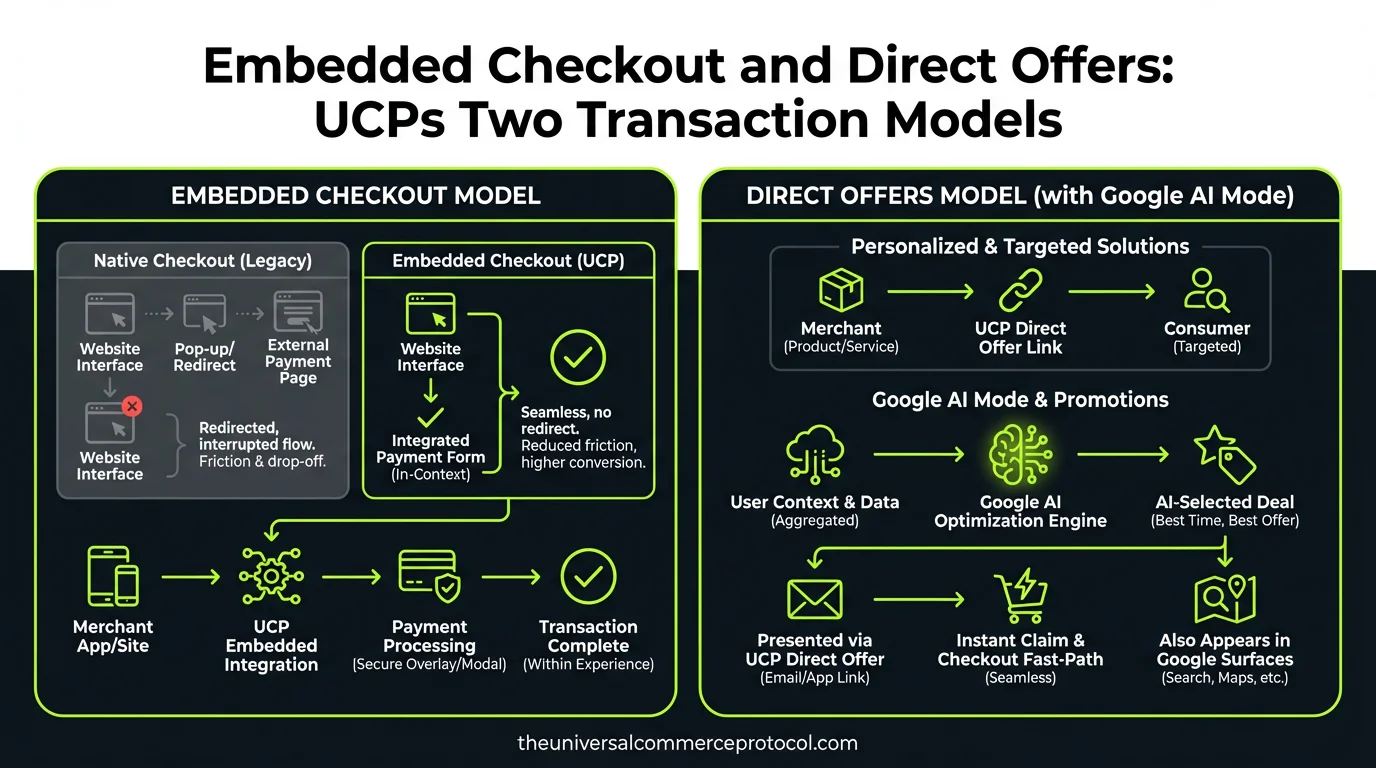
The Universal Commerce Protocol defines two distinct transaction models that determine how a purchase actually happens when an AI agent acts on behalf of a shopper: Native Checkout and Embedded Checkout. Understanding the difference between these models — and choosing the right one for your business — is one of the most consequential technical decisions a merchant makes during UCP implementation.
Alongside these checkout models, Google has introduced Direct Offers, a new Google Ads capability that lets advertisers present exclusive discounts to shoppers within AI Mode. Together, these three mechanisms define the transaction layer of agentic commerce.
Native Checkout: Full Protocol-Layer Transactions
When a merchant configures the default REST API transport binding in their UCP discovery endpoint, they are telling AI agents that their store can process a complete transaction entirely through UCP’s standardized API calls — no redirect to the merchant’s website, no rendering of the merchant’s checkout pages, no browser interaction required.
In a Native Checkout flow, the AI agent handles the entire user-facing experience. The shopper expresses intent conversationally (“buy this one”), and the agent initiates a checkout session by sending a POST request to the merchant’s checkout API with the selected product, quantity, shipping address, and payment credentials. The merchant’s backend processes the order — validating inventory, calculating taxes and shipping, authorizing payment — and returns an order confirmation to the agent, which presents it to the shopper.
From the shopper’s perspective, the entire transaction happens within the conversation. There is no page load, no form to fill out, no redirect. From the merchant’s perspective, the order arrives through their existing order management system as if it came from any other sales channel.
When to Choose Native Checkout
Native Checkout is the optimal model when your products have straightforward purchase flows — standard items with clear pricing, simple shipping options, and no mandatory customization steps. It delivers the lowest-friction shopping experience and the highest conversion rates because there are zero interface transitions that could cause drop-off.
Retailers selling consumer goods, electronics, books, beauty products, apparel in standard sizes, and similar catalog items are ideal candidates for Native Checkout. The model works best when the shopper’s primary decision is “which product” rather than “how to configure this product.”
Embedded Checkout: Merchant-Controlled UI Within AI Surfaces
Embedded Checkout — signaled by including the embedded transport in the services definition of the discovery document — takes a different approach. Instead of the AI agent handling the full transaction, the merchant’s own checkout interface renders within the AI surface as an embedded component. The shopper interacts with the merchant’s checkout UI — which can include custom forms, configuration options, delivery schedulers, and branded experiences — without leaving the AI conversation.
According to Google’s developer documentation, Embedded Checkout is an optional path available to specific, approved merchants with bespoke branding or complex checkout flows. This model is designed for merchants whose checkout process involves decisions that require visual interfaces or interactive elements that cannot be easily expressed through conversational text. A furniture retailer that requires customers to select a specific delivery date and time slot, a custom jewelry store that needs shoppers to choose engraving options, or a travel company with complex booking configurations would all benefit from Embedded Checkout.
When to Choose Embedded Checkout
Choose Embedded Checkout when your products require configuration or customization during the purchase process, your checkout flow includes legally required disclosures or consent steps that must be presented in a specific format, you want to maintain complete visual control over the checkout experience including branding, or your transaction involves complex multi-step decisions like delivery scheduling, assembly options, or service tier selection.
The trade-off is slightly higher friction — the shopper transitions from a conversational interface to a visual checkout component. However, for products that genuinely require these interactive elements, the alternative of forcing everything into a text-based conversation would actually increase friction and reduce completion rates.
Direct Offers: Exclusive Deals in AI Mode
Direct Offers is a separate but complementary capability announced alongside UCP’s broader rollout. Unlike Native and Embedded Checkout — which are UCP protocol features available to any implementing merchant — Direct Offers is a Google Ads product that lets advertisers present exclusive discounts to shoppers who are actively researching and ready to buy within AI Mode in Google Search.
When a shopper is conversing with AI Mode about a product category, advertisers participating in the Direct Offers pilot can present time-limited, exclusive promotions — for example, “20% off this item, available only through this AI Mode conversation.” The offer is presented as part of the AI’s response, alongside organic product results.
Direct Offers bridges the gap between advertising and agentic commerce. Traditional display and search ads drive traffic to a merchant’s website. Direct Offers drive immediate transactions within the AI conversation, combining promotional incentives with the zero-friction checkout experience enabled by UCP.
How Direct Offers Work With UCP Checkout
When a shopper accepts a Direct Offer, the transaction flows through the same UCP checkout infrastructure — either Native or Embedded — as any other AI-initiated purchase. The promotional pricing is applied at the checkout session level, meaning the merchant’s backend sees the discounted price and processes the order accordingly. The AI agent handles the presentation of the offer and the shopper’s acceptance, then initiates the standard UCP checkout flow.
Technical Implementation: Declaring Your Checkout Model
Your checkout model is declared in your /.well-known/ucp discovery document within the services object. When the embedded transport binding is present alongside the rest transport, the merchant supports both integration paths. The default REST API path handles standard checkout, while the embedded path provides an iframe-based UI for products that require configuration.
When both transport bindings are present, the AI surface can determine which path to use based on the transaction context. This means a single merchant can offer a seamless API-based checkout experience for standard catalog items while providing an iframe-based branded checkout for configurable or complex products.
The native_commerce Attribute
For products to be eligible for UCP-powered checkout — whether Native or Embedded — they must have the native_commerce attribute set in their Google Merchant Center product feed. This attribute serves as the opt-in signal that tells Google’s AI surfaces these products can be purchased through the agentic checkout flow.
Products without the native_commerce attribute may still appear in AI search results and product recommendations, but shoppers will be redirected to the merchant’s website to complete the purchase rather than being offered an in-conversation checkout experience. Setting this attribute is therefore a prerequisite for both Native and Embedded Checkout.
Choosing the Right Model: A Decision Framework
The decision between Native and Embedded Checkout is not about which is “better” — it is about which model fits your products and your customers’ purchase journey. Start by asking: can a shopper make a fully informed purchase decision for this product based on the information an AI agent can present in a conversation? If yes, Native Checkout delivers the best experience. If the shopper needs to interact with visual configuration tools, select from complex options, or view specific legal disclosures, Embedded Checkout is the right choice.
Many merchants will use both. A sporting goods retailer might offer Native Checkout for standard items like running shoes and protein powder while using Embedded Checkout for custom team jerseys that require name and number selection. The UCP discovery document supports this mixed approach natively.
Frequently Asked Questions
What is the difference between Native Checkout and Embedded Checkout?
Native Checkout processes the entire transaction through UCP’s API within the AI conversation — no merchant UI is shown. Embedded Checkout renders the merchant’s own checkout interface as a component within the AI surface, allowing custom forms and visual configuration.
Can I support both checkout models at the same time?
Yes. You can declare support for both Native and Embedded Checkout in your UCP discovery document and assign different models to different product categories based on their complexity.
What is the native_commerce attribute?
It is a Google Merchant Center product feed attribute that opts products into UCP-powered checkout. Without it, products may appear in AI results but will redirect to your website for purchase rather than offering in-conversation checkout.
Are Direct Offers available to all merchants?
Direct Offers launched as a Google Ads pilot program. It is not yet available to all advertisers. Check your Google Ads account for eligibility or contact your Google Ads representative for access information.
Which checkout model has higher conversion rates?
Native Checkout typically delivers higher conversion rates because it has zero interface transitions. However, for products requiring configuration, Embedded Checkout can actually outperform because it provides the necessary interactive elements that a text-only conversation cannot.
Do Direct Offers cost extra?
Direct Offers is a Google Ads product. The promotional discount is funded by the merchant. Unlike standard Google Ads, Direct Offers placements are not governed by a conventional keyword auction. Instead, Google’s AI determines when an offer is relevant to surface based on the shopper’s context and perceived purchase intent.
🎙️ The UCP Brief — Audio Summary
Read transcript
Welcome to The UCP Brief. Today we’re diving into the nuts and bolts of how transactions actually happen in the age of AI-powered commerce. The Universal Commerce Protocol, or UCP, lays out two distinct paths: Native Checkout and Embedded Checkout. Choosing the right one for your business is a bigger deal than you might think, because it fundamentally defines the boundary between the AI agent and your existing systems.
Native Checkout is all about letting the AI agent handle the entire transaction, soup to nuts, using standardized UCP API calls. Think of it as a completely seamless experience where the shopper never leaves the AI’s interface. They say “buy it,” the agent handles payment and shipping, and boom, order confirmed. The beauty here is zero friction, which translates to higher conversion rates.
Now, Embedded Checkout is different. It brings your own checkout UI components right into the AI’s surface. This means you preserve your custom checkout experience, which is crucial if you have complex configurations or specific branding you want to maintain. Plus, Google’s new Direct Offers feature lets you serve up exclusive discounts within AI Mode, adding another layer of personalization to the mix. These checkout models, combined with Direct Offers, are the building blocks of agentic commerce.
Ultimately, Native Checkout shines when you have straightforward products with simple purchase flows, like consumer goods or electronics. Embedded Checkout is your go-to when you need to maintain control over the checkout experience or have products that require configuration. Both models are key to unlocking the full potential of AI-driven sales.
I’m Will Tygart. Stay curious.
Leave a Reply