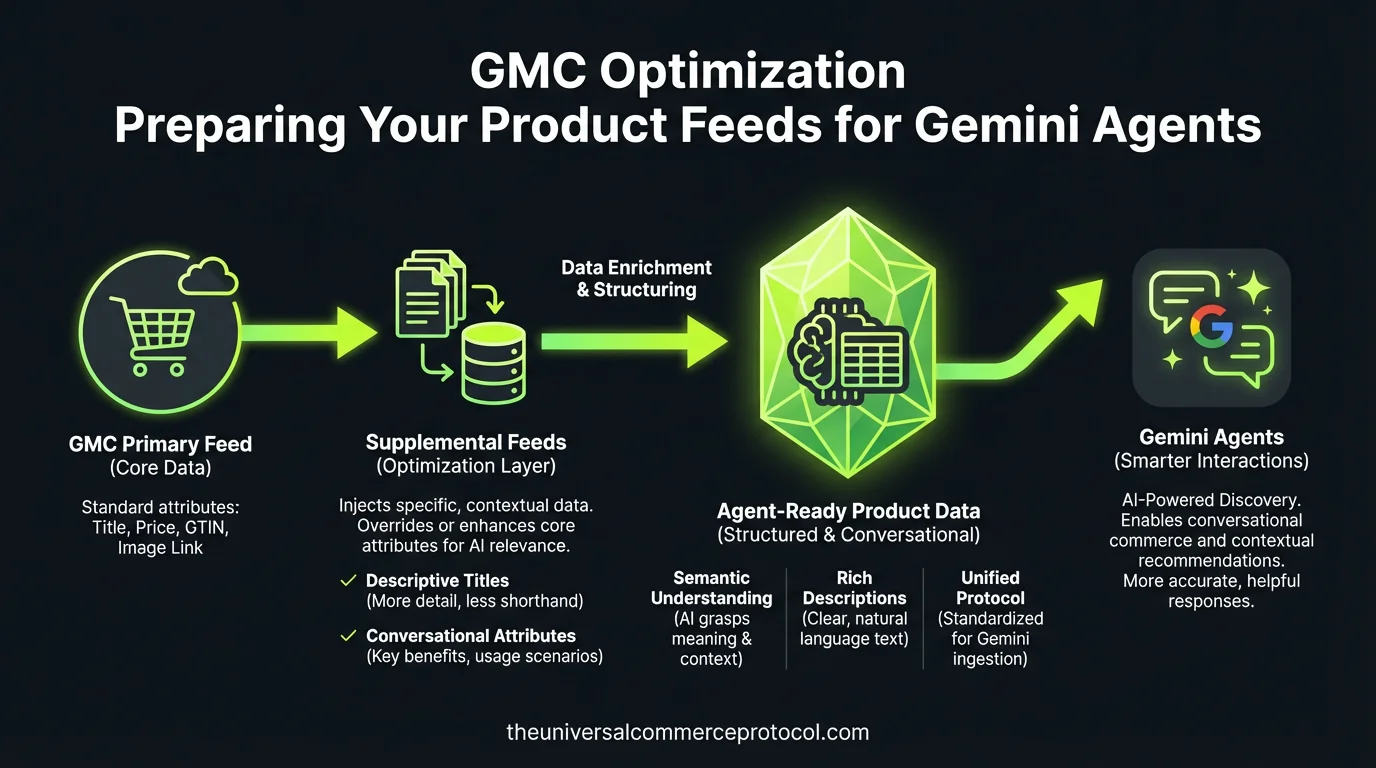
GMC Optimization: Preparing Your Product Feeds for Gemini Agents
The paradigm of e-commerce SEO is shifting from human-centric browse-and-click models to agentic-centric search-and-execute models. In this new landscape, Google Merchant Center (GMC) is no longer merely a repository for Shopping Ads data; it is the primary knowledge base for Google Gemini and its associated AI agents. To transition from being ‘searchable’ to ‘transactionable’ within the Universal Commerce Protocol (UCP) framework, merchants must look beyond the standard product feed. This guide focuses on leveraging Supplemental Feeds to inject high-fidelity, machine-readable metadata that enables Gemini to move from intent to purchase without a single manual click.
Transforming Visual Search to Agentic Action
For years, Google Merchant Center Feed Optimization was defined by high-resolution imagery and keyword-rich titles. While these remain important for human validation, AI agents—specifically those operating on the Model Context Protocol (MCP)—require a different type of optimization: deterministic availability and programmatic endpoints. When a user asks Gemini, ‘Find me a carbon fiber road bike in size 54cm available for delivery tomorrow and buy it using my Google Pay,’ the agent does not browse your website. It queries the GMC index. If your feed only contains ‘visual’ data, the agent will stall, eventually reverting to a standard link that forces the user back into a traditional checkout funnel. By integrating UCP-compliant attributes via Supplemental Feeds, you provide the ‘Agentic Logic’ required to facilitate Native Checkout directly within the Gemini interface.
Why Standard Feeds Fail AI
Standard GMC feeds are inherently ‘lossy’ regarding transactional logic. They focus on the ‘what’ (product title, price) but fail on the ‘how’ (API endpoints, specific tax logic, and real-time inventory locking). There are three primary reasons standard feeds fail AI agents: 1. Ambiguous Availability: A ‘In Stock’ status is insufficient for an agent that needs to guarantee a transaction. 2. Lack of Transactional Endpoints: Standard feeds do not specify where an agent should POST payment data. 3. Compliance Gaps: Agents cannot guess regional requirements like California Prop 65 or complex tax calculations without explicit metadata. To solve this, UCP introduces a schema that bridges the gap between the static GMC feed and the dynamic REST API requirements of modern commerce.
Setting up Supplemental Feeds
The most efficient way to prepare for Agentic Commerce without overhauling your entire ERP system is via Supplemental Feeds. These allow you to append additional attributes to your primary GMC data without modifying the core feed logic. To start, navigate to GMC > Feeds > Supplemental Feeds. Create a new Google Sheet or TSV file. The key is to use the `id` attribute as the join key to match your existing products. Once the join is established, you can introduce UCP-specific headers. Essential headers for Gemini readiness include `ucp_checkout_type`, `ucp_endpoint_uri`, and `ucp_mcp_context`. By setting `ucp_checkout_type` to ‘native’, you signal to Gemini that the product is eligible for an embedded checkout experience where the agent handles the identity linking and payment via Google Pay.
Mapping Attributes for Gemini reasoning
To enable true agentic reasoning, your Supplemental Feed must include data points that Gemini can parse into logical constraints.
Machine-Readable Eligibility
Use the `eligibility_signals` attribute to define parameters like ‘restricted_to_over_18’ or ‘requires_signature’. This prevents Gemini from attempting to purchase products that have legal blockers it cannot resolve.
Tax and Regulatory Logic
For products shipping to California, the `prop_65_warning` attribute must be present in a structured format, not buried in a text description. Gemini uses this to provide mandatory disclosures to the user before the final ‘execute’ command.
The MCP Resource URI
This is perhaps the most critical field. By including an MCP (Model Context Protocol) URI, you provide Gemini with a direct path to your server’s context. This allows the agent to fetch real-time shipping quotes or verify coupon codes via a JSON-RPC call before the user confirms the order.
| Standard Attribute | UCP Enhancement | Agent Benefit |
|---|---|---|
| g:availability | ucp_stock_count | Deterministic inventory verification |
| g:shipping | ucp_shipping_webhook | Real-time dynamic carrier rates |
| g:description | ucp_agent_summary | Token-optimized product briefing |
As we move toward a world where Agentic Commerce dominates, the merchants who win will be those who treat their product feeds as ‘API Documentation’ for Gemini. By mastering Supplemental Feeds today, you ensure your products are not just seen, but bought.
🎙️ The UCP Brief — Audio Summary
Read transcript
Welcome to The UCP Brief. Today we’re diving into how to optimize your Google Merchant Center, or GMC, for the coming wave of AI commerce powered by Gemini agents. The old rules of e-commerce SEO, focused on human shoppers, are rapidly becoming outdated. We’re moving to a world where AI agents handle the entire purchase process, and your GMC needs to be ready.
The key takeaway here is that your GMC is evolving from a simple product catalog to the primary knowledge base for these AI agents. Think about it: when someone asks Gemini to find and buy a specific item, the agent doesn’t browse your website. It queries your GMC data. If all you have is basic product info, the agent hits a wall, forcing the user back to the old way of doing things.
That’s where Supplemental Feeds come in. Standard GMC feeds are inherently limited when it comes to transactional details. They tell the AI what you’re selling, but not how to actually buy it. Supplemental Feeds let you add the crucial missing pieces, like real-time inventory status, API endpoints for payments, and even region-specific compliance information. This is what enables a seamless, one-click purchase experience within the Gemini interface.
The best part is, you don’t need to overhaul your entire system to make this happen. Supplemental Feeds allow you to add this critical data without disrupting your existing product feed. Start by creating a new feed in Google Sheets or TSV format, using the product ID to link it to your existing data. This is how you make your products truly “transactionable” in the age of AI commerce.
I’m Will Tygart. Stay curious.
Q: What is the primary purpose of Google Merchant Center in the era of Gemini agents?
A: Google Merchant Center has evolved beyond a Shopping Ads repository to become the primary knowledge base for Google Gemini and its associated AI agents. It now serves as the central index that enables AI agents to execute transactions directly, moving from user intent to purchase without requiring manual clicks or website browsing.
Q: How does the optimization strategy differ between human-centric and agentic-centric models?
A: Human-centric models relied on high-resolution imagery and keyword-rich titles for browse-and-click shopping. Agentic models require deterministic availability and programmatic endpoints with high-fidelity, machine-readable metadata. This shift means merchants must optimize for AI agent readability and transactional capability, not just human visual validation.
Q: What are Supplemental Feeds and why are they important?
A: Supplemental Feeds allow merchants to inject additional high-fidelity, machine-readable metadata into Google Merchant Center beyond standard product feed data. They enable Gemini agents to access detailed, deterministic information needed to fulfill complex user requests like same-day delivery or programmatic purchasing without reverting to traditional website links.
Q: What is the Universal Commerce Protocol (UCP) framework?
A: The UCP framework is the standard that allows merchants to transition from being ‘searchable’ (appearing in search results) to ‘transactionable’ (able to complete purchases directly through AI agents). It requires optimized product feeds with structured data that enables direct agent-to-merchant transactions.
Q: What happens when a Gemini agent cannot find required metadata in a product feed?
A: When critical data like specific sizing, availability windows, or programmatic endpoints is missing, the Gemini agent will stall and eventually revert to providing standard links that force users back to traditional website browsing, defeating the purpose of agentic commerce.
Leave a Reply