Understanding MCP Fundamentals
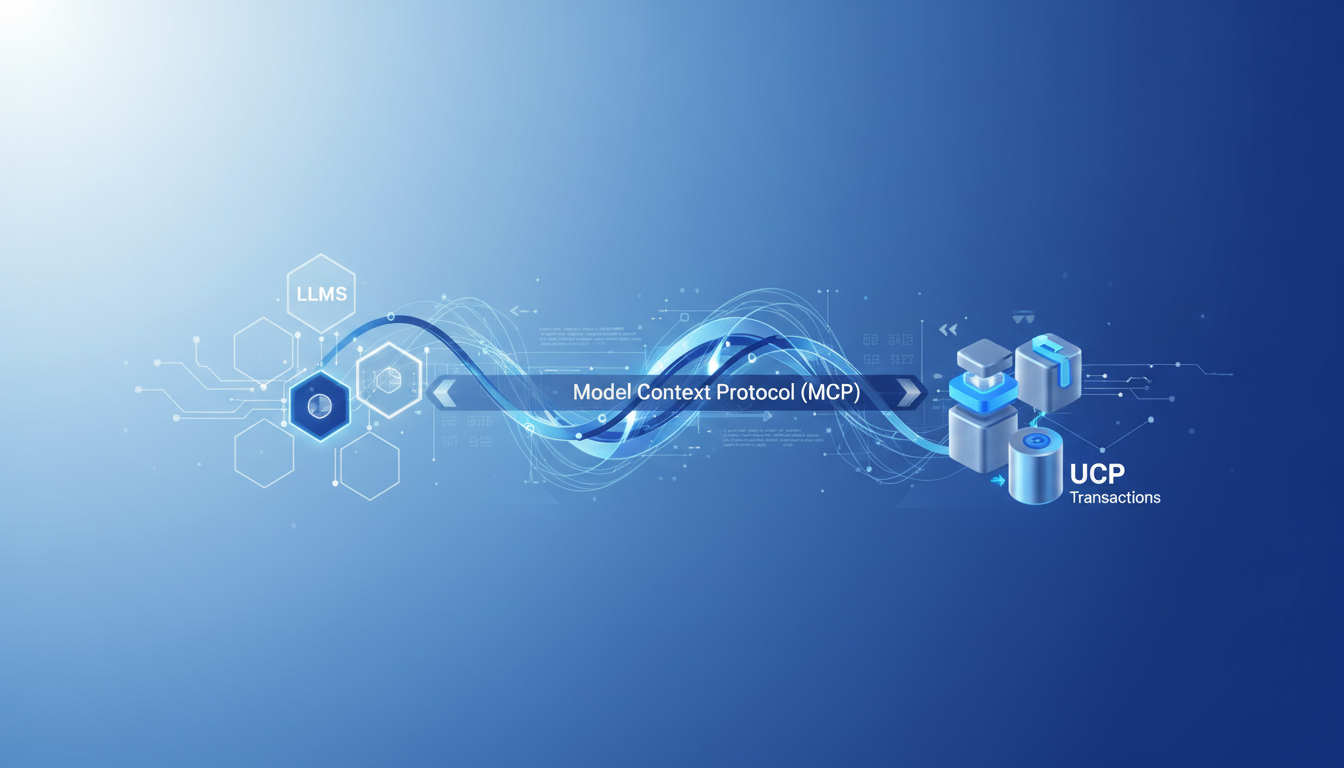
In the evolving landscape of agentic commerce, the bridge between Large Language Models (LLMs) and actionable data has historically been a fragmented network of bespoke API connectors. The Model Context Protocol (MCP), an open standard introduced by Anthropic and championed across the Google ecosystem, represents a paradigm shift. For developers and CTOs, MCP provides a standardized architecture that allows AI models—particularly the Gemini 1.5 series—to interact with external systems like the Universal Commerce Protocol (UCP) without the need for manual, one-off tool-calling configurations.
At its core, MCP operates on a client-server-host model. The Host (an application like a specialized IDE or a Gemini-powered workspace) connects to an MCP Client, which in turn communicates with various MCP Servers. These servers expose three primary primitives: Resources, Tools, and Prompts. When integrated with UCP, these primitives transform the LLM from a passive advisor into a functional transaction agent capable of querying inventory, calculating taxes, and initiating secure checkouts.
The Power of Standardized Context
Traditional RAG (Retrieval-Augmented Generation) often suffers from latency and format mismatches. MCP solves this by providing a protocol-level definition for how a model should request data. Instead of hard-coding a ‘GetProductPrice’ function for every merchant, a developer can build a single UCP MCP Server that exposes the entire UCP API surface. The model then uses the protocol to discover what it needs to fulfill a user’s intent, such as: ‘Find me the best price for a 4K monitor and buy it using my Google Pay profile.’
Connecting UCP Endpoints to MCP Servers
The technical implementation of a UCP-MCP bridge involves wrapping UCP’s RESTful endpoints within an MCP server framework. This allows the UCP Interoperability Layer to serve as the ‘Source of Truth’ for agentic queries. By utilizing JSON-RPC as the underlying transport mechanism, developers can ensure that Gemini can call UCP functions with minimal overhead.
Mapping UCP Resources to MCP Tools
To enable seamless commerce, the MCP server must expose specific UCP capabilities as ‘Tools’. For instance, a get_product_availability tool would map directly to the UCP Product Feed API, while a calculate_total_cost tool would interface with the UCP Tax and Shipping engines. This mapping allows the AI agent to gather all necessary variables for a transaction in a stateless, verifiable manner.
- Discovery: The agent calls the MCP
list_toolsendpoint to understand its commercial capabilities. - Execution: When a user expresses purchase intent, the agent executes a
call_toolcommand, passing parameters likeproduct_idandshipping_address. - Response: The MCP server returns a standardized JSON object from UCP, which the model interprets to present the final offer to the user.
Orchestrating the Checkout Path: Native vs. Embedded
One of the critical decisions for CTOs is determining the checkout flow. Through the UCP-MCP integration, agents can facilitate two distinct paths:
| Feature | Native Checkout via UCP | Embedded Checkout via UCP |
|---|---|---|
| User Experience | Completed entirely within the AI interface. | Agent provides a secure link to the merchant’s site. |
| Payment Handling | UCP processes via Google Pay / Stored Credentials. | Merchant of Record (MoR) handles payment on-site. |
| Data Flow | Full transaction data stays within the UCP pipeline. | Agent hands off session to a web-view. |
| Friction | Ultra-low (Zero-click potential). | Medium (Requires context switch). |
By using MCP, the agent can dynamically choose the path based on the merchant’s Eligibility Signals. If the merchant supports the UCP Native Checkout specification, the agent executes the transaction directly. If not, it gracefully falls back to an embedded approach, ensuring no lost conversion opportunities.
Real-time Data Synchronization with Google Merchant Center
For UCP to remain effective within an MCP context, it must have access to real-time data. Integrating Google Merchant Center (GMC) feeds into this architecture is essential. By linking GMC Supplemental Feeds to the UCP Interoperability Layer, the MCP server can provide Gemini with up-to-the-second pricing, stock levels, and even California Prop 65 compliance warnings. This ensures that the ‘Context’ in ‘Model Context Protocol’ is never stale, preventing the hallucination of expired discounts or out-of-stock items.
The Security of Agent-Led Calls
Entrusting an LLM with financial transactions introduces significant security requirements. The integration of UCP and MCP relies on a robust ‘Security and Trust’ framework to protect both the consumer and the merchant. This is not merely about encryption; it is about verifiable intent and authorization.
Identity Linking and OAuth 2.0
The first line of defense is Identity Linking. Before an MCP server allows a ‘Buy’ command to be executed, it must verify the user’s identity via OAuth 2.0. In the Google ecosystem, this often involves a secure handshake between the user’s Google Account and the UCP Identity Layer. The MCP server acts as a gatekeeper, ensuring that the ‘Session Token’ passed by the AI agent is valid and has the specific scope required for a financial transaction.
Transactional Integrity and Risk Signals
Every call made by an AI agent through the MCP-UCP bridge carries a payload of Risk Signals. UCP evaluates these signals—such as IP reputation, device fingerprinting, and behavioral biometrics—to determine the legitimacy of the request. Since the agent is an intermediary, UCP applies additional scrutiny to ensure the model isn’t being manipulated via ‘Prompt Injection’ to redirect funds or bypass price controls.
Furthermore, UCP ensures that all agentic calls are idempotent. If a network flicker causes the MCP server to send a transaction request twice, the UCP Interoperability Layer recognizes the duplicate request_id and prevents double-billing, a critical requirement for maintaining trust in agent-led commerce.
Compliance and Privacy
In a globalized market, compliance is non-negotiable. The UCP-MCP stack handles complex regulatory requirements—like GDPR, CCPA, and specialized product warnings—at the protocol level. When a Gemini-powered agent queries a product via MCP, UCP automatically appends necessary legal disclosures to the response. This ensures that the merchant remains compliant, even when the ‘storefront’ is a chat interface or a voice assistant.
Conclusion: The Future of Agentic Commerce
The integration of the Model Context Protocol with the Universal Commerce Protocol marks the end of the ‘Chatbot’ era and the beginning of the ‘Transaction Agent’ era. For developers, the combination of Google’s AI prowess and UCP’s transactional infrastructure provides the tools necessary to build a truly frictionless global marketplace. By standardizing how models access the world of commerce, MCP and UCP are not just bridging a technical gap—they are defining the new standard for how we buy, sell, and interact in an AI-first world.
What is the Model Context Protocol (MCP)?
The Model Context Protocol is an open standard introduced by Anthropic that provides a standardized architecture allowing AI models, particularly the Gemini 1.5 series, to interact with external systems like the Universal Commerce Protocol (UCP) without requiring manual, one-off tool-calling configurations.
How does MCP’s client-server-host model work?
MCP operates on a three-tier architecture: the Host (an application like a specialized IDE or Gemini-powered workspace) connects to an MCP Client, which communicates with various MCP Servers. These servers expose three primary primitives—Resources, Tools, and Prompts—that enable LLMs to interact with external systems.
What are the three primary primitives exposed by MCP Servers?
The three primary primitives are Resources, Tools, and Prompts. When integrated with UCP, these primitives transform the LLM from a passive advisor into a functional transaction agent capable of querying inventory, calculating taxes, and initiating secure checkouts.
How does MCP improve upon traditional RAG approaches?
Traditional RAG often suffers from latency and format mismatches. MCP solves this by providing a protocol-level definition for how a model should request data, eliminating the need to hard-code individual functions like ‘GetProductPrice’ for every integration.
What is the relationship between MCP and UCP transactions?
MCP bridges Large Language Models and Universal Commerce Protocol (UCP) transactions by providing a standardized way for AI models to access and interact with commerce systems, enabling secure and efficient transaction processing without fragmented, bespoke API connectors.
Leave a Reply