Tag: ML Engineer
-
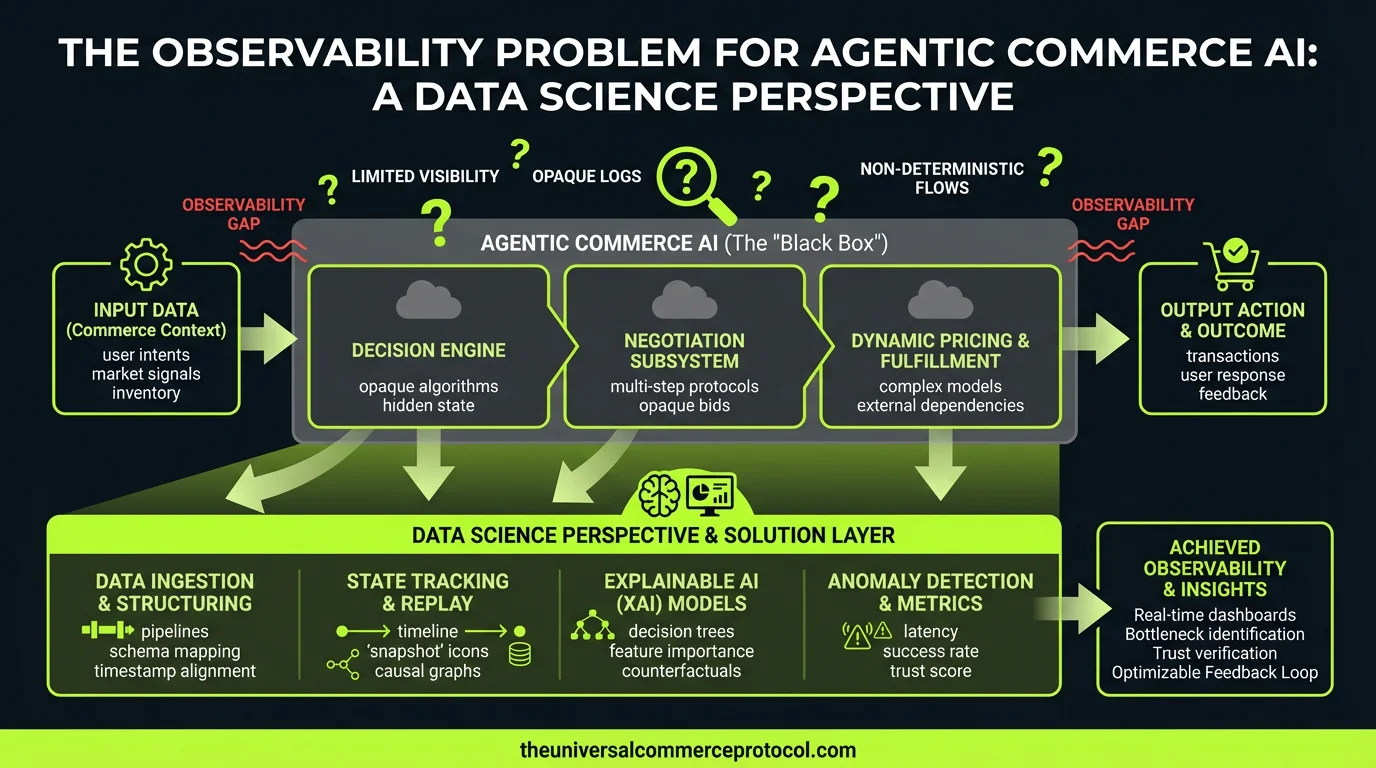
Observability Problem for Agentic Commerce AI
Agentic commerce AI systems processing high-volume transaction workflows require observability frameworks that move beyond traditional ML metrics like precision and recall to capture business-critical signals: transaction success rates, conversion funnel completion, fraud detection accuracy, and latency-induced revenue loss. Data science teams must implement causal inference methodologies and counterfactual analysis to validate decision-making quality across autonomous…
-

Training Commerce Agents: UCP vs Claude Marketplace
Anthropic’s Unified Commerce Platform (UCP) implements deterministic API-based catalog integration for agent state representation, while Claude Marketplace employs vector embedding retrieval (similar to RAG architectures) for semantic product matching. These architectural approaches produce distinct reward functions and action spaces: UCP supports direct inventory state access for deterministic pricing and fulfillment decisions, whereas Claude Marketplace’s probabilistic…
-
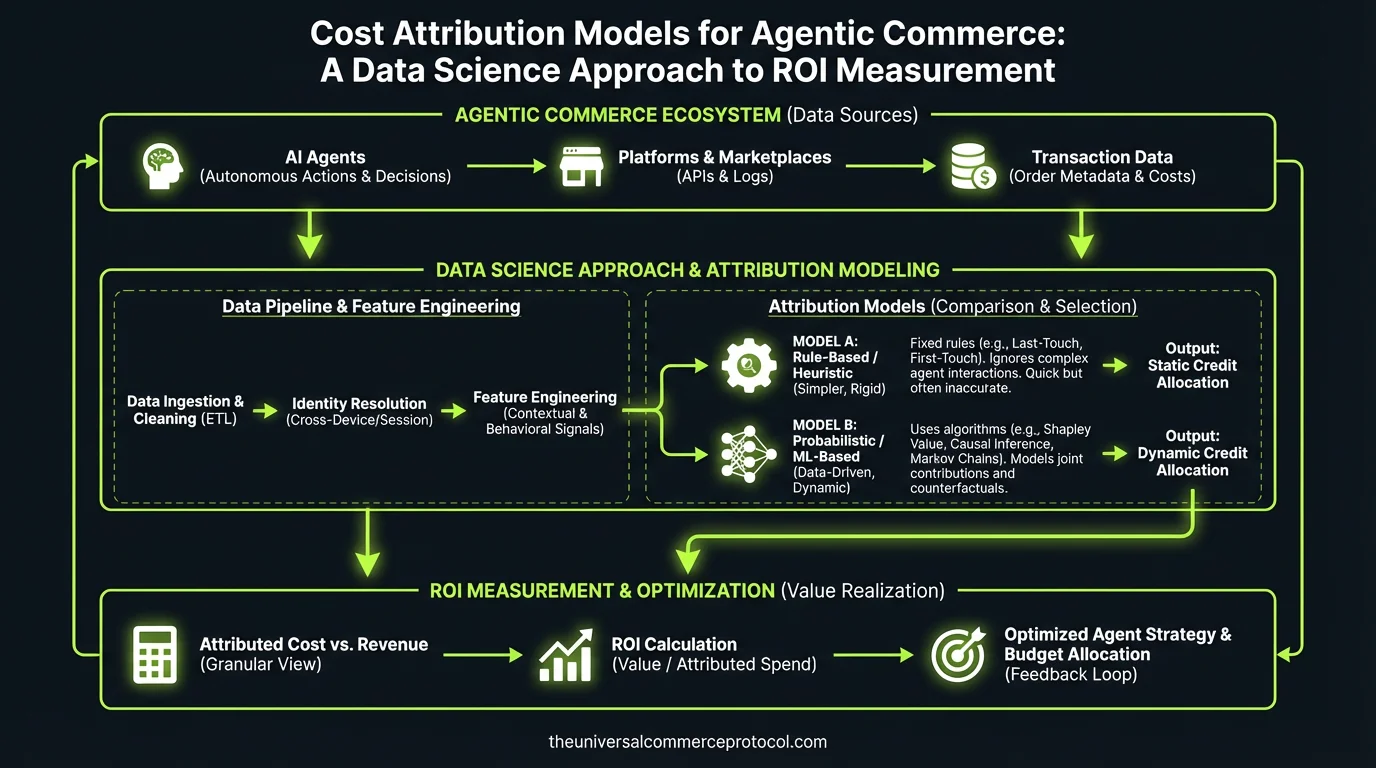
Cost Attribution Models for Agentic Commerce
Cost attribution models for agentic AI commerce quantify expenses across multi-step LLM inference chains—including token consumption, vector database queries, and API calls—where traditional transaction-level metrics fail to isolate individual agent decision costs. Data science approaches like shapley value decomposition and hierarchical cost allocation enable attribution of total cost of ownership (TCO) to specific customer journeys,…
-

Agent State Recovery: Commerce AI & Reinforcement Learning
Amazon, Shopify, and eBay implement Markov Decision Processes (MDPs) with Q-learning, temporal difference learning, and policy gradient methods to optimize state recovery in distributed e-commerce systems during partial infrastructure failures. These reinforcement learning frameworks use reward functions that quantify downtime costs, data consistency violations, and customer churn, enabling value iteration algorithms to minimize cumulative operational…
-

Training Commercial AI Agents to Self-Monitor for Factual Accuracy: A Model-Centric Approach to Hallucination Detection
How to architect AI commerce agents that self-monitor for hallucination — confidence estimation, UCP validation layers, and continuous feedback loops that keep product data, pricing, and inventory claims accurate.
-

Commerce Agent Performance Evaluation Frameworks
Commerce agents powered by large language models (LLMs) including OpenAI’s GPT-4, Anthropic’s Claude, and Meta’s Llama 2 require specialized evaluation frameworks measuring task success rates, latency in milliseconds, cost-per-transaction metrics, and human preference ratings across model architectures. Production-grade assessment of agentic commerce systems employs A/B testing, shadow testing deployments, hallucination rate monitoring, and task completion…
-
Feature Engineering for Agent Cost Attribution: Building Predictive Models for Commerce AI ROI
How to engineer features, train models, and evaluate agentic commerce systems where cost per transaction varies by 40x based on interaction complexity.
-

Amazon Protocol Gap: Agentic Commerce Standards Challenge
Amazon, which controlled 41% of the U.S. e-commerce market with $575.5 billion in 2023 revenue, has not adopted Open Commerce API (OCAPI) or OpenCommerceAI governance standards, creating dataset accessibility gaps for agentic AI systems built on Anthropic Claude, OpenAI GPT-4, and Meta Llama models. This non-adoption prevents autonomous shopping agents from accessing standardized API specifications,…
-

Feature Contamination in Commerce AI: A Data Science Framework for Agent Robustness
Data poisoning attacks exploit feature space vulnerabilities in commerce agents, requiring novel detection methods beyond traditional validation.
-

Commerce Agent Performance: Data Science Testing
Commerce agent performance frameworks evaluate NLP-driven conversational AI systems using precision metrics including conversion rate optimization (CRO), cart abandonment rates, and session-level accuracy across unified commerce platforms spanning e-commerce, omnichannel retail, and mobile commerce channels. Data science testing methodologies quantify recommendation engine performance via click-through rates (CTR) and revenue per session (RPS) metrics, while validating…