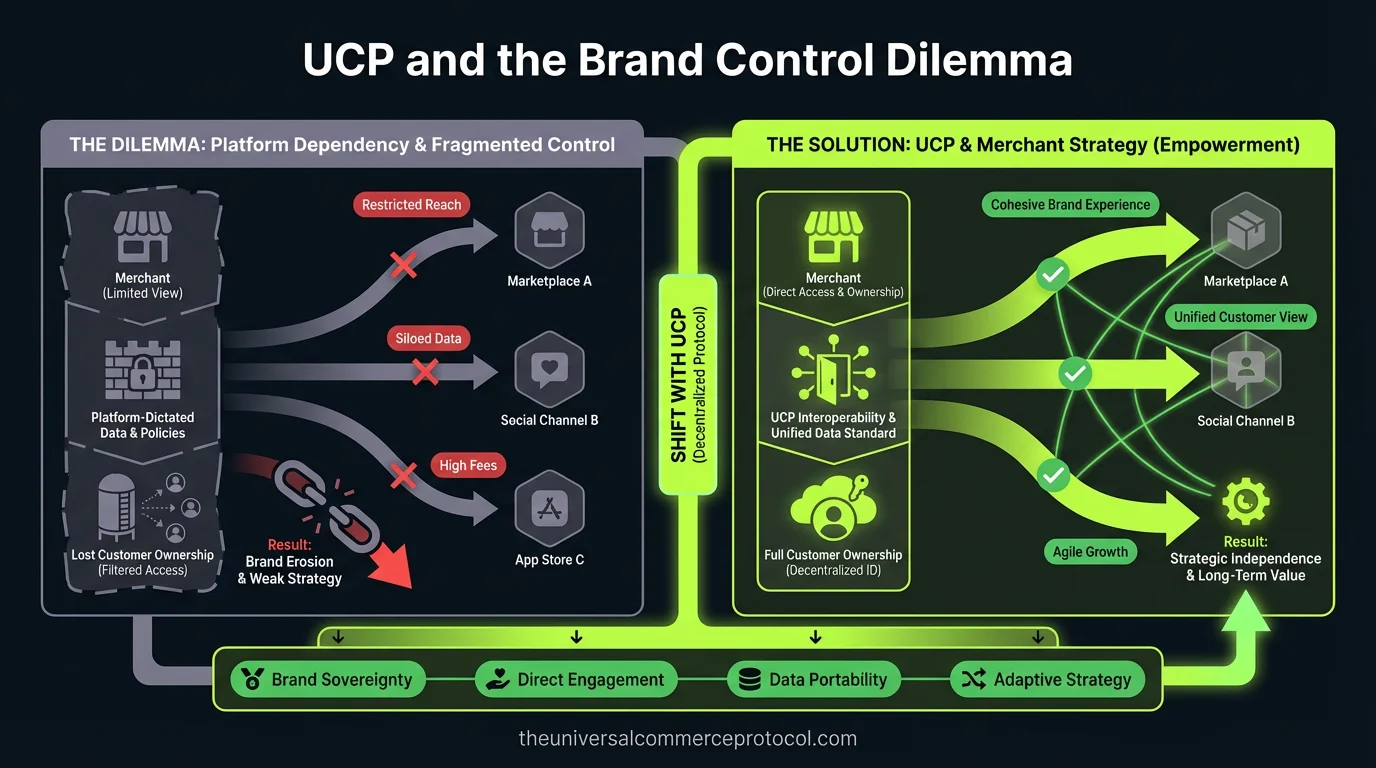
Adopting the Universal Commerce Protocol is not a purely technical decision. For any merchant, it is a choice about where transactions happen, how brand experience is shaped at the moment of purchase, and what relationship is preserved with the customer after the sale.
This article does not advocate for or against UCP adoption. It presents the confirmed facts about what merchants retain under UCP, what changes, and what legitimate strategic questions have been raised by industry observers — sourced entirely from official documentation, direct stakeholder statements, and published commentary from named experts. No speculation is presented as fact.
What Merchants Retain Under UCP: Confirmed Facts
Google’s official documentation is explicit on several points that are central to the merchant’s strategic calculus. These are not marketing claims — they are the technical and contractual design of the protocol.
Merchant of Record Status
Under UCP, the merchant remains the Merchant of Record for every transaction. Google does not become a party to the sale. As Google’s official FAQ states: “You remain the Merchant of Record for all transactions. You retain full ownership of your customer relationships, data, and the post-purchase experience.” Source: Google UCP FAQ.
Customer Data Ownership
Merchants retain full ownership of their customer relationships and transaction data. The UCP integration surfaces transaction outcomes to the merchant; it does not transfer ownership of that data to Google or any intermediary. Source: Google UCP FAQ.
Business Logic Control
UCP is designed to integrate with existing merchant business logic. Merchants retain control over discount rules, loyalty program terms, subscription billing cadences, and fulfillment policies. Complex checkout scenarios that cannot be resolved autonomously by an agent route back to a merchant-controlled continuation flow. Source: Google UCP FAQ and Shopify Engineering.
Integration Flexibility
Merchants choose between native checkout (direct API integration) and embedded checkout (merchant UI embedded within the agent surface). For merchants with complex or custom checkout requirements, the embedded path preserves more control over the checkout experience. Source: Google UCP Embedded Checkout Guide.
What Changes Under UCP: Confirmed Facts
The Transaction Occurs on Google’s Surface
For native UCP checkout, the transaction is completed within Google AI Mode or Gemini — not on the merchant’s website. The shopper does not visit the merchant’s domain to complete the purchase. This is a confirmed structural fact about how UCP-powered checkout works. Source: Google Merchant Center Help: About UCP.
Payment Is Processed via Google Pay at Google’s Surfaces
For transactions completed inside Google’s AI surfaces, payment credentials come from Google Wallet via Google Pay. The merchant’s PSP processes the transaction using a payment token from Google Pay. The merchant does not control which payment UI the shopper sees within the AI surface. Source: Google UCP FAQ.
Product Discoverability Depends on Merchant Center Data Quality
Products that appear in Google AI Mode and Gemini are surfaced based on Merchant Center feed data. Merchants who do not add the native_commerce attribute to their product listings will not have Buy buttons appear. Merchants who do not maintain high-quality, complete product data in Merchant Center will be less discoverable in conversational commerce contexts. Source: Google Merchant Center Help: About UCP.
Strategic Concerns Raised by Industry Observers
Several named experts and analysts have raised specific strategic concerns about UCP and agentic commerce more broadly. These concerns are presented here as documented positions, not as conclusions.
Customer Relationship and Brand Experience
Jeremy Goldman, Senior Director at eMarketer, stated in published commentary: “Universal, agent-mediated commerce reduces the importance of owned storefronts at the moment of purchase. When transactions occur inside Google’s environment, brands lose control over UX, merchandising, and post-purchase engagement. Products risk becoming interchangeable inputs, ranked by availability, price, and fulfillment reliability rather than narrative or identity.” Source: Digiday, “WTF is Google’s Universal Commerce Protocol?”
Platform Dependency Risk
Aaron Dicks, CTO at performance marketing agency Impression, stated: “Brands may be reluctant — certainly initially — to adopt a technology that will allow customers to transact away from their owned properties, where the experience is controlled by them.” Source: Digiday, “WTF is Google’s Universal Commerce Protocol?”
Product Commoditization Risk
Published analysis from Smarter Ecommerce noted: “Automation seeks the path of least resistance. Frictionless spending is dangerous if you don’t control what is being sold.” The concern is that AI agents optimizing for transaction completion may favor products ranked by price, availability, and fulfillment speed — potentially at the expense of brands that compete on differentiation, narrative, or premium positioning. Source: Smarter Ecommerce, “What is Google’s Universal Commerce Protocol?”
The Merchant’s Evaluation Framework
Based on confirmed facts from official sources, merchants evaluating UCP should assess the following concrete questions — without speculation about outcomes not yet documented:
- Is your PSP Google Pay compatible? If not, this is a prerequisite that must be addressed before integration is possible.
- How complete and accurate is your Merchant Center product data? Discovery in AI Mode and Gemini depends entirely on feed quality. Merchants with thin or incomplete product data will not benefit from UCP-powered reach.
- What percentage of your current sales rely on on-site brand experience to convert? Merchants whose conversion depends heavily on website design, storytelling, cross-sell sequences, or post-browse retargeting will experience a different impact from off-site UCP checkout than merchants who compete primarily on price and availability.
- Do you have an existing Google Merchant Center account in good standing? This is a prerequisite for the integration.
- What is your current cart abandonment rate? The reduction in friction that UCP enables is most valuable for merchants with high checkout abandonment driven by friction rather than intent.
Primary Sources for This Article
- Google UCP FAQ (developers.google.com)
- Google UCP Developer Guide (developers.google.com)
- Google Merchant Center Help: About UCP and UCP-powered checkout
- Shopify Engineering: Building the Universal Commerce Protocol (January 11, 2026)
- Digiday: WTF is Google’s Universal Commerce Protocol?
- Smarter Ecommerce: What is Google’s Universal Commerce Protocol?
🎙️ The UCP Brief — Audio Summary
Read transcript
Welcome to The UCP Brief. Today we’re diving into the Universal Commerce Protocol and the strategic choices it presents for merchants. It’s easy to get lost in the tech, but at its core, UCP forces a reckoning: where do you want transactions to happen, and how much control do you want over the brand experience at the point of sale?
One crucial point to understand is what you, as a merchant, *keep* under UCP. Despite transactions happening on Google’s surfaces, you remain the Merchant of Record. You retain full ownership of customer data, and you maintain control over your business logic – things like discounts and loyalty programs. This isn’t marketing fluff; it’s how the protocol is technically and contractually designed.
However, there are clear shifts in control. With native UCP checkout, the transaction happens within Google’s AI environment, not your website. The customer never actually visits your domain to buy. Payment is processed via Google Pay. This means less direct exposure to your brand during that critical purchase moment. That’s a trade-off every merchant needs to carefully consider.
I’m Will Tygart. Stay curious.
Leave a Reply