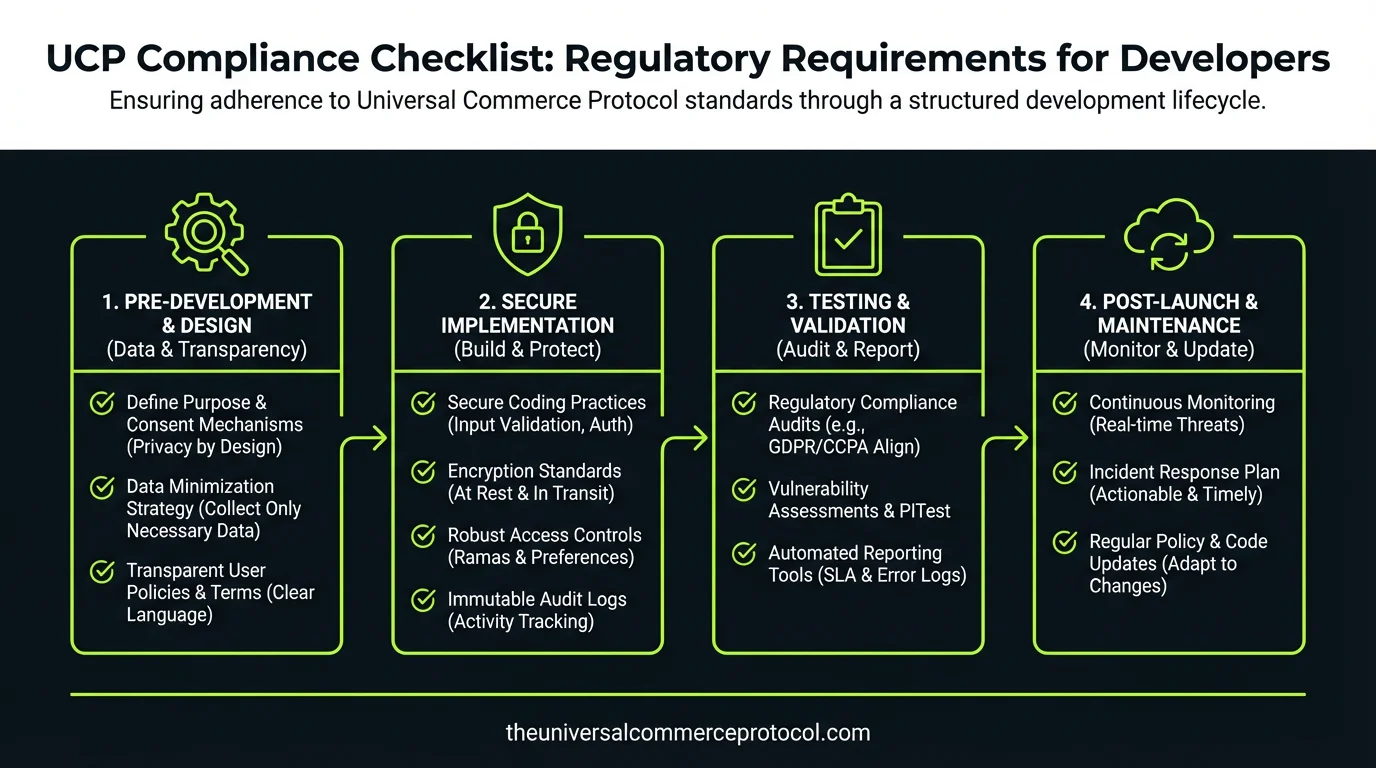
UCP Compliance & Regulatory Requirements: A Developer’s Checklist for Global Commerce
Yet as merchants and developers integrate UCP—especially across borders—a critical gap has emerged: compliance guidance.
While technical integration articles cover API rate limits, error handling, and sandbox testing, almost no published material addresses the regulatory requirements developers must satisfy when building UCP commerce agents. PCI-DSS certification, GDPR data handling, payment processor licensing, and regional restrictions create real legal and financial risk.
This article provides a structured compliance checklist for UCP developers and merchants.
This checklist is author practice guidance for building auditable integrations, not legal advice. It does not determine PCI-DSS, GDPR, PSD2, Regulation E, or other regulatory outcomes. The merchant remains merchant of record on Google UCP surfaces with control of customer relationships and data, performing inventory, address, and error-code responsibilities. Confirm all regulatory requirements with qualified counsel and your processor before deployment.
Why UCP Compliance Matters Now
| Regulatory Domain | Governing Standard | Mandatory Technical Requirement | Implementation Primitive | Non-Compliance Penalty | Audit Verification Method |
|---|---|---|---|---|---|
| Payment Security | PCI DSS v4.0 Requirement 6.4.3 & 11.6.1. | Zero plain PAN exposure; mandatory network tokenization and passkey isolation. | FIDO AP2 WebAuthn & EMVCo Tokenization. | Heavy card scheme fines & loss of processing rights. | Automated SAQ-D compliance report & penetration test. |
| Data Protection | GDPR Article 22 & CCPA / CPRA. | Explicit user consent for autonomous profiling; right to human intervention. | W3C Verifiable Consent Credential with audit log. | Up to €20M or 4% of global annual turnover. | Verifiable user consent ledger & data deletion API. |
| Consumer Disclosure | FTC Act Section 5 & State AI Disclosure Laws. | Clear, conspicuous automated disclosure that transaction is agentic. | Pre-checkout disclosure modal with timestamped receipt. | Civil penalties up to $51,744 per occurrence. | Signed disclosure attestation record in order envelope. |
| Spend Limits & Budgets | Electronic Fund Transfer Act (EFTA) & Regulation E. | Hardware-enforced transaction dollar caps and velocity limits. | RFC 9396 Rich Authorization Requests (RAR). | Mandatory bank refund obligations for unauthorized debits. | Cryptographic budget ceiling assertion in payment token. |
| Audit Ledgers | SOC 2 Type II & SEC Books and Records. | Tamper-evident write-ahead hash-chained ledger storing all transaction stages. | RFC 9421 signed transaction digest with external timestamp. | Regulatory audit sanctions & material control failure. | Continuous automated cryptographic hash validation. |
UCP delegates transaction execution to autonomous agents. This fundamentally changes compliance responsibility. In traditional e-commerce, a merchant or payment processor controls the transaction flow. In agentic commerce, the agent decides payment routing, fulfillment timing, and customer data access.
Payment processors that support agentic checkout publish their own compliance requirements. Your UCP integration must satisfy both the protocol specification and your processor’s regulatory obligations.
PCI-DSS & Payment Data Security
PCI Data Security Standard (PCI-DSS) introduces requirements for payment systems.
Your Compliance Obligations:
- Tokenization: Your UCP agent must never store or transmit full primary account numbers (PANs). All card data must be tokenized via your processor’s payment method endpoint before agent access.
- Encryption in Transit: All UCP API calls handling payment data require TLS 1.2 or higher. Validate certificate pinning on client-side implementations.
- Access Controls: Document which agent roles (fulfillment, payment routing, refunds) have access to which payment methods. Use IAM policies to enforce least-privilege access.
- Agent Audit Logging: Log every agent decision involving payment data—routing decisions, failed authorization attempts, method selection criteria.
- Third-Party Assessment: If your UCP agent integrates with a third-party data enrichment service (fraud scoring, address validation), that vendor must also be PCI-compliant. Verify their Attestation of Compliance (AoC) annually.
Common Failure Point: Developers often cache payment method IDs or processor tokens in agent state to avoid repeated API calls. This risks retaining cardholder data. Retrieve tokens only when needed; never persist them in agent memory or logs.
GDPR & Customer Data Rights
Key GDPR Requirements for Agentic Commerce:
- Data Processing Agreements (DPA): Your payment processor (Stripe, Wizard, J.P. Morgan, etc.) must sign a Data Processing Addendum if they access customer data on your behalf. Verify this before deploying agents.
- Algorithmic Transparency: Your privacy policy must disclose that agent-driven payment selection is in use, and offer human review of high-value transactions.
- Data Minimization: Your agent should access only payment and fulfillment data necessary for the transaction. Do not pass customer email, shipping address, or behavioral data to payment routing agents unless required for fraud scoring or compliance. If you do, document the legal basis (usually “legitimate interest” for fraud prevention).
- Retention Limits: Transaction records linked to customer identity must be deleted or anonymized after the legal retention period. Agent logs containing customer identifiers fall under this rule.
- Right to Erasure: Implement a process to purge customer data from agent training datasets and cached decision logs upon request. This is operationally difficult; many companies use synthetic or anonymized data for agent training specifically to avoid this burden.
Practical Implementation: Use UCP’s payment method tokenization to ensure agents never see raw customer identity data. Route only token + transaction amount + merchant ID to the routing agent. This minimizes GDPR exposure because the agent never processes “personal data” as GDPR defines it.
Regional Payment Regulations
United States (Regulation E, NACHA, FinCEN):
- If your agent initiates ACH transfers or wire payments, ensure transaction receipt requirements and liability considerations are addressed with counsel.
- Money transmitter licensing may apply if your agent acts as an intermediary.
- Ensure your agent captures and forwards customer identity data as required for international payments.
European Union (PSD2 & PSD3):
- Implement SCA via your processor’s 3D Secure interface; agents should request SCA when needed, not hide it.
- Monitor agent behavior and consider human approval for high-risk transactions.
UK (Financial Conduct Authority):
- Designate a Senior Manager responsible for your agentic commerce platform and document their oversight process.
Australia (ASIC & ACCC):
- Maintain audit trails of agent reasoning (why this payment method was chosen) and make them available to regulators on request.
Developer Compliance Checklist
Before Deploying a UCP Agent:
- ☐ Verify your payment processor (Stripe, Wizard, etc.) has signed a DPA or Data Processing Addendum if handling EU customer data.
- ☐ Confirm PCI-DSS compliance: tokenization in place, no raw PAN storage, TLS 1.2+ encryption, audit logging enabled.
- ☐ Document which customer data the agent can access. Remove unnecessary fields (email, address, phone) from agent inputs.
- ☐ Implement Strong Customer Authentication (SCA) callbacks. Agents must request SCA when required; do not bypass it.
- ☐ Add agent decision reasoning to transaction logs (e.g., “Routed to Visa due to lower cross-border fee”).
- ☐ Set up customer data deletion workflow. Test that customer data removal cascades to agent logs and cached decision models.
- ☐ Configure API rate limiting and monitoring. Alert on anomalous agent behavior (e.g., agent repeatedly selecting the same payment method despite balance failures).
- ☐ Review your privacy policy. Disclose agent-driven payment selection; offer human review option for transactions over your threshold.
- ☐ Engage legal review for any agent automated decision-making behavior. If yes, implement human override.
- ☐ Test UCP integration in compliance sandbox with realistic payment scenarios. Verify compliance logging works.
Frequently Asked Questions
Why must UCP developers implement PCI DSS v4.0 tokenization rather than raw card storage?
PCI DSS v4.0 strictly penalizes storing or transmitting unencrypted Primary Account Numbers (PANs) through AI models or LLM context; tokenization isolates financial credentials entirely from application code.
How does UCP comply with GDPR Article 22 automated decision-making rules?
UCP requires a cryptographically recorded user consent token and provides a standardized fallback hook that allows the human consumer to intervene or review transaction parameters before settlement.
What is the developer requirement for FTC-compliant agent disclosures?
Developers must ensure their agent application displays a clear and conspicuous notice identifying itself as an automated purchasing agent before requesting the user’s final biometric checkout confirmation.
Leave a Reply