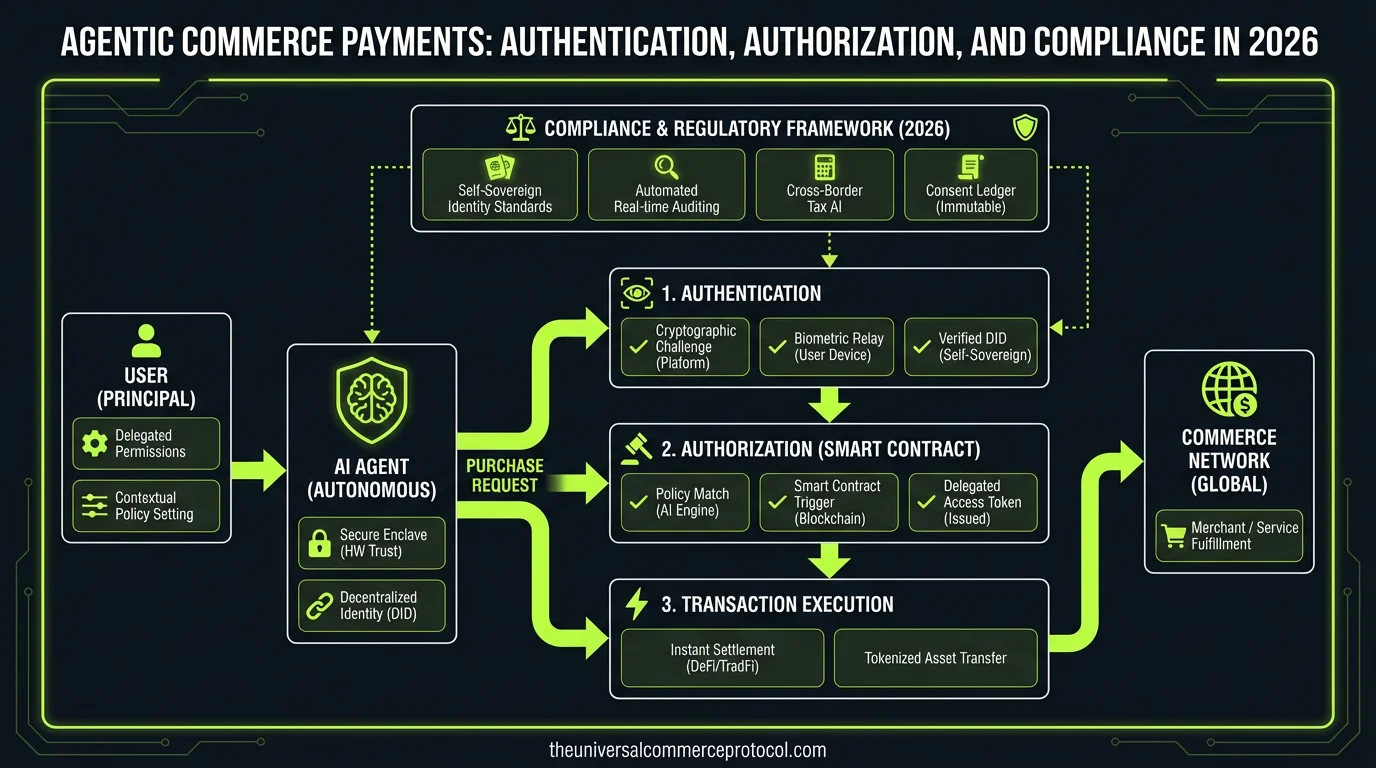
Agentic commerce has moved from pilot to production in 2026. Autonomous agents now execute procurement, settlement, and payment workflows across supply chains, B2B marketplaces, and enterprise procurement platforms, operating at machine speed across currencies and systems. Unlike traditional e-commerce where a human authorizes each transaction, agentic commerce delegates payment authority to software operating within defined parameters and guardrails.
This shift makes authentication, authorization, and compliance the determining layer for whether agentic payments remain trustworthy, auditable, and legally defensible. Editorial framing: agentic commerce payments combine authentication, authorization, and compliance controls so autonomous agents can settle transactions safely inside the Universal Commerce Protocol (UCP). The sections below map how those layers fit together for merchants, payment teams, and compliance owners.
Version pin for this edition: this guide is aligned to UCP spec v2026-08-25 (Latest). Google-surfaced implementations track 2026-04-08. Where earlier drafts described UCP authentication, logging, tokenization, or proofs without a version, this edition replaces those ambiguous statements with that version split. Behavior that differs between Latest and the Google implementation should be evaluated against the named version, not against generic UCP claims.
Authentication in Autonomous Payment Flows
The Three Pillars of Agentic Payment Architecture Matrix (2026 Edition)
Autonomous financial execution requires decoupling agent identity verification from transactional spending power and regulatory oversight. The matrix below defines the three foundational pillars under UCP RFC 2026-08-25.
| Pillar | Core Responsibility | Standard Specification | Primary Artifact | Enforcement Layer | Regulatory Scope |
|---|---|---|---|---|---|
| 1. Authentication | Verifying agent provenance, runtime integrity, and key possession. Proves WHO the agent is. | RFC 9449 DPoP & mTLS (RFC 8705) | Ephemeral Ed25519 Keypair & JWS Header | Merchant API Gateway Ingress | Zero-Trust Architecture |
| 2. Authorization | Bounding agent purchasing authority, spending limits, and SKU constraints. Proves WHAT the agent may buy. | FIDO AP2 Delegated Mandates & OAuth 2.1 Rich Authorization Requests (RAR) | Signed Passkey ECDSA Mandate Token | Cart Policy Engine & Payment Vault | PSD3 SCA Exemption |
| 3. Compliance | Ensuring jurisdictional legality, age verification, sanctions screening, and auditability. Proves HOW the transaction complies. | UCP Audit Ledger & W3C Verifiable Credentials (VC) | Immutable Merkle Tree Receipt & ZKP Age Attestation | Card Scheme Settlement Clearing | EU DORA / AMLD6 / US BSA |
In agentic commerce, who is making the payment decision is fundamentally ambiguous. Is it the agent, the enterprise that deployed the agent, or the human stakeholder who set the parameters? Authentication must establish a verifiable identity chain across all parties before any authorization logic is evaluated. The principle that survives from the canonical edition is that agents need cryptographic, verifiable identity — not a shared secret, not a session cookie alone, and not an assertion carried in an unsigned header.
How UCP Authentication Works in This Edition
Header-alone authentication is not sufficient in UCP. A caller-supplied identifier, order reference, or agent name carried only in an HTTP header can be spoofed and must not be treated as proof of identity. Authentication in the pinned versions requires cryptographic verification against advertised keys.
The verification flow is:
- Discover keys at a well-known endpoint: Relying parties fetch verification material from https://ucp.goog/.well-known/ucp.json, specifically the keys[] array. That array replaces the older signing_keys[] naming. Implementations must use keys[] and must not depend on the superseded field name remaining present.
- Verify RFC 9421 signatures, not generic signatures: Requests carry Signature and Signature-Input fields using ES256 for the Google UCP surface. Verification means checking the signature bytes against the public key in keys[] for the presented key id, validating coverage, freshness, and request binding per RFC 9421, not merely checking that a signature field exists.
- Distinguish transport from message authentication: mTLS authenticates the channel. RFC 9421 ES256 in Signature / Signature-Input authenticates the message. One does not substitute for the other. A valid TLS session without a valid message signature must not authorize payment action, and a valid signature presented over an untrusted or unvalidated channel must still fail transport policy.
- Cache with a bounded max-age and refetch on unknown kid: Cache the well-known document up to max-age 86400 seconds. If a request presents an unknown kid, refetch the well-known document before rejecting, to handle rotation without hard failure. Do not cache a negative result indefinitely.
- Handle algorithm separation by surface: Google UCP uses ES256 as described above. If no AP2 / Web Bot Auth material is present, use single ES256. Where AP2 or Web Bot Auth material applies, the expected forms are Ed25519 for Web Bot Auth and P-256 for ap2.merchant_authorization. These must not be conflated into a single generic keypair model.
- Keep Visa TAP separate: Visa Trusted Agent Protocol uses Ed25519 / RSA-PSS-SHA256, not ES256. Do not apply Google ES256 verification logic to Visa TAP payloads, and do not present the two as interchangeable.
In practice that means a payment receiver performs the same ordered checks on every agentic call: resolve the claimed key id to keys[] from the current or refetched well-known document, verify the RFC 9421 signature with the correct algorithm for the surface in use, validate time and request binding, then pass the now-authenticated identity into authorization. Unauthenticated or mis-authenticated calls stop before capability, delegation, or compliance evaluation.
Earlier drafts that described peer-to-peer verification by exchanging generic keypairs, signing with a private key without RFC 9421 and well-known verification, or combining PKI with decentralized identifiers as the UCP authentication method are superseded and are not used in this edition.
Continuous Agent Attestation
Label: generic engineering practice — TEE attestation pattern, not UCP normative.
Beyond initial authentication, many operators apply continuous attestation as a general engineering practice: periodically re-verifying that the agent workload remains in its expected state before it is allowed to keep payment capability.
A complete treatment of the pattern typically includes:
- Establish a baseline: record the expected build, configuration, and policy version for each payment-capable agent image or workload.
- Collect attestation at intervals and at privilege boundaries: request a fresh attestation before high-value authorization, before capability renewal, and on schedule during long-lived runs, not only at startup.
- Verify before use: validate the attestation against the baseline and reject or quarantine the workload on mismatch, even if its earlier authentication was valid.
- Bind attestation to authorization decisions: log which attestation was evaluated for which payment decision so auditors can reconstruct why a workload was considered trustworthy at execution time.
- Fail closed on missing or stale evidence: treat absent, expired, or unverifiable attestations as a reason to pause execution and escalate, not as a reason to proceed with reduced logging.
This pattern does not replace RFC 9421 verification or keys[] discovery. It complements them by addressing drift and compromise after identity has been established.
Authorization: Defining Agent Payment Authority
Authorization determines what payment actions a specific authenticated agent can execute. The canonical model retained here is capability-oriented: authority is expressed as what the agent can pay, to whom, under what conditions, how often, and for how long — enforced before settlement and re-evaluated as context changes.
Capability-Based Limits
Label: generic authorization design pattern, not UCP normative.
As a generic design pattern, teams often express agent authority as bounded capabilities:
- Vendor-specific capabilities: restrict transfers to pre-approved vendor accounts, bound to identifiers the finance system controls. Any request naming a new or altered destination falls outside capability and stops for review.
- Amount boundaries: set maximum transaction size, daily aggregate limits, and per-vendor caps. Enforcement belongs at the authorization layer, not only in application convenience logic, so a UI bypass cannot widen authority.
- Temporal constraints: give capabilities explicit expiry, require renewal, and support real-time revocation by a human supervisor without redeploying agent code. Expired capability is denied by default.
- Conditional execution: trigger capability only when defined conditions hold — for example, a matching purchase order and invoice, a breached inventory threshold, or a price condition being met. If conditions are not satisfied at execution time, the payment does not proceed even if amount and vendor would otherwise be allowed.
A full implementation walks each payment through the same order: authenticate identity, load the active capability set for that identity, check vendor, amount, aggregate, time window, and conditions, then allow, escalate, or deny. Every branch writes its inputs and result to the audit record described below.
Permission Scoping With OAuth-Style Scopes
Label: generic engineering practice — OAuth scoping example.
Rather than granting blanket payment authority, many systems implement granular permission scoping that restricts agents to specific transaction parameters. The OAuth 2.0 framework, widely adopted in payment systems, provides a familiar foundation for this scoping.
An authorization scope in this pattern might specify: a maximum transaction amount such as $10,000, allowed payment methods such as card, ACH, or wire, permitted merchant categories such as suppliers only, and time windows such as business hours only. Agents attempting transactions outside these scopes are rejected before payment processing begins.
Step-by-step, the pattern is:
- Define scopes at issuance: state amount ceiling, methods, categories, and windows explicitly when the agent credential is created.
- Present scope with the request: require the agent to present only the scope it needs for the current action.
- Enforce before processing: reject out-of-scope attempts at the authorization boundary, before any call to a processor or rail.
- Review dynamic adjustment carefully: some designs consider raising or lowering limits based on history or risk signals. If used, changes require their own authorization event, policy control, and audit entry — they must not happen silently inside the agent.
This scoping example is illustrative engineering practice. It is not stated here as UCP-normative behavior.
Attribute-Based Authorization for Compliance
Label: generic compliance-engineering pattern.
Where capability answers what the agent holds, attribute-based evaluation answers whether the specific transaction context permits use right now. In this generic pattern, transaction attributes are evaluated against compliance policy in real time.
A complete pass includes:
- Collect attributes: gather payer and payee attributes, amount, geography, sector, licensing flags, and risk indicators relevant to the policy in force.
- Evaluate against policy version: apply the policy version active at transaction time and record that version in the decision.
- Score and branch: allow low-risk matches to proceed, pause and route elevated scores to human review, and block prohibited combinations outright. Paused agents wait; they do not retry around the control.
- Escalate with context: send reviewers the attributes evaluated, the policy applied, and the reason for escalation so the decision is reviewable without re-running the agent.
- Write the rationale to the audit log: generate audit logs documenting the authorization decision rationale for later inspection, including who or what approved an override and under which policy.
The escalation and rationale-logging steps are the point of the pattern: compliance value comes from demonstrating which policy produced which decision, not merely from blocking.
Delegation and Sub-Agent Authorization
Label: generic engineering practice — hierarchical delegation concept.
Complex commerce ecosystems often involve agent hierarchies where primary agents delegate payment authority to sub-agents. A supply chain agent might delegate purchasing authority to category-specific agents, each with distinct permission boundaries. Each delegation event in the generic pattern creates a record specifying which permissions transferred from parent to child, with revocation capability at any level.
A disciplined treatment follows these steps:
- Delegate explicitly: name the parent, the child, the exact subset of permissions transferred, and the expiry. A child never receives more than the parent holds.
- Prevent escalation: validate every delegated use against both the child grant and the parent grant. Any attempt to widen scope fails and raises an alert.
- Support revocation at any level: allow revoking the child grant, the parent grant, or the delegation link itself, with immediate effect on subsequent checks.
- Reconcile to UCP delegation modes: delegation in UCP contexts must be reconciled to User Present versus User Not Present handling. A Trusted Surface is never an LLM. Where payment mandates apply, they use SD-JWT form. Delegation-hierarchy convenience logic and any claim of an immutable record by default must not be presented as UCP-normative; the normative controls are the mode handling, Trusted Surface separation, and mandate form just stated.
Regulatory Compliance and Audit Requirements
Agentic commerce operates across regulatory jurisdictions with divergent requirements. This section retains only the heading-level principle: build jurisdiction-aware policy handling, continuous audit, and complete records. Jurisdiction-specific rule statements, vendor screening integrations, reporting-schema adoptions, and bank-platform specifics are excluded from this edition as unverified and must not be read back in.
Know Your Agent, Monitoring, and Reporting Principles
At principle level, compliance-ready agentic payments require provenance, real-time prevention, and automatic reporting readiness:
- Establish agent provenance: record owner and operator, purpose and use case, expected volume, and how human oversight can interrupt execution.
- Monitor before settlement: evaluate behavioral, pattern, and rule signals before funds move, because machine-speed execution leaves little value in after-the-fact review alone.
- Generate compliance-ready records automatically: log amount, parties, timestamp, authorization details, risk results, and policy version for every agent payment so reporting does not depend on manual reconstruction.
- If AP2 is referenced, keep its role precise: AP2 is an authorization and evidence layer, not settlement, and it is rail-agnostic. A checkout mandate is signed on the Trusted Surface and verified by the merchant, carried via the dev.ucp.common.payment.ap2_mandate extension in v2026-08-25. AP2 from September 2025 predates UCP from January 2026, and there is no live Google product using AP2 stated in this edition.
Continuous Audit and Immutable Records
Label for the completeness principle below: generic engineering practice — audit-trail principle.
Continuous audit means regulators and internal control can query current behavior without waiting for a periodic export. Immutable records mean those answers remain stable over time. The retained principle is complete auth-decision records: every transaction should be reconstructible from authentication evidence through authorization inputs to compliance determination.
In full, that completeness check is:
- Capture identity and authorization together: who was authenticated, with which key and attestation if used, and which capability, scope, and policy version authorized the action.
- Capture checks performed: which compliance and risk evaluations ran, what attributes they consumed, and whether human review or override occurred.
- Capture settlement linkage: what was executed, when, with which mandate or reference, and how it ties back to the authorization above.
- Protect the record: store records so they cannot be retroactively altered without detection, and make the full chain available for dispute and regulatory review.
Data Security: Tokenization and Encryption
Label: generic engineering practice — tokenization principle.
Any agentic system handling card data must avoid raw card storage in agent-accessible state. Agents cannot store raw card data; they must work with tokens. In the retained pattern, agents receive tokens representing payment methods rather than card details, and use those tokens for subsequent transactions. Token handling, rotation, and scope binding are controlled outside the agent’s writable memory.
Label: generic engineering practice — transport and storage encryption.
Protect data in transit and at rest as baseline infrastructure. Transport Layer Security (TLS) 1.3 provides encryption for data in transit, while Advanced Encryption Standard (AES-256) protects stored payment information. At scale, avoid storing keys alongside agents; use Hardware Security Modules and managed key services with centralized storage and audit logging, so thousands of daily agent transactions can obtain cryptographic operations without holding exportable keys locally.
Dispute Resolution and Chargebacks
Label: generic engineering practice — audit-trail principle for disputes.
When payment disputes arise, complete transaction records are essential. Systems should maintain records showing agent identity, authorization details, transaction parameters, compliance checks performed, and settlement confirmation. Chargeback prevention in this pattern rests on verifiable proof of authorization: demonstrating that a specific authorized agent, within scope, executed the transaction at a specific time. New dispute categories around compromised agents or out-of-scope operation are handled by the same record — the authorization chain shows whether scope was respected or exceeded.
Emerging Threats and Defense Mechanisms
Prompt Injection and Authorization Bypass
Label: generic security practice for all defenses in this section.
Where agents consume natural-language or semi-structured transaction data, adversaries may attempt to embed instructions that cause agents to override constraints. The retained defense patterns, as generic practice, are:
- Semantic screening: parse transaction requests for semantic anomalies and injection patterns before authorization. Quarantine suspicious requests for human review rather than allowing the agent to interpret them as instructions.
- Capability isolation: run agents sandboxed from payment authorization systems. Agents invoke only pre-defined, sealed authorization functions with validated inputs; they never write authorization policy or mint their own capability.
- Red-teaming: conduct regular adversarial exercises in which security teams attempt to manipulate agents into unauthorized payments, then close the gaps the exercise reveals and re-test. Treat results as control evidence, not as a one-time pass.
Each defense is enforced in order: screen input, isolate authority, then prove the combination under test. A failure at any layer stops the payment path.
Supply Chain Payment Fraud
Label: generic security practice.
Agentic procurement widens classic supplier fraud — compromised accounts, redirected payouts, and false invoices — because volume and speed reduce manual scrutiny. The retained generic defenses are:
- Payee verification: verify that payment destinations match pre-registered vendor accounts using controlled proofs and bank verification before execution. Changes to destination require re-verification and a new authorization, not a silent update.
- Invoice matching: cross-reference payment requests against purchase orders, receipts, and inventory records before executing payments, preventing payments for non-existent goods or duplicated invoices.
- Anomaly detection: monitor agent payment patterns for anomalies such as unusual vendors, geographic shifts, or timing changes, and escalate suspicious transactions to compliance teams with the supporting history attached.
Future Directions
Label: author-voice forward look, not UCP normative.
Decentralized Identifiers and Verifiable Credentials are discussed as an emerging direction that could reshape agent authentication. In this forward look, agents might carry portable, verifiable credentials demonstrating authorization scope and compliance posture without depending on a single identity provider. This is presented as a possible evolution to watch, not as current UCP behavior and not as a substitute for the keys[], RFC 9421, and mandate controls pinned above.
Frequently Asked Questions
What is the difference between authentication and authorization in machine payments?
Authentication verifies the agent’s identity and origin via RFC 9421 HTTP Message Signatures; authorization verifies that the human principal has granted permission for this specific dollar amount and item via FIDO AP2 tokens.
How does tokenization prevent agent credentials from being stolen in transit?
Transactions use ephemeral single-use cryptographic tokens bound to the specific merchant’s public key, rendering intercepted tokens completely useless for any other transaction or recipient.
What compliance audit logs must merchants retain for machine payment authorizations?
Merchants must maintain tamper-evident logs containing the signed request hash, the user delegation token ID, the timestamped catalog quote, and the settlement confirmation for a minimum of 7 years.
Leave a Reply